 Historical Figure MBTI
#771 · 6-9-26 · The Conquest of the Andes
Francisco Pizarro
The Illiterate Patience of Cajamarca
c. 1478 — 1541
11 min read
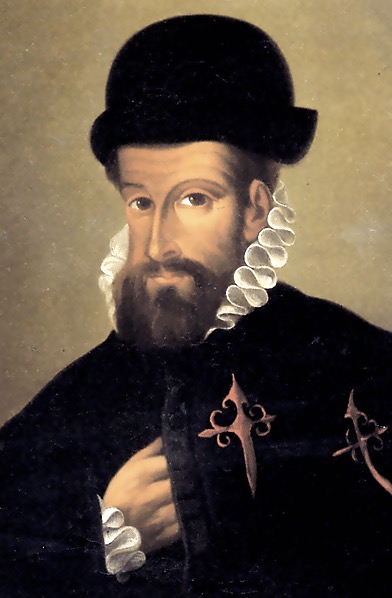
Portrait of Francisco Pizarro
The Man Who Could Not Sign His Name
He could not read. That fact sits at the center of Francisco Pizarro like a stone in a riverbed, and every account of him has to flow around it. The illegitimate son of an infantry colonel and a servant woman in the hard, dry hills of Extremadura, he grew up with no schooling worth the name and never acquired one. As governor of Peru — master of more silver than any European had ever seen at once — he authorized documents by having a notary write his name and then stamping his mark between the halves. The most consequential conquistador in the Spanish empire left almost nothing in his own words. What he left instead was a series of physical acts, each one perfectly timed.
For roughly twenty years he was nobody in particular: an encomendero in Panama, a town councilman, a competent middle-aged soldier in a colonial world full of them. He was present when Balboa first saw the Pacific in 1513, and six years later, when his commander and friend fell out with the governor Pedrarias Dávila, it was Pizarro who put him under arrest — the arrest that led to Balboa's execution. There is no surviving record of Pizarro agonizing over it. He read the situation, saw where power had moved, and moved with it. That gesture is the whole man in miniature: long, patient, unremarkable subordination, and then one sudden, irreversible, entirely unsentimental turn at the exact moment the ground shifts.
Everything afterward runs on the same rhythm. Years of failed expeditions probing south down a coast of mangrove and fever, funded out of his own pocket at real risk of ruin. Then a line drawn in the sand at the Isla del Gallo. Then a small enclosed square at Cajamarca and an ambush so precisely engineered that an empire of ten million people lost its head in an afternoon. He never argued anyone into anything. He waited, and then he struck.
Pizarro is the archive's clearest ISTP — a man whose dominant Introverted Thinking needed no audience, no doctrine, and no permission, only a clear read of the physical situation and the patience to wait until it opened.
Ti — The Private Ledger
Introverted Thinking is the function that keeps its own accounts. It does not require the world's agreement, an ideology to hang itself on, or a public justification; it builds an internal model of how things actually work and then acts on that model regardless of who is watching. In a century thick with crusading rhetoric — Sepúlveda arguing natural slavery, Las Casas arguing the opposite, everyone citing scripture — Pizarro produced essentially none. He said almost nothing about why. He simply calculated, and moved.
The Isla del Gallo in 1527 is the purest expression of it. Two expeditions had already failed. His men were starving on a mosquito-ridden island; the governor of Panama had sent ships with orders to bring everyone home. A leader running on external validation would have taken the ships — the authority was legitimate, the men were willing, the failure was defensible. Pizarro drew a line in the sand with his sword and invited anyone who wanted Peru to cross it. Thirteen did. He had run the numbers privately and concluded the kingdom was real and reachable, and no amount of institutional pressure could edit that conclusion. He was, at that moment, a middle-aged illiterate soldier with thirteen men and a private certainty. It was enough.
The same detachment shows in the ugliest places. Balboa had been his commander and, by every account, his friend; when the political weather changed, Pizarro arrested him without visible struggle. Atahualpa's ransom was paid in full — a room of gold, twice that in silver — and Pizarro had him executed anyway, on charges everyone involved understood to be manufactured. There is no evidence he thought of this as betrayal, and none that he thought of it as justice either. A living Atahualpa was a standing risk with an army in the field; a dead one was not. Ti does not moralize its own arithmetic. It just closes the ledger and turns the page.
Se — The Geometry of the Square
Extraverted Sensing is attention to the physical present at full resolution: terrain, distance, sightlines, numbers, who is armed and who is not, how long a horse needs to cross a plaza. Cajamarca on 16 November 1532 is one of the most extreme demonstrations of the function in recorded history. Pizarro had roughly 168 men. Atahualpa had an army of tens of thousands camped outside the town. Any strategic calculation on paper said the Spanish were finished. Pizarro was not calculating on paper.
What he did instead was read the ground. He chose a walled plaza with narrow exits and put his cavalry and infantry inside the buildings around it, out of sight. He sent an invitation, and he waited — for hours, with his men so frightened that several chroniclers admit they wet themselves — until Atahualpa entered with a retinue that was ceremonial and unarmed. Then everything happened at once: falconets fired into a packed crowd, horses came out of the buildings, gunpowder and cavalry both entirely unfamiliar to the Inca. The square that had been chosen for its enclosure became a killing pen because the crowd could not disperse. Pizarro went straight for the litter himself and took Atahualpa alive with his own hands, taking a wound doing it. Twenty years of positioning resolved in about half an hour of physical work.
Se also explains the shape of his death. In June 1541 the supporters of Almagro's son forced their way into his palace in Lima. Pizarro was somewhere past sixty, the richest man in the Indies, with every reason to run for a window or start negotiating. He got a sword in his hand and fought them in his own dining room, killing at least one before he went down. Reportedly he drew a cross on the floor in his own blood as he died. Whatever else that gesture was, it was the last thing a body could still do — and the body, for Pizarro, was always where the argument got settled.
Ni — The Kingdom He Had Never Seen
Tertiary Introverted Intuition in an ISTP is narrow but stubborn: not a sweeping vision of history, but a single fixed conviction about one thing, held far longer than the evidence justifies. Pizarro's was Peru. For the better part of a decade — through two disastrous voyages, through swamps and starvation and men dying of hunger on a coast that produced nothing but rumors — he held onto the belief that a rich kingdom lay somewhere south. He put his own money into it, in partnership with Almagro and the priest Hernando de Luque, and lost most of it repeatedly. He was not following a map. He was following a shape he had assembled out of secondhand stories.
The conviction was correct, which is the seductive thing about tertiary Ni: when it lands, it looks like prophecy. But its narrowness is equally visible. Pizarro saw one thing coming — the kingdom, and the seizure of its head — and nothing at all after it. He had no picture of what a Spanish Peru would be, no theory of how to hold it, no projection of what the men who had followed him to Cajamarca would do once the gold was divided and there was nothing left to take together.
Founding Lima in 1535 was the closest he came to long-range thinking, and even that was a sensory decision more than a visionary one: a coastal site with a harbor and a river, chosen because ships could reach it and Cusco could not be resupplied from Spain. It turned out to be an inspired choice — Lima ran Spanish South America for three centuries. But it was the choice of a man reading terrain, not a man imagining an empire. The imagining was left to Toledo, forty years later.
Fe — The Partnership He Could Not Keep
Inferior Extraverted Feeling is the ISTP's blind spot: the social field — loyalty, grievance, resentment, the emotional bookkeeping other people are constantly doing — is simply not in the model. Pizarro could read a plaza perfectly and could not read a room at all. He kept the affection of the handful of men who had crossed the line at the Isla del Gallo, and of his brothers, and beyond that he seems to have understood human attachment mostly as an alliance of convenience that either paid out or did not.
Almagro is the wound. They had been partners for fifteen years, had bankrupted themselves together, had shared the entire risk. When Pizarro went to Spain for the capitulación de Toledo, he came back with the governorship and the great titles for himself and a subordinate command for Almagro — and appears to have been genuinely puzzled that this caused a problem. To Pizarro the arrangement was a technical fact about a document. To Almagro it was the betrayal of a life. The dispute over Cusco that followed was not really about jurisdiction; it was about a man who had been made small by a friend who never noticed doing it. It ended with Almagro garroted in 1538 on the Pizarros' orders.
Three years later the bill came due in the most literal way available. Almagro's son and a knot of ruined, unrewarded men — the ones Peru had left with nothing — walked across Lima in daylight, and nobody warned Pizarro, because he had never built the kind of loyalty that produces warnings. He had been told repeatedly that a plot existed and had waved it off. He died with a sword in his hand in his own house, killed by the social currents he had spent a lifetime declining to look at.
Why ISTP Over ESTJ
Why not ESTJ?
The ESTJ case is real: Pizarro held institutional office for most of his adult life — encomendero, town councilman, ultimately governor and marquis — and he pursued royal authorization through proper channels, sailing to Spain to obtain the capitulación de Toledo from Charles V before he would commit to the final expedition. But an ESTJ builds. The signature of dominant Extraverted Thinking is a functioning structure left behind it: clear chains of command, offices that outlast the officeholder, procedure that keeps working when the founder is not in the room. What Pizarro left behind at Cajamarca was gold in a heap and no system for dividing it, and what followed within five years was a Spanish civil war among his own subordinates that eventually killed his partner, two of his brothers, and himself. He sought the title because the title made the ambush legal. He never governed with it.
The distinction gets sharper when you set him beside Cortés, the archive's ENTP, whose conquest looks superficially identical and was psychologically its opposite. Cortés improvised legal fictions: he founded a town on an empty beach so that its brand-new council could appoint him and thereby dissolve the authority of the governor who had sent him. He talked his way into Moctezuma's court, worked through La Malinche, wrote long self-justifying letters to the emperor, argued relentlessly, and turned every predicament into a rhetorical position. Pizarro improvised ambushes. He wrote nothing; his literate brother Hernando and the notaries handled the paper. Where Cortés out-argued, Pizarro out-waited — and then struck. Two men, the same decade, the same crown, the same result; one won with words he invented on the spot, the other with a square he had walked and measured beforehand.
Connected Figures
Further Reading
- The Conquest of the Incas — John HemmingThe definitive narrative history of Pizarro's campaign and the long Andean aftermath it set in motion.
- The Men of Cajamarca: A Social and Biographical Study of the First Conquerors of Peru — James LockhartThe essential prosopography of the original 168 — who they were, what they took, and what became of them.
- History of the Conquest of Peru — William H. PrescottThe classic 1847 narrative; dated in its judgments, still the most widely read account in English.
- Francisco Pizarro and His Brothers: The Illusion of Power in Sixteenth-Century Peru — Rafael Varón GabaiOn the Pizarro family as an economic enterprise — and on how quickly its power proved hollow.
- The Last Days of the Incas — Kim MacQuarrieAccessible modern narrative running from Cajamarca through the Vilcabamba resistance.
