 Historical Figure MBTI
#783 · 6-10-26 · The Conquest of the Andes
Pedro de la Gasca
Blank Pardons, No Army
1493 — 1567
9 min read
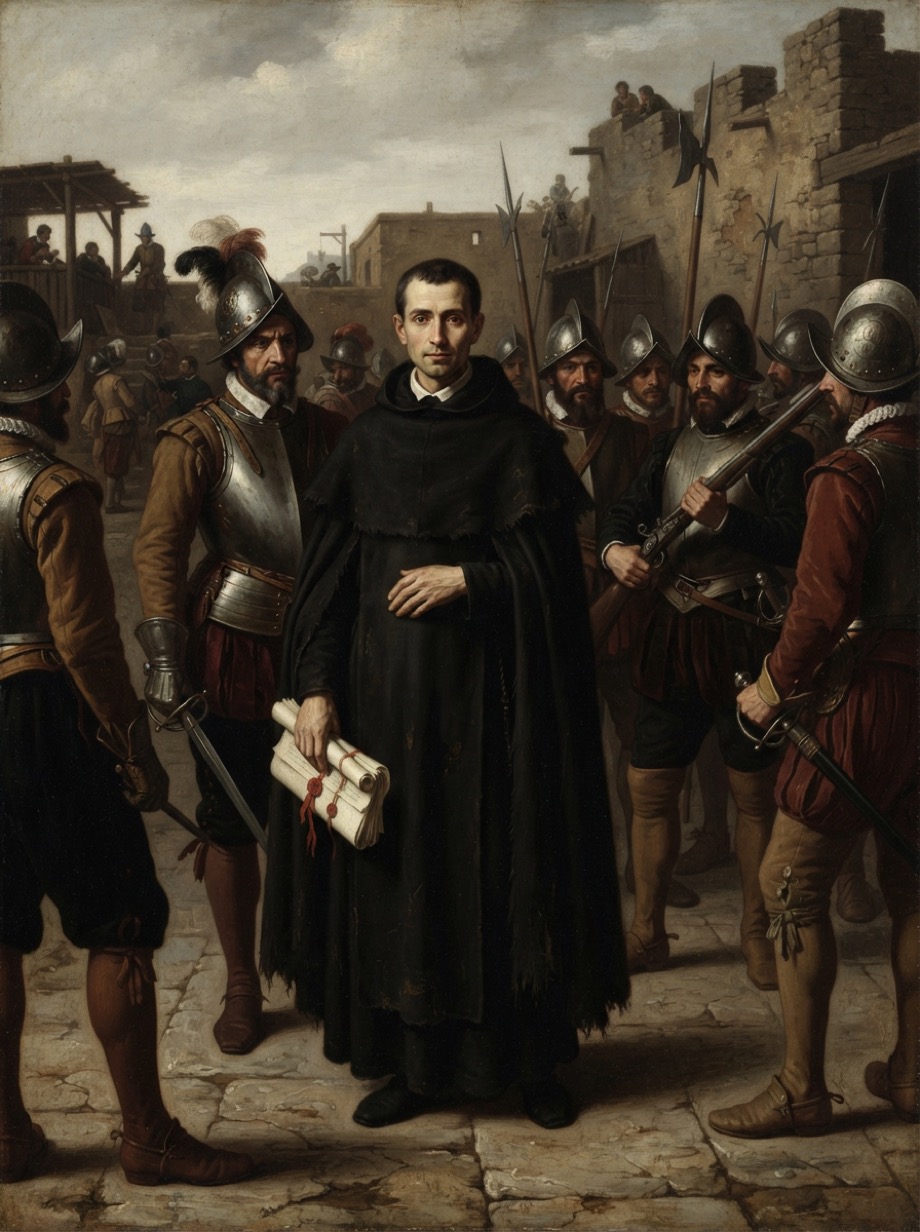
AI-assisted Portrait of Pedro de la Gasca
The Least Impressive Man Ever Sent to Peru
In 1546 the Emperor Charles V had a problem with no obvious solution. Peru — the richest new possession in the world, the silver-bearing heart of the Spanish empire — was in open revolt. Gonzalo Pizarro, last of the conquering brothers, had defeated and killed the crown’s own viceroy in the field and was ruling the Andes as something close to a king. The armies available to the crown were thousands of miles and many months away. The treasury was strained. And the man Charles chose to send carried no troops, no fleet, and no money worth mentioning.
Pedro de la Gasca was fifty-three, a churchman and canon lawyer who had spent his career in ecclesiastical courts and inquisitorial tribunals. He was small, homely, chronically unwell, and — by every account that survives — physically ridiculous: contemporaries described a man whose arms and legs seemed mismatched to his body, who looked, on horseback, like a joke. When he landed at Panama the rebel officers who came to inspect him reported back with relief. This was what Spain had sent. This was nothing.
What Gasca actually carried was a folder of blank pardons signed in advance by the king, which he could fill in at his own discretion, plus authority so sweeping it amounted to the crown’s entire will in one frail body. He had, in other words, exactly one weapon, and it was not a weapon anyone in Peru had thought to defend against. Within two years Gonzalo Pizarro’s army would dissolve on a battlefield without fighting, and the man who had done it would go home to a minor bishopric.
Gasca is the archive’s purest demonstration of INTJ Ni: the refusal to fight the war everyone assumed had to be fought, in favor of the one that could actually be won.
Finding the Real Lever
Every other actor in the Peruvian crisis made the same assumption: that a rebellion held by an army must be broken by a larger army. The viceroy Blasco Núñez Vela had assumed it and died of it. Gonzalo Pizarro assumed it, which is why he counted his strength in men-at-arms and arquebuses and found the count reassuring. Gasca looked at the same board and concluded that the army was not the thing holding the rebellion together at all. What held it together was arithmetic: every conquistador in Peru had calculated that his encomienda, his men, and his life were safer under Gonzalo than under a crown that had just tried to strip them all away. Change that arithmetic and the army was not an army. It was a crowd.
This is dominant Ni in its least mystical and most devastating form — not prophecy but the ability to see through a situation to the single load-bearing element and ignore everything else. Gasca understood before he sailed that he did not need to defeat Gonzalo Pizarro. He needed to make every individual man in Gonzalo’s service privately certain that the rebellion would eventually lose and that a signed pardon was available right now, on terms that preserved his property. Once that belief was general, the collapse would come on its own, and it would come from the inside, where no fortification faced.
The insight was invisible precisely because it was unconventional. Nobody in Peru defended against it because nobody recognized it as an attack. Gasca’s harmlessness — the bad horsemanship, the sickly frame, the lawyer’s manner — was not a handicap he overcame; it was the condition that let him land, move, and talk to people who would have killed a general on sight. He was permitted to operate for months because the men he was dismantling never understood that the dismantling had begun.
The Campaign Fought in Letters
An insight of that kind is worthless without machinery, and Gasca built the machinery with a bureaucrat’s relentlessness. From Panama outward he ran what was effectively a correspondence war: letters to captains, letters to notaries and priests and shipmasters, letters carried by men who had themselves just been pardoned and could vouch that the pardons were real. He turned Gonzalo’s own communication lines into his delivery system. He converted the Panama fleet — the rebellion’s link to the outside world — before he ever reached Peru, which meant that from that moment forward Gonzalo’s information about Spain arrived filtered through Gasca.
This is auxiliary Te doing what Te does best: taking a private conviction and building it into a system that produces measurable defections on a schedule. Gasca kept accounts of who had come over and what it had cost. He priced loyalty. He did not moralize at the rebels, because moralizing does not move ledgers — he offered terms, in writing, with the royal signature already on them, and he honored the terms he offered, which is the only reason the second and tenth and hundredth offers were believed.
The result was a battle that was not a battle. At Jaquijahuana in April 1548, Gonzalo Pizarro’s formations began walking across the field toward the royal line before the fighting could start — company by company, then in numbers that made the outcome a formality. Gonzalo was captured and executed the next day. So was his ferocious old field commander, Francisco de Carvajal, the eighty-year-old who had won every engagement he fought and lost the only one that mattered without a shot fired at him. The two men met on that field as pure opposites of method: Carvajal’s improvised, theatrical, terrifying violence against Gasca’s patient, unglamorous information war. The archive has no cleaner case of the administrator beating the warlord.
A Man With Nothing to Want
Gasca’s tertiary Fi shows up not as warmth but as an unusually complete indifference to what everyone around him wanted. He was in the wealthiest place on earth, holding authority to dispose of it, surrounded by men who had crossed an ocean for gold — and he took none. He did not build a faction, did not seat relatives in the encomiendas he redistributed, did not convert his victory into a governorship. The private code was intact and it was not for display; it simply never occurred to him to be for sale, and that unpurchasability is what made the pardons credible. A negotiator with an angle can be bargained with. Gasca had no angle to find.
It also gave him the stomach for the unpopular part. After Jaquijahuana he did not restore the pre-rebellion order — he sat down and reallocated the encomiendas himself, reasoning that the grievance over labor grants had caused the revolt and would cause the next one unless it was settled. Nearly everyone was disappointed. The men who had defected to him early believed they had been promised more; the men who had stayed loyal believed they deserved better than the pardoned. Gasca absorbed the resentment of both and left his settlement standing.
Then he went home. His reward for solving a crisis that had killed a viceroy and threatened to sever Peru from Spain was a modest Iberian bishopric and no further high office, and there is no record of him complaining about it. The tertiary function in an INTJ rarely asks for recognition; it asks whether the thing was done correctly. Gasca appears to have concluded that it was, and that this concluded the matter.
The Body That Was Never the Point
Inferior Se is usually a liability, and in Gasca’s case it was total. He could not ride well, could not fight, could not project physical authority in a colony where authority was almost entirely physical. He was ill for much of the campaign. In a world of conquistadors — men whose entire claim rested on what their bodies had done at Cajamarca or Las Salinas — he was, in the only currency Peru recognized, bankrupt.
He never contested that ground. There is no episode of Gasca attempting a display, no staged entry, no armor, no gesture toward looking the part. He accepted that the physical theater of command was closed to him and constructed a campaign in which it did not appear. At Jaquijahuana he was present at a battle he had already won elsewhere, in rooms, on paper, over eighteen months. The field was a formality; the decisive terrain had been the inside of other men’s calculations.
The irony is exact. Carvajal, the archive’s great Se improviser, read every physical situation faster than anyone alive and was undone by a threat that had no physical signature at all. Gasca, who could read no physical situation, won by operating in the one dimension his opponents could not see. An inferior function is not always a wound to be managed; sometimes it is simply the domain a person has correctly declined to compete in.
Why INTJ Over ISTJ
Why not ISTJ?
Everything on the surface argues for it: a career canon lawyer and inquisitorial judge, patient, procedural, unshowy, personally austere, and absolutely loyal to established royal authority. That is an ISTJ profile almost line for line. But an ISTJ facing an armed rebellion would have executed the established remedy — raise loyal forces, restore the king’s order by the book, as Blasco Núñez Vela had just tried and died attempting. Gasca did the opposite: he judged the conventional playbook unwinnable with the resources at hand and invented a method nobody in the conflict had ever seen, then trusted that invention with an empire.
The distinction is not discipline — both types have it in abundance — but where the plan comes from. Si reasons from precedent: this is how rebellions are put down, so this is how we will put this one down. Ni reasons from a model of what will actually happen: an army in the Andes cannot be beaten by an army I do not have, therefore the army is not the target. Gasca’s procedural rigor was real, but it was rigor in service of an unprecedented design, not rigor as a substitute for one. He used the machinery of the law — signatures, notarized terms, the binding force of a royal pardon — as instruments in a scheme the law had never contemplated. That is an INTJ using Te to build what Ni saw, and it is why the least impressive man in Peru left with the province and everyone else left in pieces.
Connected Figures
Further Reading
- The Conquest of the Incas — John HemmingThe standard narrative — Gasca's mission and the unwinding of the Pizarro rebellion in full context.
- Spanish Peru, 1532–1560: A Social History — James LockhartOn the encomienda redistribution and the post-rebellion settlement Gasca left behind.
- The Last Days of the Incas — Kim MacQuarrieAccessible narrative of Jaquijahuana and its aftermath.
- Peru's Indian Peoples and the Challenge of Spanish Conquest — Steve J. SternThe Andean side of the colonial settlement the civil wars produced.
