 Historical Figure MBTI
#784 · 6-10-26 · The Conquest of the Andes
Pedro de Valdivia
Carved Chile Out of Nothing
c. 1497 — 1553
6 min read
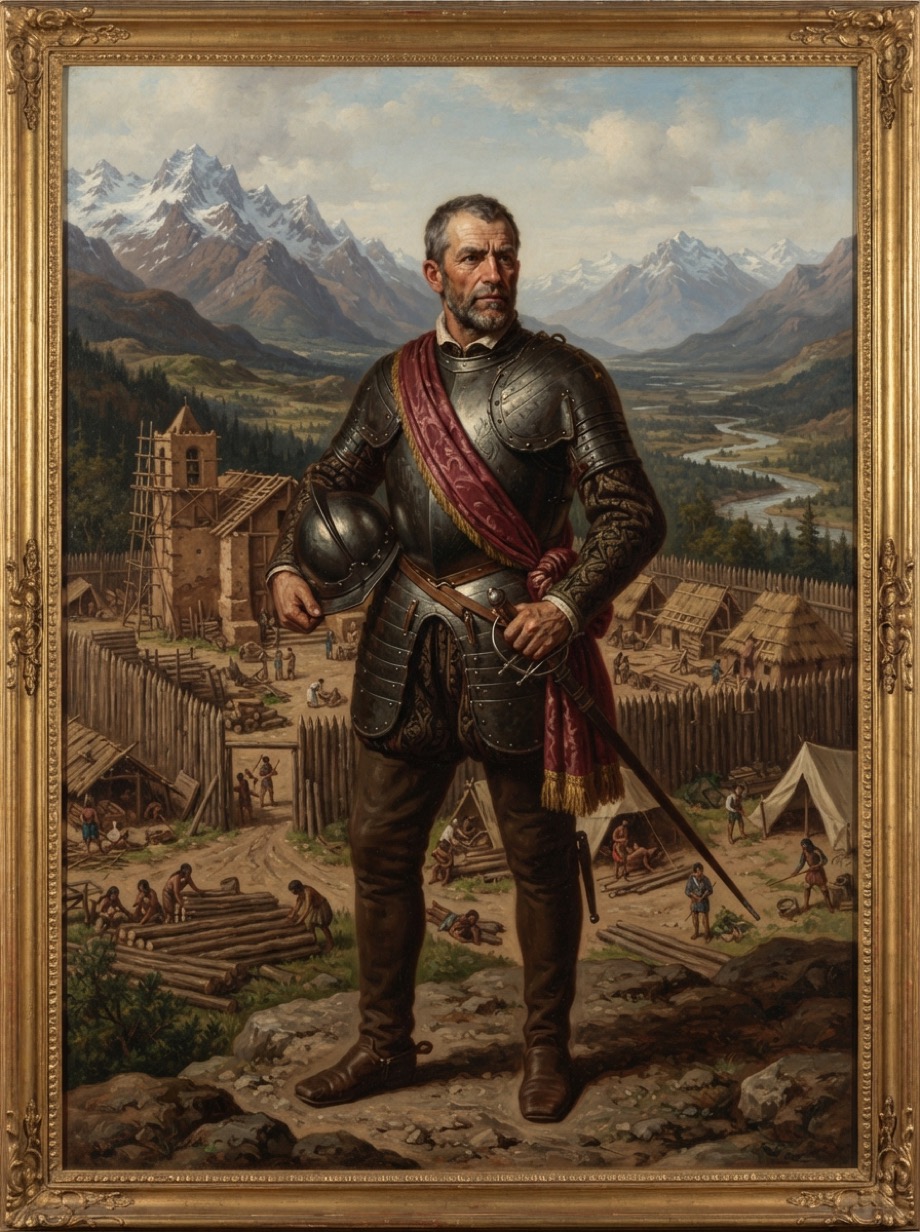
AI-assisted Portrait of Pedro de Valdivia
The Poorer Country, Chosen on Purpose
By the time Pizarro's Peru had been carved into fiefdoms and the first civil wars had already begun consuming the men who conquered it, Pedro de Valdivia — a hardened veteran of Europe's own wars, who had fought in Italy and against the French crown before he ever crossed the Atlantic — made a choice that looked, to most of his contemporaries, like a mistake. He did not stay to compete for a slice of Peru's silver and its already-divided estates. He marched south, into Chile, a territory that had already broken one conquistador. Diego de Almagro had gone there before him and found nothing but frozen passes, starvation, and Indigenous resistance so fierce he turned back calling it a wasteland not worth holding.
Valdivia went anyway, and where Almagro had found only ruin, he built. He founded Santiago in 1541 — a city that stands today as the capital of Chile — and around it he assembled, methodically and against constant siege, the administrative skeleton of a colony: a council, a garrison, a mint, a chain of subordinate towns. He governed what he founded, defended it through years of relentless Mapuche resistance, and in 1553 was captured and killed by Mapuche forces under the toqui Lautaro — a death in the field, at the edge of an empire he had built with almost no help and no guarantee it would outlast him.
That is not the resume of an opportunist chasing the nearest plunder. It is the resume of a man who looked at a saturated, contested prize and calculated that an empty, harder one was worth more — because it could be his.
Valdivia did not want Peru's wealth divided among rivals. He wanted a country of his own to found, even if it was the poorer one — the signature of an ENTJ's dominant Te, chasing durable command rather than a faster payout.
A City Where There Was Nothing
Valdivia's Te shows most clearly in what he refused to do. Peru in the early 1540s offered an experienced captain like him a straightforward path: attach himself to an established faction, claim an encomienda, extract wealth from an already-organized conquest. He turned it down. Instead he raised his own expedition, largely at his own expense and on his own authority, and marched it into territory that had already defeated a rival conquistador — precisely because unclaimed, ungoverned ground was the only kind of ground on which he could build something that was structurally his from the foundation up, rather than a subordinate share of someone else's.
Once in Chile, the pattern repeats at every scale. He did not simply raid and retreat, the way looser, more improvisational conquistadors often did when resistance turned costly. He laid out Santiago as a permanent settlement, installed a cabildo to govern it, minted currency, and kept founding satellite towns even as Mapuche attacks burned his fields and killed his men. When the political winds in Peru shifted — when Gonzalo Pizarro, his former commander, rose in rebellion against the Crown — Valdivia made the harder, more structurally sound choice again: he sided with royal authority rather than the man he'd served under, because a colony built on legitimate, recognized institutions would outlast one built on a rebel's personal loyalty. That is Te in its purest conquistador form — not appetite for objects, but a compulsion to convert raw opportunity into standing, governable structure.
The Calculation Behind the Poorer Country
The decision to go to Chile at all is where Valdivia's Ni is legible — not as some mystical foresight, but as a strategic read of where the long-term advantage actually sat. Peru in 1540 looked, to any short-term calculation, like the obvious prize: an already-conquered empire, its wealth already flowing to Spain, its command structure already staffed by men senior to Valdivia. A purely present-focused operator would have stayed and fought for a bigger cut of a known quantity. Valdivia instead read the shape of the years ahead — that Peru's abundance guaranteed permanent rivalry among its conquerors, that every fortune there would always be someone else's to contest, and that the only way to actually found and govern something was to go where no one else wanted to compete for it.
That same long-range read shaped his most dangerous political decision. When Gonzalo Pizarro — the brother of Valdivia's own former commander — rebelled against the Crown, siding with him would have been the easier, more immediately loyal choice. Valdivia instead judged, correctly, that a rebellion against the Spanish state could not produce a durable colony, only a temporary and ultimately doomed captaincy. He backed the Crown, at real personal risk, because his internal map of the future ran years past the current crisis: only royal legitimacy would let Santiago outlast the men who founded it. Chile did outlast him — the capital he laid out in 1541 is still Chile's capital today — which is Ni's clearest vindication a historian can ask for.
Why ENTJ Over ESTP
Why not ESTP?
The case for ESTP is easy to make on the surface: Valdivia was a battle-tested soldier who spent decades in physically dangerous, high-stakes campaigns across two continents, and ESTP's dominant Se thrives exactly in that kind of environment. But ESTP's pattern is short-horizon — read the immediate terrain, act, move on to the next opportunity — and it rarely sustains the years of unglamorous administrative follow-through that Valdivia actually delivered. He did not just fight his way into Chile; he stayed to found a cabildo, mint currency, and govern a colony under siege for over a decade. That sustained, structure-building commitment after the fighting is Te, not Se, doing the driving.
The clearest tell is what Valdivia chose to fight for once the fighting itself was optional. An ESTP who had proven himself in Peru's wars had every physical and financial incentive to stay where the action and the plunder already were. Valdivia instead walked away from an established conquest to build an unclaimed one from nothing, then spent his final decade as an administrator and governor rather than a freelance captain. That is the arc of a Te-Ni type converting ambition into lasting institutions, not an Se-type chasing the next contest.
Connected Figures
Further Reading
- The Conquest of the Incas — John HemmingCovers Valdivia's early career under Pizarro during the Peruvian conquest and civil wars.
- La Araucana — Alonso de ErcillaThe epic poem on the Spanish–Mapuche wars, composed by a contemporary participant in Valdivia's Chilean campaigns.
- A History of Chile, 1808–2002 — Simon Collier & William F. SaterIncludes background on the colonial founding of Santiago and the early governorship Valdivia established.
