 Historical Figure MBTI
#785 · 6-10-26 · The Conquest of the Andes
Inés de Suárez
Beheaded the Hostages at Santiago
c. 1507 — 1580
6 min read
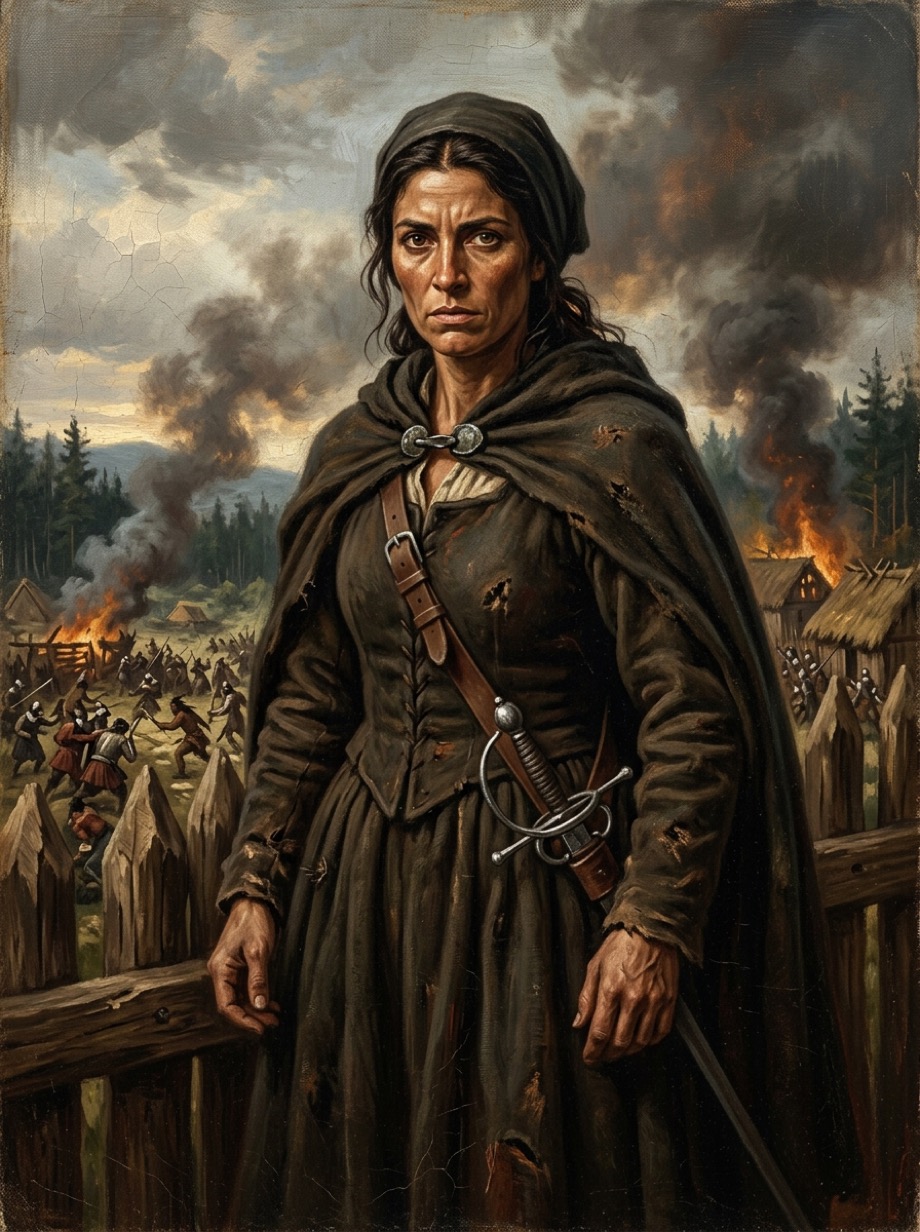
AI-assisted Portrait of Inés de Suárez
Seven Heads Over the Wall
She had crossed an ocean and half a continent looking for a husband who was already dead, and found instead a war she was better suited to than almost anyone fighting it. Inés de Suárez left Spain for the Indies searching for a man lost somewhere in the New World; by the time she learned he had died, she had already remade herself as something the colonial world had no polite category for — the companion, provisioner, and effectively the co-commander of Pedro de Valdivia’s expedition into Chile. She rode with his men through country no Spaniard had mapped, and when he founded Santiago in 1541, she was there, in a settlement of a few hundred people camped on the edge of an empire that had not agreed to be conquered.
That September, with Valdivia and most of the garrison’s fighting strength away, a massive Mapuche assault fell on Santiago and came close to erasing it in an afternoon. The Spanish held a handful of captured caciques as hostages, and as the walls buckled and the men around her lost the initiative, Inés de Suárez did not wait for anyone’s permission or counsel. She beheaded seven of the hostages herself and had their heads thrown over the wall at the attackers below — a single, irreversible act performed in real time, calculated not as ceremony but as a weapon, and by every surviving account it broke the momentum of the assault. Then she picked up a sword and rode out to fight.
An ESTP’s dominant Se does not deliberate under fire — it acts, and lets the act do the arguing.
The Crisis as the Only Argument
Se reads a room by reading the bodies in it, and Inés de Suárez read the siege of Santiago the way a fighter reads an opponent’s weight shift a half-second before the punch lands. There was no council of war before she moved on the hostages — there was a collapsing perimeter, a garrison running out of options, and a resource sitting in front of her that no one else had thought to weaponize in that instant. She didn’t theorize about what might deter the attackers in the abstract. She looked at what was physically available — seven captive chiefs, a wall, a besieging force close enough to see over it — and she used it.
That same immersion in the physical moment put her on a horse with a sword afterward, fighting alongside soldiers rather than retreating to safety once her decision had been made. An Se-dominant doesn’t treat decisive action as a discrete event that ends the crisis; the crisis is still live, so the body stays live in it. The chroniclers who recorded her riding out to fight were not describing a woman making a symbolic gesture after the fact — they were describing someone who had never left the immediate physical present in the first place, because leaving it was never how she operated.
It is worth noticing what her instinct was not. It was not to hide, not to pray, not to wait for a man with a captain’s commission to authorize the killing — and in a colonial hierarchy that had no formal role for her at all, that absence of hesitation is itself the data point. Se doesn’t require permission from the org chart. It requires only that the moment be real and that she be standing in it.
What Would Actually Break Them
Beneath the violence was a cold, working calculation, and that is where Ti shows up — not as an elaborate framework, but as an immediate private read of cause and effect. Killing the hostages accomplished nothing on its own; throwing their heads over the wall was the mechanism, a deliberate act of psychological engineering aimed at a specific, predictable effect on a specific audience. Someone without a functioning internal logic could have ordered the execution and stopped there. Inés de Suárez understood, in the moment, that the message had to be delivered visibly and immediately to the people it was meant to terrify, or the act was wasted.
This is auxiliary Ti in its least sentimental form: not theorizing for its own sake, but stripping a crisis down to the one variable that mattered and acting on that variable alone, indifferent to how the decision would look to anyone judging it later. She was right about the mechanics — the assault broke. Whatever cost that judgment carried, it carried it in service of a conclusion she had reasoned out for herself, under pressure, with no one to check her work.
Why ESTP Over ISTP
Why not ISTP?
Both types can be devastatingly decisive under pressure, which is what makes the comparison tempting. But an ISTP’s decisiveness tends to stay internally contained — a private tactical calculation, executed quietly, with little interest in how it registers to onlookers. Inés de Suárez’s act was the opposite of quiet: it was staged as public spectacle, heads thrown over a wall specifically so the enemy would see them. That is an extraverted use of shock, aimed outward at an audience, not an introverted problem solved and left unannounced.
The rest of her documented life reinforces the read. She wasn’t a background tactician who occasionally surfaced to act — she was visibly, continuously present in the colony’s day-to-day survival, its provisioning, its defense, its social fabric, in a way that made her impossible for Valdivia’s expedition, or later chroniclers, to write out of the record. That is Se and Fe operating in the world together, not Ti and Se operating in isolation from it.
Connected Figures
Further Reading
- Inés of My Soul — Isabel AllendeA historical novel, not a primary source, but closely researched and the most widely read account of Inés de Suárez's life — useful for texture on events the documentary record leaves thin.
- La Araucana — Alonso de ErcillaA contemporary epic poem on the Spanish–Mapuche wars, written by a soldier-poet who served in Chile not long after the siege of Santiago; invaluable for the world she operated in.
- A History of Chile — Simon Collier & William F. SaterA standard general history that covers the colonial founding of Santiago and the early Spanish–Mapuche wars, giving the institutional and military context for the 1541 siege.
