 Historical Figure MBTI
#786 · 6-11-26 · The Conquest of the Andes
Titu Cusi Yupanqui
Negotiated From Vilcabamba
c. 1529 — 1571
6 min read
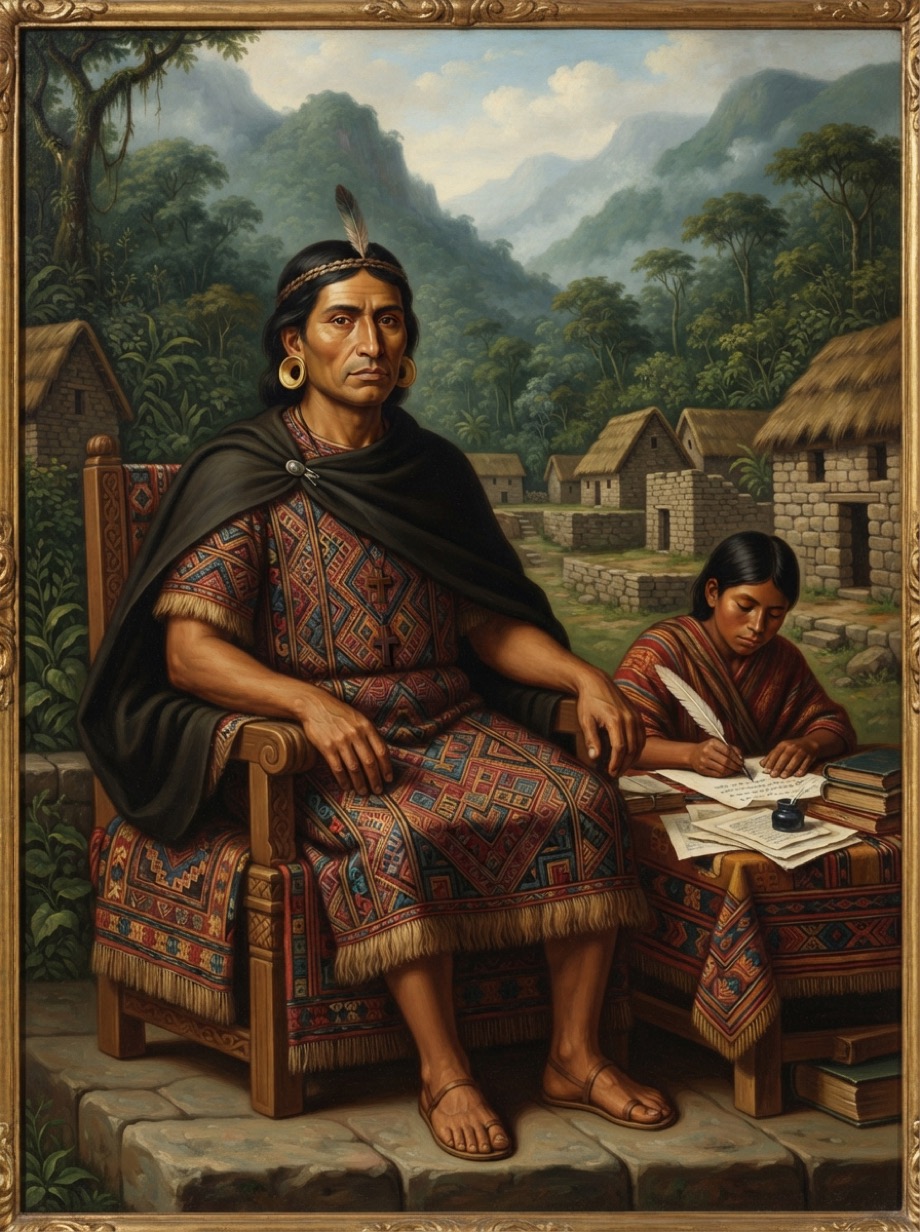
AI-assisted Portrait of Titu Cusi Yupanqui
The Sovereign Who Chose the Pen Over the Sword
By the time Titu Cusi Yupanqui inherited the rump state of Vilcabamba, the Inca cause had already tried both extremes and lost. His father, Manco Inca (#778), had raised a siege of Cuzco and then retreated into the cloud forest to fight on, only to be murdered by the Spanish renegades he had sheltered. His half-brother Sayri Túpac had tried the opposite path — walking out of the mountains to accept a Spanish title and a Spanish pension, and was dead within two years, the poison rumors never quite proven and never quite silenced either. Titu Cusi Yupanqui watched both roads dead-end and built a third: neither war nor surrender, but two decades of managed, unresolved negotiation, conducted from a jungle capital the Spanish never quite dared to storm.
He accepted baptism, styled himself a Christian ally, corresponded with viceroys, dangled the promise of eventual submission — and never actually gave up Vilcabamba. Every concession was calibrated, every letter written for an audience, every gesture of friendship a hedge against the one thing he could not survive: a renewed Spanish invasion of the last free Inca ground. And near the end of his life he did something none of his predecessors had: he sat down with a scribe and dictated, in his own words, an account of the conquest — the only chronicle of that catastrophe narrated by a reigning Inca rather than reconstructed secondhand.
Titu Cusi Yupanqui was an ENFJ, and his Fe was not warmth — it was statecraft, the patient management of an audience he could never afford to lose.
A Correspondence Kept Open for Twenty Years
Fe is attunement to other people's expectations and the discipline to act on that attunement rather than one's own impulses, and nothing in Titu Cusi Yupanqui's record shows it more clearly than the baptism. He had every reason, personally and dynastically, to refuse it — his father had died fighting the men who wanted it of him. He accepted it anyway, provisionally, as a signal aimed at a specific audience: Spanish administrators who needed to be able to report upward that Vilcabamba was reconcilable, not a standing rebellion to be crushed. He gave them exactly enough to write that report, and no more.
That same calibration runs through his correspondence with successive Spanish governors. He never closed a channel and never fully opened one; every letter kept the possibility of submission alive without ever committing to it, because he understood — correctly, for nearly two decades — that as long as Madrid believed a peaceful settlement was still on the table, no army would be sent up the mountain roads to Vilcabamba. That is Fe pointed outward at strategy rather than sentiment: reading what an audience needs to believe, and supplying it, in service of a survival that pure force could not have bought.
The dictation of his own chronicle near the end of his life is the same instinct turned toward posterity instead of policy. A man less concerned with how he and his cause would be remembered could have let the Spanish or later mestizo chroniclers write the only surviving version. Titu Cusi Yupanqui refused that, and made sure an Inca voice — his own — sat inside the historical record his enemies were already assembling.
Playing a Twenty-Year Game He Could Not Win Outright
Ni is the capacity to hold a single long-range outcome in view while the immediate situation keeps shifting beneath it, and Titu Cusi Yupanqui's entire reign is legible only at that timescale. He was not managing any one negotiation to a decisive close — he was managing the *absence* of a close, indefinitely, because he had concluded, correctly, that Vilcabamba's survival depended on never letting the question resolve. Every Spanish governor who came and went, every treaty draft that stalled, every year that passed without an army in the passes was itself the victory condition, not a step toward some other one.
That is a different cognitive shape from his father's and his half-brother's choices, both of which were bets on a single decisive move — Manco Inca's uprising, Sayri Túpac's surrender — resolved quickly, for better or worse, within a year or two. Titu Cusi Yupanqui instead built a state whose entire purpose was to keep multiple futures alive simultaneously: reconciliation, defiance, and delay, none of them foreclosed, for as long as ambiguity itself was useful. That is Ni doing what it does best — not predicting a single future, but recognizing which future stays open longest if no single door is fully closed.
Why ENFJ Over ENTJ
Why not ENTJ?
He led a state and negotiated from a position of real authority, which makes the ENTJ case tempting on the surface. But an ENTJ pattern would show blunt, direct assertion of terms — dictate a position and hold it. Titu Cusi Yupanqui's method was the opposite: sustained, calibrated persuasion, provisional concessions like the strategic baptism designed purely to manage how Spanish authorities perceived him, and finally an act of literal narrative-authorship meant to shape how he would be remembered. That is influence and relationship-management as the primary tool of statecraft, not command — Fe in service of Ni, not Te.
The clearest evidence is comparative: set against his father and his half-brother, both of whom made single decisive bets and lost quickly, Titu Cusi Yupanqui's two decades of open-ended correspondence look less like indecision and more like a deliberate refusal to let any one confrontation define the outcome. That refusal — patient, audience-aware, sustained far longer than any tactical necessity required — is the signature of a Fe-Ni pairing working exactly as it should, not of a commander simply biding time before the real move.
Connected Figures
Further Reading
- An Inca Account of the Conquest of Peru — Titu Cusi Yupanqui, trans. Ralph BauerHis own dictated chronicle, the primary source for this entry.
- The Conquest of the Incas — John HemmingThe standard narrative covering the Vilcabamba negotiations.
- The Last Days of the Incas — Kim MacQuarrieAccessible narrative treatment covering Sayri Túpac's alternative path.
