 Historical Figure MBTI
#787 · 6-11-26 · The Conquest of the Andes
Túpac Amaru
The Last Sapa Inca
c. 1545 — 1572
7 min read
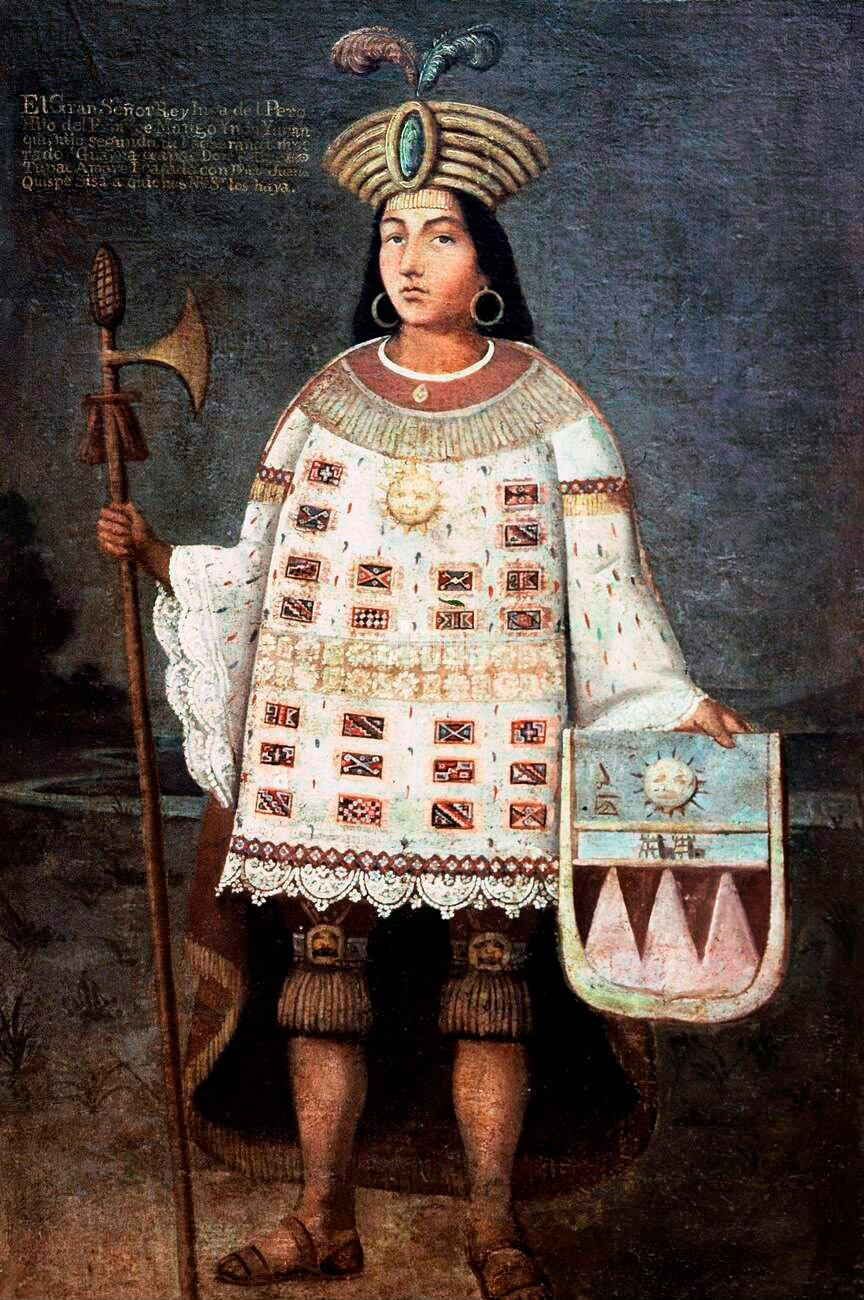
Portrait of Túpac Amaru
The Hand That Silenced a Square
In 1572, in the great plaza of Cusco, a young man who had spent almost his whole life tending a sun temple in the jungle stood on a scaffold before a crowd that had come to watch him die. The Andean population of the city filled the square, packed onto rooftops and against the walls of palaces their grandfathers had built. As the executioner made ready, their grief broke open into a wail so vast that the attending friars could not make themselves heard, and they begged the condemned man to quiet his own mourners. He raised one hand. The square went silent. Then he was beheaded, and the Inca line ended.
He was not raised for that plaza. A son of Manco Inca, the rebel who carried the Inca state into the mountains at Vilcabamba, he was not the son groomed to inherit it — that was his half-brother Titu Cusi Yupanqui, who bought the rump kingdom a decade of life with words. Túpac Amaru was kept apart as a keeper of the sun cult, custodian of the mummies and the calendar and the offerings. When Titu Cusi died in 1571, the throne of a doomed state passed to a priest who had never governed, never campaigned, and never bargained with a Spaniard.
What followed was less a reign than a collapse. A Spanish emissary was killed at Vilcabamba under circumstances the sources still dispute — quite possibly without his order — and Francisco de Toledo, the viceroy sent to finish things, had his pretext. The state fell in weeks. The last Sapa Inca fled into the jungle, was overtaken, and was executed over the objections of half the clergy in Cusco.
Túpac Amaru is the archive's clearest ISFP sovereign: a man whose authority came not from command or doctrine but from dominant Fi — a private, unarguable inwardness that, the one moment it was made visible, stopped a weeping city with a gesture.
Fi — The Authority of a Man Who Never Argued
Dominant introverted feeling is the hardest function to find in a historical record, because it produces almost nothing to record. It is a private compass — a wordless measurement of what is worthy and what is false — and it rarely explains itself. Túpac Amaru left no manifesto, no treaty, no reported speech of any length. What the sources give us is posture: decades of quiet custodial devotion, a refusal to perform the diplomatic warmth his half-brother performed so fluently, and the composure at the end.
Consider what he was doing for those decades. Titu Cusi was running a state; Túpac Amaru was doing none of it, and by every indication wanted none of it. In a kingdom where every surviving man of the royal line was a political asset, choosing the sacred over the political is a value judgment — and it held for his whole adult life. Fi does not seek an office; it seeks a life it can stand behind.
Then the scaffold. When the wailing rose he did not harangue the square, invoke the sun, or make the speech a leader makes when history is watching. He lifted a hand — a gesture so emptied of rhetoric that it carried the entire weight of who he was, and fifteen thousand people obeyed it instantly. That is the signature of the function: authority drawn from the visible integrity of a person, needing no argument because it is not making one.
Se — Everything Happening in the Room
Auxiliary extraverted sensing gave that hand its timing. Se is presence — total registration of the physical moment, and a body that acts in it directly rather than through a plan. The friars' request came without warning, before a crowd in open grief, in the last minutes of his life. A man not anchored in the immediate would have frozen or reached for something prepared. Túpac Amaru read the square and gave it what it needed: a movement, not a sentence, at exactly the right second.
His religious life ran in the same channel. The sun cult was not a theology of propositions but a practice of objects and acts — mummies dressed, offerings poured, ceremonies timed to the sky and executed with the body. Forty years inside a sensory discipline made a man who thought with his hands. The same function explains his worst hour: when Vilcabamba fell he organized no defense and attempted none of his half-brother's diplomacy, but went into the jungle — an immediate physical answer to an immediate physical threat, with no second move behind it. Se is superb in the moment and badly served when the moment required a strategy begun six months earlier.
Ni — The Symbol He Knew He Was Becoming
Tertiary introverted intuition in an ISFP is a narrow, occasional gift: not the foresight of a dominant Ni type, but a sudden sense of what a moment will come to mean. Túpac Amaru had it once, at the right time. He knew the last legitimate Sapa Inca dying in the plaza of the Inca capital was an image that would outlast the men staging it, and he composed that image himself — refusing to be seen pleading, asserting one last sovereignty over a crowd already becoming his mourners.
It worked in a way Toledo never anticipated. The viceroy wanted closure and produced a martyrdom with a perfect final scene — and two centuries later a rebel in the same highlands took the name Túpac Amaru II and raised the largest indigenous uprising the Spanish empire ever faced. But tertiary is tertiary: nothing in the preceding year suggests any long-range reading of the Spanish position. The intuition arrives only at the end, and only about meaning — never about maneuver.
Te — A Kingdom He Could Not Organize
Inferior extraverted thinking is the ISFP's blind side: logistics, chains of command, procedure, contingency. Vilcabamba in 1571 needed exactly that machinery and got a priest. The state Titu Cusi handed over was held together by a diplomatic apparatus he ran personally — not an institution but one man. When he died it died, and his successor neither rebuilt it nor replaced it.
The killing of the Spanish emissary is inferior Te's fingerprint. Whether or not he ordered it — most accounts suggest not — it happened on his watch, with the fate of the state depending on it not happening. A ruler with working Te controls who may act in his name, and knows exactly what a dead envoy is worth to a viceroy looking for a reason.
Set him beside his opponent and the contrast is total. Toledo was Te as a life's work — the visitas, the reducciones, the mita, a viceroyalty rebuilt into a functioning instrument. Against that stood a man who had spent his life keeping a ritual calendar. The military outcome was never in doubt. What Toledo could not do was win the plaza — the only ground where Túpac Amaru had ever been strong.
Why ISFP Over ISTJ
Why not ISTJ?
The ISTJ reading is tempting: a quiet, inward man who spent his life as custodian of an inherited ritual system, faithful to observance, unambitious for power. But the ISTJ keeps tradition because it is the established and correct procedure — Si and Te together produce a person who meets crisis by reaching for the applicable rule, the precedent, the chain of authority. Túpac Amaru did the opposite at every point that mattered. Handed a state, he built no administration; facing invasion, he followed no protocol; facing execution, he neither invoked the formulas of his own cult nor gave the dynastic speech the occasion scripted for him. He raised a hand — an act with no precedent behind it at all. His devotion was never procedural. It was personal, and what remained when everything else was stripped away was not a rule but a self.
The distinction is the difference between a functionary and a martyr. An ISTJ last Sapa Inca would be remembered, if at all, as the man who kept the rites correctly until the Spanish came, and Toledo would have had his tidy ending. What he got was an ISFP: no strategy, no army, no procedure, and total ownership of the final scene. Fi does not govern well. It does, at the end, refuse to be edited.
Connected Figures
Further Reading
- The Conquest of the Incas — John HemmingThe definitive narrative of the conquest and its aftermath, with the fullest scholarly account of the fall of Vilcabamba and the execution in Cusco.
- The Last Days of the Incas — Kim MacQuarrieAn accessible modern narrative of the Vilcabamba resistance, vivid on the final campaign and the scene in the plaza.
- History of the Inca Realm — María RostworowskiThe leading Peruvian ethnohistorian on Inca political structure, the Vilcabamba state, and the extinction of the dynastic line.
- El primer nueva corónica y buen gobierno — Felipe Guaman Poma de AyalaThe 1,200-page illustrated chronicle addressed to Philip III, which records and laments Túpac Amaru's execution in both text and drawing.
