 Historical Figure MBTI
#788 · 6-11-26 · The Conquest of the Andes
Polo de Ondegardo
Found the Hidden Mummies of Cusco
c. 1500 — 1575
6 min read
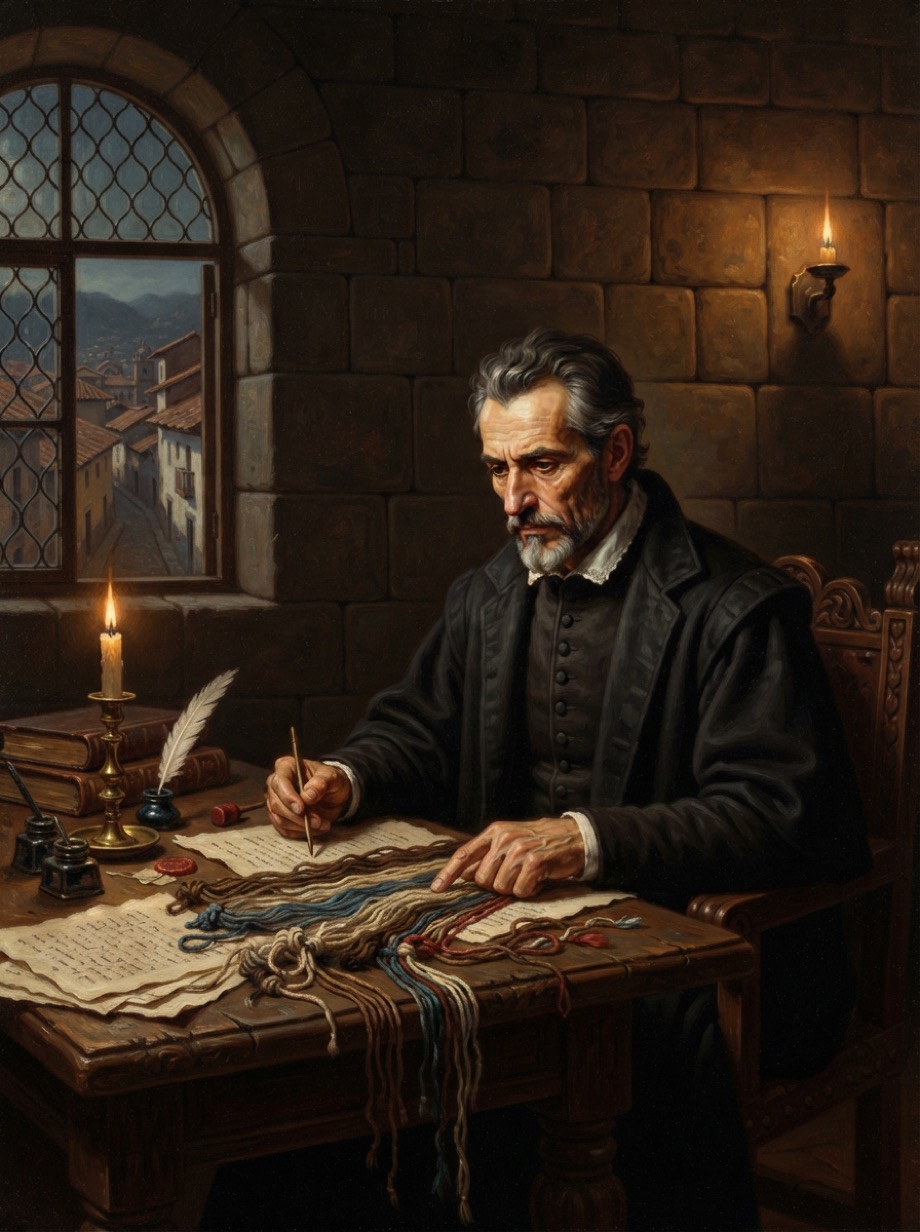
AI-assisted Portrait of Polo de Ondegardo
The Magistrate Who Found What Everyone Else Had Missed
By the 1550s the Spanish had held Cusco for twenty years, and they still did not understand what they had conquered. They knew, vaguely, that something was wrong — that the old order kept exerting a pull no decree could break, that the panaca lineages of the dead Inca emperors still moved through the city with an authority that outlasted the men who had built it. What they lacked was the patience to find out why. Polo de Ondegardo, a corregidor with a magistrate's training and a scholar's temperament, supplied that patience. In 1559 he did what two decades of Spanish administration had failed to do: he tracked down the mummified bodies of the Inca kings, secretly preserved and venerated by their descendants in defiance of every effort to stamp the old religion out, and had them removed from Cusco for good.
It was not a lucky raid. It was the product of the same method Polo de Ondegardo applied to everything he touched in Peru — the quipu records, the ceque lines radiating out from the city's center, the mit'a labor system, the whole intricate architecture of Inca statecraft. He wrote it all down, exhaustively, not because any viceroy demanded a report of that length but because he seemed constitutionally unable to leave a system half understood. Those reports outlived their occasion. They became the blueprint Francisco de Toledo used to reorganize the whole colony a decade later, and they remain, four and a half centuries on, among the most trusted primary sources historians have for how the Inca state actually worked.
Polo de Ondegardo was an INTP, and the mummies were solved the way an INTP solves anything — by refusing to stop turning the problem over until the internal logic of the system gave up its secret.
The Detective's Model of the Machine
The mummy problem was, at bottom, a logic problem. The Spanish had known for years that the panaca lineages of the dead emperors still held estates, still commanded labor, still received offerings — the outward evidence was everywhere, if anyone had cared to trace it. What they had never done was build an accurate internal model of how the panaca system actually functioned: who inherited what, which rituals signaled which loyalties, why a supposedly buried king kept turning up as a live political actor in the accounts of Cusco's elite. Polo de Ondegardo built that model. He did not raid on a hunch; he reasoned his way to the mummies by first reconstructing, piece by piece, the logic of a succession system in which a dead Inca did not really die — his mummy kept the estate, kept the servants, kept the cult — and only then asking where such a system would necessarily be hiding its most dangerous relics.
That same habit of mind produced the informes on the quipu and the mit'a: not administrative summaries but working analyses of mechanism, written by someone who needed the internal consistency of the thing to make sense before he would call it understood. A functionary interested only in extracting revenue could have stopped once the mit'a's outputs were known. Polo de Ondegardo kept going until he could explain, in writing, why the system produced those outputs — the Ti signature of a mind that treats a correct account of how something works as its own justification, independent of what the report was commissioned to accomplish.
A Curiosity That Refused to Stay in Its Lane
No one asked Polo de Ondegardo to understand the ceque system. Nothing in his brief as a corregidor required him to map the sacred lines radiating out from the Coricancha, or to connect that ritual geography to land tenure, to the calendar, to the mit'a rotations that supplied Cusco's temples with labor. He did it anyway, because his mind kept reaching past the boundary of any single administrative question toward the larger pattern connecting it to everything else. The panaca system was not, for him, a religious curiosity to be filed separately from the quipu records or the labor draft — it was one thread in a single fabric, and pulling on any of them revealed how the others were woven in.
That is the outward-ranging half of the INTP pairing, Ne in service to Ti rather than running loose: curiosity that keeps opening new domains — record-keeping, religion, land, labor — without ever losing the discipline to close each one into an accurate, documented account before moving to the next. It is what separates his reports from mere colonial cataloguing and what makes them, centuries later, still legible as ethnography rather than propaganda.
Why INTP Over ENTP
Why not ENTP?
An ENTP investigating the same puzzle would have worked it more sociably and more visibly — through networks of informants, rapid public engagement, persuasion, a running improvisation with whatever the moment offered. Polo de Ondegardo's method was the opposite: solitary, written, methodical, built on the patient accumulation of documented evidence rather than on-the-fly extraversion. His reports read like the product of a mind working alone with primary material for years, not a quick study performing brilliance in front of an audience.
The confusion is understandable, because both types share the same restless intellectual appetite — the willingness to chase a system across every domain it touches rather than stopping at the administratively convenient boundary. But an ENTP's Ne leads, turned outward and improvisational; Polo de Ondegardo's Ti led, and his curiosity served it, feeding the internal model rather than performing for an audience. The mummies were found by a man who needed to be right in his own head before he acted, not by a man who thought best out loud.
Connected Figures
Further Reading
- Relación de los fundamentos acerca del notable daño que resulta de no guardar a los indios sus fueros — Polo de Ondegardo (1571)One of his own informes to the colonial administration — a foundational primary source on Inca law and custom.
- History of the Inca Realm — María RostworowskiDraws heavily on Polo de Ondegardo's documentation of panaca and administrative structures.
- Religion in the Andes — Sabine MacCormackExamines the mummy cult, the ceque system, and Polo de Ondegardo's role in documenting and dismantling them.
