 Historical Figure MBTI
#789 · 6-11-26 · The Conquest of the Andes
Francisco de Toledo
The Andean Albuquerque
1515 — 1582
8 min read
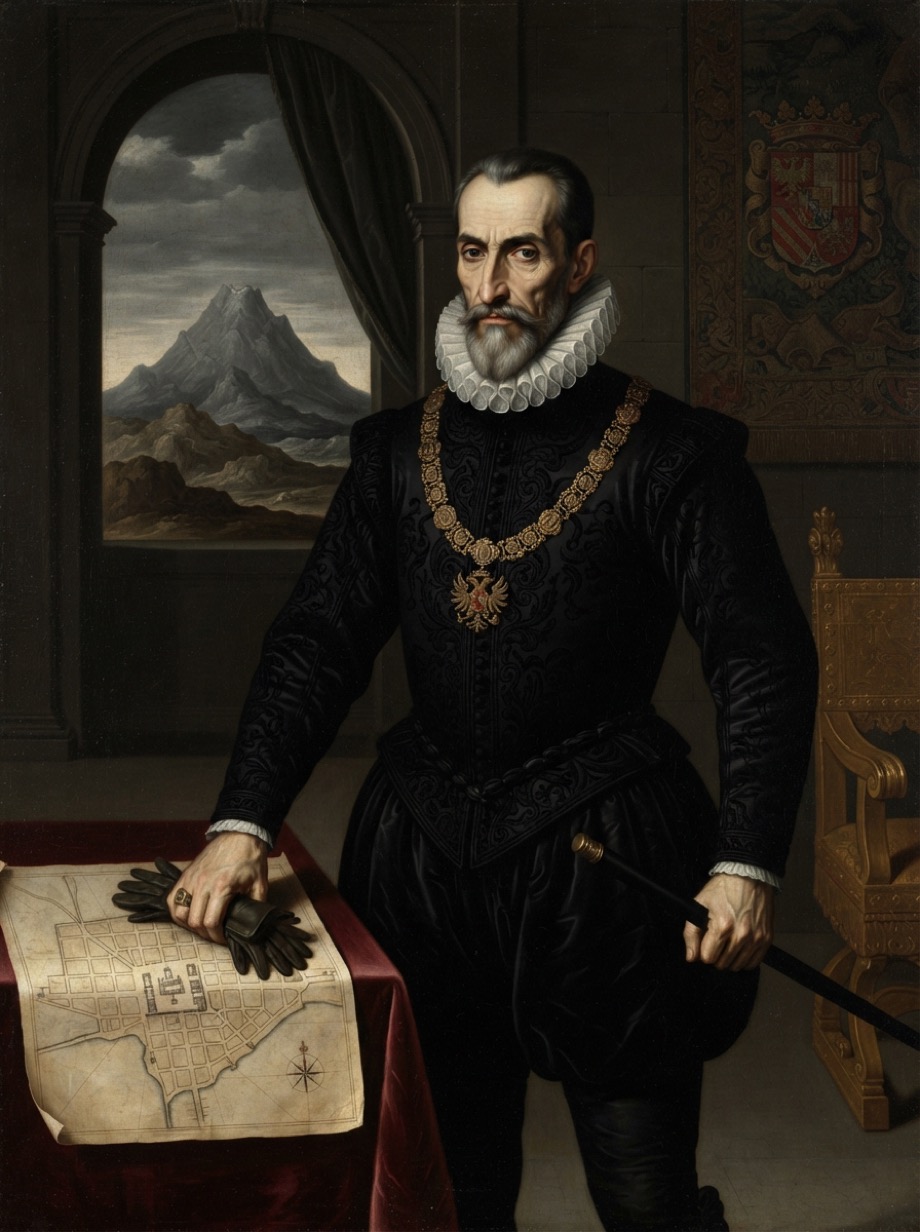
AI-assisted Portrait of Francisco de Toledo
The Man Who Finished the Conquest with a Filing System
Forty years after Cajamarca, Peru was still not a colony. It was a wound that kept reopening — conquistadors who had murdered each other over the spoils, a shadow Inca state holding out in the jungle at Vilcabamba, an indigenous population scattered across thousands of hamlets no Spaniard could count or tax, and a mountain of silver at Potosí that would not yield at the rate the Crown had been promised. Philip II sent Francisco de Toledo to fix it, and did not get a governor. He got an engineer of societies — a man who looked at a civilization and saw a machine assembled wrong.
Toledo's first act as viceroy was to refuse to govern. Rather than settle into the palace at Lima and issue decrees into the fog, he left, and stayed gone for roughly five years, dragging a travelling secretariat through the Andes on a general inspection at brutal distances and altitudes — interrogating curacas and parish priests and mine managers, counting people, measuring tribute, mapping which Inca institutions still functioned and which had rotted. Nothing of consequence was decreed until the survey was done. Then the decrees came all at once, as one integrated design.
That design remade the Andes more thoroughly than the conquest itself had — reducciones, a reorganized mit'a, mercury amalgamation. Each piece was useless alone; together they made Peru the fiscal engine of the Spanish empire for a century. Toledo improvised none of it. He had seen the whole shape before he laid the first stone.
Toledo is the archive's cleanest INTJ of empire: a dominant Ni that perceives an entire social order as one convertible system, and refuses to touch it until it can see the finished thing.
The Five-Year Look Before the Blow
The general inspection is the tell. An energetic administrator tours a province, hears complaints, and starts fixing; Toledo toured a subcontinent and fixed nothing for five years. He was not collecting grievances but the parameters of a system he intended to replace whole. Ni waits, absorbing, until a single organizing image resolves, and then treats that image as the thing to be built. Everything Toledo did afterward is the execution of one picture formed somewhere on the road.
He also grasped, as almost no other colonial official did, that the Inca state had been an information system before it was an army — so he read it. The reports of Polo de Ondegardo — that patient anatomist of the quipu, the panaca lineages, the ceque shrine-lines, the mit'a rotation — became his source code, studied the way a man studies a mechanism he means to rebuild for another purpose. The mit'a survived him precisely because he understood it well enough to invert it: an obligation that had once bound a subject to his emperor now bound him to a silver shaft.
The most Ni thing he ever did, though, was commission a history. Toledo saw that Spanish title to Peru rested on an argument, and that Bartolomé de las Casas and his heirs had already begun attacking it. So he had Pedro Sarmiento de Gamboa write the Historia Índica, assembled from indigenous testimony to prove the Inca emperors recent, illegitimate usurpers rather than an ancient dynasty: if the Incas were tyrants, Spain had liberated rather than stolen. That is a man fortifying ground no one else can yet see is contested.
Grids, Quotas, Quicksilver
A vision that stays a vision is daydreaming. What makes Toledo the type in its hardest form is the completeness with which the picture became machinery. The reducciones were less a policy than a physical rewrite of the Andean landscape: hundreds of new settlements on a checkerboard around a church and a plaza, populated by people marched off the slopes where their dead were buried. The grid is Te made geography. You cannot administer a hillside of scattered kin groups; you can administer a rectangle.
The Potosí system shows the same instinct at the level of throughput. Toledo set the quotas, defined the catchment provinces that owed rotational labor, fixed the terms and wages, and then broke the bottleneck no decree could touch by importing the patio process — mercury amalgamation, which pulled silver from ore the old smelting had left as waste rock. Labor supply, refining chemistry, town planning and tax rolls were one problem to him, solved as one problem. The result is measurable in the way Ni-Te always wants its work measurable: the silver fleets got heavier, and stayed heavier for generations.
And he wrote it all down. The Ordenanzas were a codified operating manual for a viceroyalty that had run on improvisation and murder. Te does not trust a system that depends on the man who built it — so Toledo built one that did not need him, and his design outlived his disgrace by two centuries.
The Conviction That Answered to No One
Toledo was not cruel in the swaggering manner of the conquistador generation he was sent to clean up after. He was colder and more modern: a man with a private, sealed certainty about what was right, reasoned out alone and never submitted for review. Tertiary Fi in an INTJ rarely looks like feeling. It looks like an unbudgeable internal warrant.
The execution of Túpac Amaru in Cusco's plaza in 1572 is where that shows. The young Sapa Inca was no serious military threat, the Vilcabamba state was a remnant, and the pretext was thin. Spanish colonists and clergy who witnessed the beheading were audibly disturbed — a crowd of Andeans wailing in the square, a baptized prince killed on a legal fiction. Toledo pushed it through anyway, because in the design there could be no second claimant to Andean sovereignty, ever, and mercy here would have left a door unsealed. He had already prepared the historiography to justify it. The killing was a line item.
It cost him. Philip II had wanted stability rather than a martyred king, and Toledo went home to a cold reception and died near disfavor — the man who had made Peru profitable, unthanked for it. He never repented. That refusal is the signature: tertiary Fi does not seek absolution, because the tribunal it answers to is internal and has already ruled.
What the Map Could Not Hold
The inferior function is where the design meets the world and the world does not cooperate. Toledo's Se deficit is written across the reducciones. On paper the resettlement was elegant — dispersed people consolidated, everyone within reach of a priest and a tax collector. On the ground it was a catastrophe the plan had no column for: fields at the wrong altitude for the crops that had fed those families, kin obligations severed, huacas and ancestor burials abandoned on the mountainsides, epidemic disease amplified by density. Andeans drifted back to the old sites for generations, quietly undoing the grid.
Potosí is the same failure at scale. The mit'a as he engineered it treated human beings as a renewable input with a known replacement rate, and the mountain consumed them faster than the model allowed. Catchment communities bled out or fled the draft, degrading the very tribute rolls his inspection had so carefully built. A man with stronger Se would have felt the shaft, the mercury poisoning, the thinning villages as data arriving in real time. Toledo felt the ledger.
He was not blind to detail — the inspection proves ferocious diligence about sensory fact. But he gathered it once, in advance, and thereafter trusted the model over the ongoing world: reality as an input to the design phase, never a permanent interlocutor.
Why INTJ Over ESTJ
Why not ESTJ?
The ESTJ reading is tempting: Toledo is a forceful royal administrator who counts things, issues ordinances, and gets infrastructure built. But ESTJ administration is precedent-bound — it inherits a framework, applies it rigorously, and extends established procedure to new ground. Toledo did the opposite. He declined to apply the existing colonial playbook, spent five years suspending action while he modeled the whole viceroyalty, then replaced its settlement pattern, its labor system, its refining technology, and its founding historical narrative simultaneously — including manufacturing new history to secure the design's legal flank. Commissioning the Historia Índica is not something a procedural type thinks to do; it is a systems architect patching a vulnerability in the argument that holds his structure up.
The distinction is between the best executor of an order and the author of one. An ESTJ viceroy would have made the existing machinery run honestly and hard, and Peru would have been better governed and roughly the same place. Toledo left a different civilization: new towns where there had been none, a mining economy that reorganized world trade, an official past written to order, and no Inca alive with a claim. That is Ni supplying the image and Te supplying the tooling.
Connected Figures
Further Reading
- The Conquest of the Incas — John HemmingThe definitive narrative — the fullest English account of Toledo's viceroyalty, the general inspection, and the fall of Vilcabamba.
- Miners of the Red Mountain: Indian Labor in Potosí, 1545–1650 — Peter BakewellThe standard study of the mit'a and the Potosí labor system as Toledo reorganized it.
- A History of Mining in Latin America: From the Colonial Era to the Present — Kendall W. BrownSets the mercury amalgamation revolution and its human cost in the longer arc of Andean extraction.
- Religion in the Andes: Vision and Imagination in Early Colonial Peru — Sabine MacCormackOn the ideological and religious architecture of the Toledan reforms, including the Sarmiento history project.
