 Historical Figure MBTI
#762 · 6-7-26 · The Inca Empire
Pachacuti
The Andean Tlacaelel · Architect of Tawantinsuyu
c. 1418 — 1471/72
9 min read
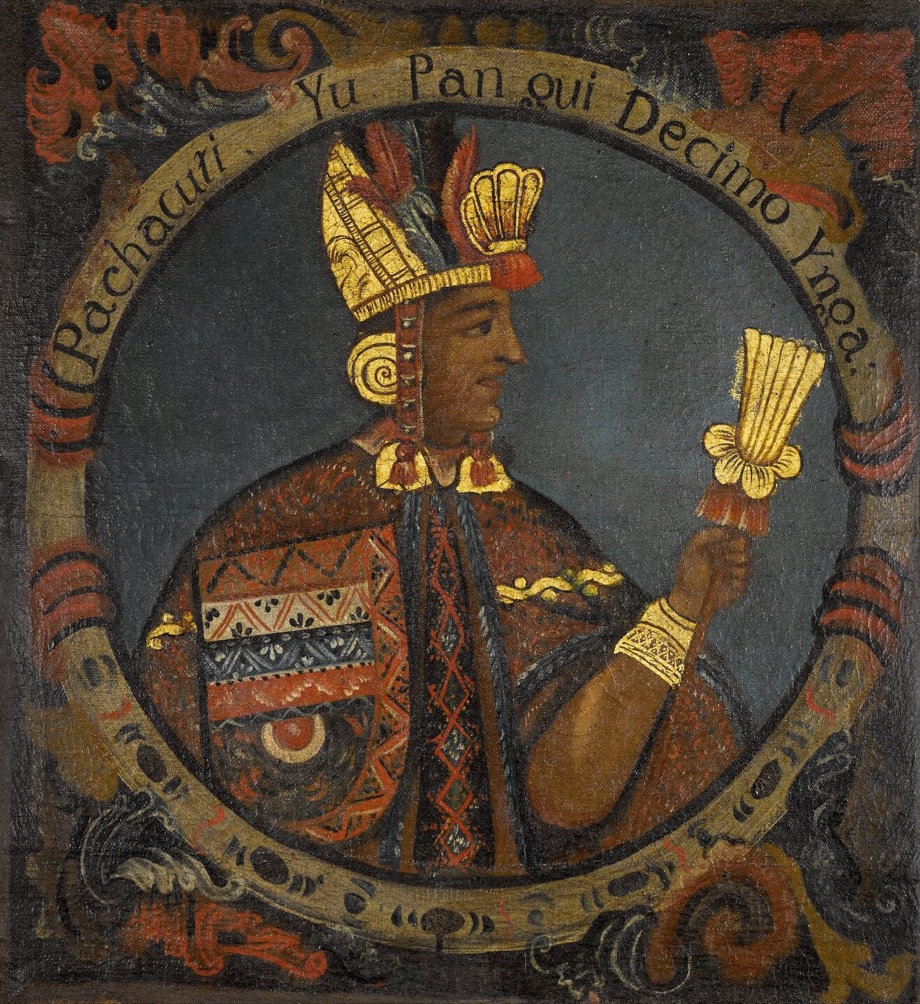
Portrait of Pachacuti
The Younger Son Who Stayed
Every empire has a founding story, and most are lies told by the winners. The Inca story is unusual only in that we can name the man who commissioned the lie. When the Chanca came down on Cusco in the 1430s, the reigning Inca, Viracocha Inca, withdrew to a fortress with his designated heir and left the city to be sacked. His younger son — a prince with no claim and no reason to be there — stayed, rallied what defenders remained, and won. Afterward the story went out that the stones of the battlefield had risen as warriors to fight beside him: the pururaucas. He was almost certainly that rumor's author.
He took the name Pachacuti — Earth-Shaker, the turner-over of the world — and earned it in the least romantic way imaginable. He deposed his brother in a coup of demonstrated competence, tore down the Cusco he had saved and rebuilt it to a plan, invented an administrative machine that would let his sons rule from Ecuador to Chile without writing or the wheel, and had the past rewritten so that the Inca — one hill-country chiefdom among dozens a generation earlier — would appear to have been destined for the world all along. He is the Andean Tlacaelel: near-exact contemporary of the Mexica statesman who burned the old codices to make his dynasty the sun's instrument. Two continents, no contact, one insight — that a state is held together by the story it tells about why it deserves to exist.
Pachacuti is the archive's clearest Andean INTJ: a dominant Ni that saw a finished empire where there was only a raided village, and then spent forty years lowering that vision into the world through law, labor, and stone.
Ni — The Empire He Saw Before It Existed
What separates Pachacuti from the war-chiefs before him is what he did the day after the victory. A talented raider consolidates: hostages, tribute, the valley secured. Pachacuti looked at a half-burned town of a few thousand and began designing a world-state — the Chanca war having been, to him, not a war but a vacancy, proof that the southern Andes had no center and an invitation to become one. The clearest fingerprint of that intuition is the rebuilding of Cusco. He did not repair the city; he emptied it, channeled its two rivers in stone, and laid the capital out as a single legible figure — the crouching puma, Sacsayhuamán its head — divided into the four quarters that gave the empire its name: Tawantinsuyu, the Four Parts Together. That is not urban planning. It is an argument made in masonry: the city is the empire in miniature, so the empire must be a natural body rather than a recent accident. He was building the diagram of a thing he intended to grow into the diagram.
Then he rebuilt the past to match, convening the keepers of the quipu and the court's oral historians to revise Inca origins: earlier rulers demoted or folded together, the Chanca miracle canonized, the sun-god Inti raised over rival huacas. This is Ni refusing to accept that the present is contingent — if the empire is inevitable, it must always have been inevitable, and the record is an inconvenient draft awaiting revision. That we still argue over which parts of Inca history are his invention measures how well it worked.
Te — Governing by Machinery
A vision that stays a vision is a daydream. Pachacuti's auxiliary Te is why his did not: he turned each piece of the design into an impersonal, repeatable system that kept running when he was not in the room. The mit'a is the purest case. Rather than tax conquered peoples in goods — which requires markets, coinage, and trust — he taxed them in scheduled labor, owed by the community rather than the individual and recorded on knotted cord by professional accountants: a tax system built by someone who cared less about revenue than about auditability. The same hand shows in the mitmaqpolicy of transplanting whole communities to break regional loyalties, and in the storehouses that made famine an administrative problem rather than a divine one.
The panaca system is that instinct turned on the dynasty. On an emperor's death his descendants became a permanent corporate body holding his estates, his servants, and his mummified body, which went on owning property and attending festivals; the new Inca inherited the office and nothing else, and had to conquer his own wealth. As engineering it is brilliant — every successor structurally obliged to expand — and unmistakably the work of a man who trusted a rule more than he trusted his heirs. That it eventually detonated, the panacas hardening into rival factions until Huayna Capac's sons tore the empire in half, is the classic Te failure: a system optimized so precisely for one problem that it manufactures the next.
Fi — The Private Verdict on His Own Father
The tertiary Fi runs cold and personal, and shows in how he handled the two men who had written him out of the succession. He did not massacre his father; he stripped Viracocha Inca of everything that mattered and left him the shell — compelled, tradition says, to return to Cusco and drink in public acknowledgment of his son's victory, then left to live out his years honored and irrelevant. Urco was removed altogether. There is no record of an explanation, because Fi does not explain: it arrives at a private judgment — you abandoned the city, and have therefore forfeited it — and treats it as binding.
That inward certainty also let him name a successor on merit against sentiment. His son Amaru Topa Inca was by most accounts the elder and first designated heir, set aside for a temperament better suited to ceremony than command in favor of Topa Inca Yupanqui: the father who had been passed over passing over his own eldest without apparent hesitation. Where the Fi surfaces warmly it surfaces as reverence rather than affection: the hymns to the creator god, the reordered ritual calendar, Coricancha sheathed in gold. A man who believed nothing would not have been that exact about what he wanted believed.
Se — One Battle, and Then the Drawings
The inferior function tends to announce itself once, spectacularly, and then be handed off. The defense of Cusco is the only moment in Pachacuti's life where he is physically present, improvising, at risk, reading the ground in real time — and everything else rests on it. He was good at it; he was never eager to repeat it. He campaigned in the highlands afterward, subduing the Colla and Lupaca of the Titicaca basin, but the pattern is of a man executing a map rather than one who loves the field. The great expansions were won under Topa Inca Yupanqui's command while the father stayed in Cusco with the builders and the accountants.
Where the Se resurfaces, it is sublimated into stone — the obsessive tactility of Inca masonry, blocks fitted without mortar to a tolerance that still refuses a knife blade, and the royal estates of the Urubamba gorge, above all the one at Machu Picchu that tradition assigns to him. The deepest signature, though, is the end. He abdicated. Old, the design substantially complete, he handed the frontier to his son and retreated into advisory power — still shaping, no longer marching. Very few conquerors have ever chosen to stop. The ones who do are the ones for whom the conquering was never the point.
Why INTJ Over ENTJ
Why not ENTJ?
The ENTJ case is real: he commanded, campaigned, deposed a sitting monarch, imposed a legal order on millions. But a dominant Te commander leads from the front indefinitely and measures the reign in conquest tempo. Pachacuti's signature moves are all domestic and structural — the redesign of Cusco, the panaca, the rewritten histories — not the outputs of an executive optimizing throughput but of a designer realizing a picture, who handed the throughput to somebody else and retired from the field while still in power.
The tell is the abdication. An ENTJ founder facing a still-expanding frontier does not stop; the frontier is the work. Pachacuti stopped, because the frontier was only the space into which a finished design would be poured, and the design was the part only he could do. A warlord leaves a tribute network that dissolves in a generation. He left an operating system, and his heirs ran it for ninety years without materially altering it.
Connected Figures
Further Reading
- History of the Inca Realm — María RostworowskiThe standard modern account of Pachacuti's reign and of how the panaca system actually worked.
- History of the Incas (1572) — Pedro Sarmiento de GamboaThe Toledo-commissioned chronicle that preserves the Chanca succession legend — while politicizing it to prove the Incas were usurpers.
- The Incas — Terence N. D'AltroySynthesis on Inca statecraft: the mit'a, the decimal administration, and the logistics of an empire without writing.
- The Shape of Inca History — Susan A. NilesOn Pachacuti's architectural and urban projects, and on reading the historiography of his reign as itself a designed artifact.
- Ancient Cuzco: Heartland of the Inca — Brian S. BauerArchaeology of the physical redesign of Cusco, including the puma plan and the river channels.
