 Historical Figure MBTI
#764 · 6-7-26 · The Inca Empire
Topa Inca Yupanqui
Conqueror of Chimor · Doubled the Empire
c. 1441 — 1493
5 min read
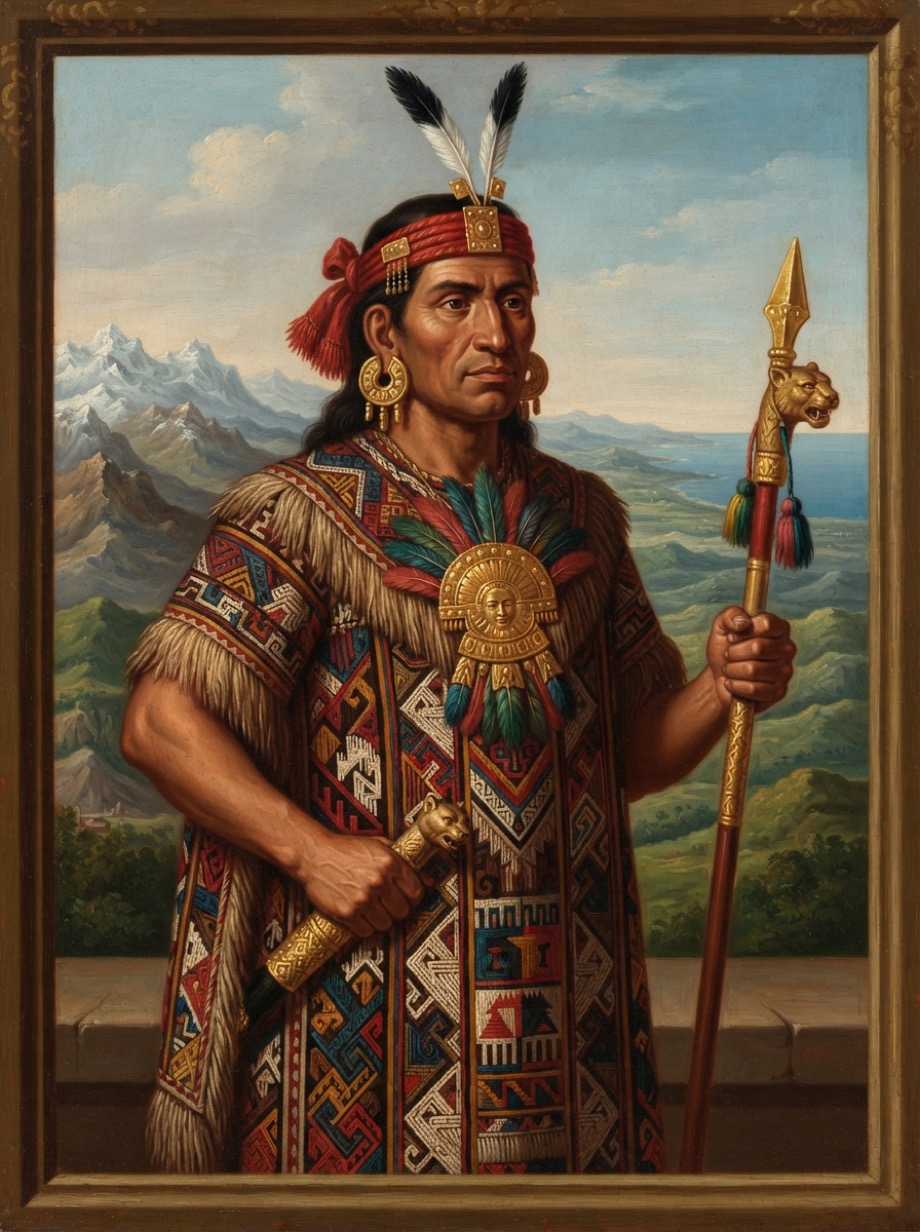
AI-assisted Portrait of Topa Inca Yupanqui
The Son Who Marched
Pachacuti built an empire on the strength of a vision — the reordering of the Andean world into a single administrative machine, run from Cusco outward. His younger son inherited the machine and immediately put it to war. Topa Inca Yupanqui was not the elder brother; Amaru Topa Inca held that place, and by most conventions of succession should have held the throne. He was passed over. What Pachacuti wanted in an heir was not a caretaker of the system he had designed but an operator willing to run it at full throttle, and that is precisely what he got.
Under Topa Inca Yupanqui's command, the empire roughly doubled. Armies pushed north through the highlands into what is now Ecuador and south along the spine of the Andes into Chile, further than any Inca force had gone before or would go again. The campaign that defined him, though, was neither the longest nor the bloodiest — it was the conquest of Chimor, the last independent power of any size left on the Pacific coast, and the way he chose to end it. He did not raze Chan Chan. He emptied it of what mattered and brought it home.
Topa Inca Yupanqui is an ENTJ, and the clearest evidence is what he did with a conquered kingdom: not destroy it, but strip it for parts and put the parts to work.
The Machine, Run Hot
Extraverted thinking organizes the external world toward measurable outcomes, and Topa Inca Yupanqui's outcomes were territorial and relentless. Where his father had stepped back to design the administrative architecture of empire — the road network, the census, the labor levies — the son took that architecture and drove it outward, campaign after campaign, without pause to admire the system's elegance. He treated the state as an instrument for acquiring more state. That is Te in its most literal form: results first, structure in service of results.
The Chimor campaign shows the logic at its sharpest. Chimor was not a loose confederation of highland communities easily absorbed by threat and treaty, as so much of Pachacuti's early conquests had been. It was a sophisticated coastal state with its own irrigation engineering, its own bureaucracy, and — critically — the finest metalworkers in the Andean world. A commander interested only in submission would have installed a garrison and moved on. Topa Inca Yupanqui deported Chimor's ruler, Minchancaman, to Cusco along with its goldsmiths and artisans, and folded their craft directly into the Inca court. The kingdom was not merely defeated; its productive capacity was relocated and put to use. That is Te thinking about conquest the way an engineer thinks about a resource — not what can be destroyed, but what can be extracted and redeployed.
He carried the same instinct into succession. After Pachacuti's death, he did not pause to reconsider or soften the machine he had inherited; he kept expanding it, kept consolidating the provinces he had already taken, kept the levies and the roads running. For an ENTJ, ruling and campaigning are not different modes — they are the same activity aimed at the same goal, with no interlude for reflection in between.
What Conquest Was For
Introverted intuition is the function that asks what a given action is ultimately building toward, and it is what separates Topa Inca Yupanqui's campaigns from mere plunder. Deporting Minchancaman and his goldsmiths was not an impulsive act of victory — it was a calculated bet on what the empire would need decades later. Inca metalworking before Chimor was competent; after the absorption of Chimor's artisans, it was transformed. That kind of foresight, converting a defeated rival's specific technical advantage into a permanent gain for the winning state, is not something Te alone produces. Te wants the immediate result. Ni supplies the sense of which immediate results will still matter in a generation.
The same pattern shows in how far he was willing to march. Pushing the empire's border deep into Chile and north into Ecuador was not dictated by any single tactical necessity — it reflects a standing image of what the Inca state should eventually encompass, held steadily enough to justify years of logistically brutal campaigning at the empire's furthest edges. Ni gave the doubling of the empire its shape; Te supplied the marching.
Why ENTJ Over INTJ
Why not INTJ?
His father Pachacuti reads as the INTJ of the pair — the architect who designed the imperial system from a remove, letting others execute the vision. Topa Inca Yupanqui inverts that posture. He is not the figure withdrawing to plan the next campaign in private; he is in the field, personally directing armies at the empire's furthest edges, year after year. Extraverted Te wants to act on the world directly and continuously — an INTJ would design the conquest and delegate it. Topa Inca Yupanqui led it.
The distinction sharpens once succession is settled. An INTJ heir content with his father's design would have consolidated and stopped. Topa Inca Yupanqui kept campaigning after taking the throne, treating the completed system as a platform for further acquisition rather than a finished work to be preserved. That is the difference between the architect and the commander who inherits the blueprint and keeps building past the edge of the page.
Connected Figures
Further Reading
- History of the Inca Realm — María RostworowskiOn the conquest of Chimor and the mechanics of imperial expansion.
- The Incas — Terence N. D'AltroyA synthesis of Inca conquest strategy and provincial administration.
- The Incas and Their Ancestors — Michael E. MoseleyOn Chimor and its absorption into the Inca state.
- Inka Settlement Planning — John HyslopOn the administrative consolidation that followed conquest.
