 Historical Figure MBTI
#765 · 6-8-26 · The Inca Empire
Huayna Capac
The Inspector-Emperor · Died Without Seeing a Spaniard
c. 1468 — 1524/25
9 min read
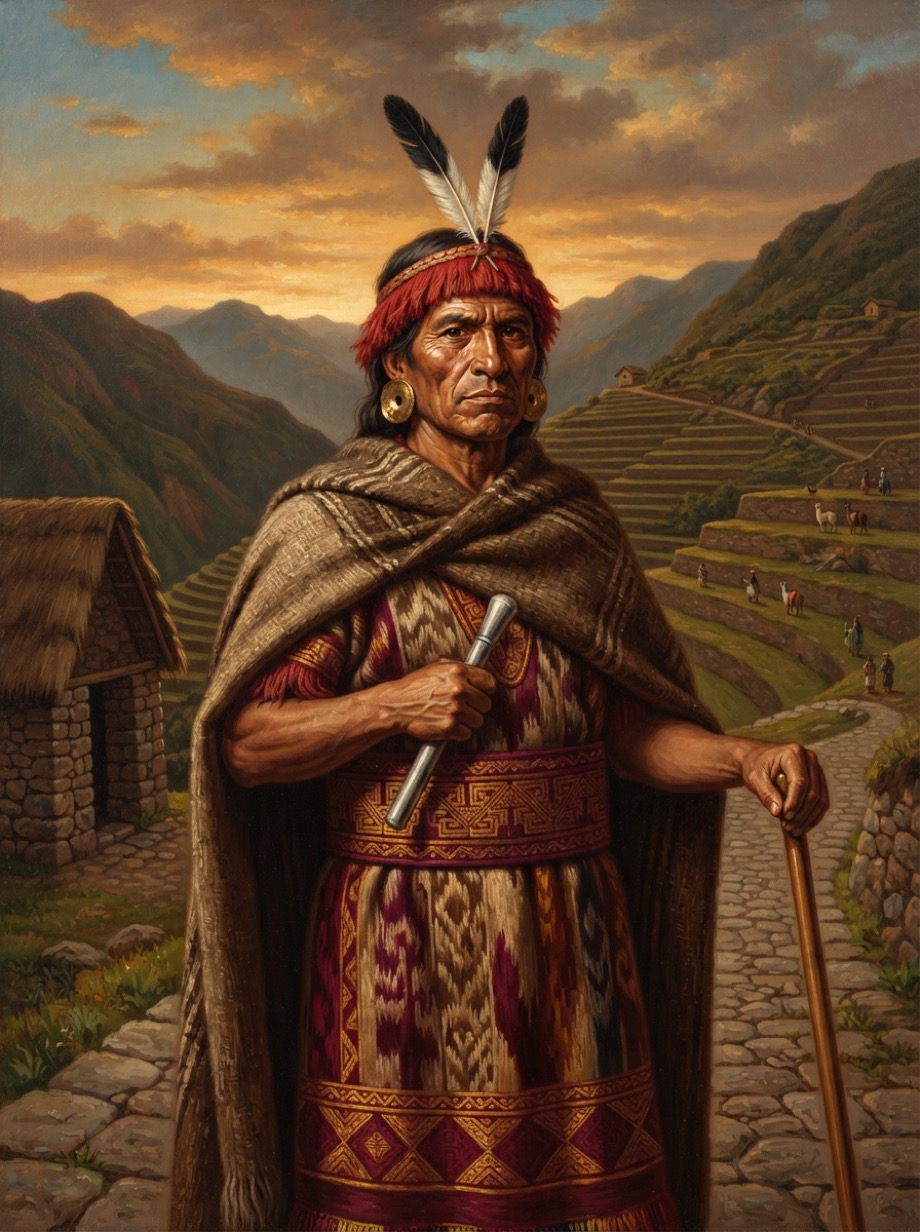
AI-assisted Portrait of Huayna Capac
The Emperor Who Governed by Walking
He is the last man to hold the whole thing in his hands. Everything after him is fracture — a war between brothers, a betrayal at Cajamarca, a puppet court, a mountain redoubt, and finally a head on a pole in the plaza at Cusco. But in the early 1520s Tawantinsuyu is intact, vast, and functioning, and the man responsible for its functioning is almost never in his capital. Huayna Capac spent the bulk of his reign on the road, in the north, in tents and provincial lodges and half-finished administrative complexes, counting things. He inherited an empire that had already been imagined for him. His work was to make sure it actually ran.
That distinction is the whole man. His grandfather Pachacuti had invented the Inca state more or less from scratch — a conceptual act, a reorganization of the cosmos with Cusco at its center. His father Topa Inca Yupanqui had taken that design and stretched it from Quito to Chile. Huayna Capac, arriving third, inherited the finished architecture and did what the third generation of a great enterprise almost always does when it is done well: he inspected it. He toured. He rebuilt roads. He ordered censuses. He moved populations. He established a second capital at Tomebamba, in what is now Ecuador, not as a rival mystique to Cusco but because the northern frontier was where the work was, and he intended to be where the work was.
It is a deeply unglamorous way to be remembered as great, and it is also the reason the empire the Spanish met was as formidable as it was. The roads were maintained, the storehouses full, the provincial governors seen in person by the Sapa Inca recently enough to remember it.
Huayna Capac is the archive’s clearest Andean ESTJ: extraverted thinking not as grand strategy but as administration by physical presence — an emperor whose governing instrument was his own arrival.
Te — The Empire as a Standing Audit
Extraverted thinking wants the external world measured, ordered, and made to perform. Huayna Capac’s reign is that impulse applied to a landmass. He inherited the decimal administrative system — households grouped in tens, hundreds, thousands, each unit with an accountable head — and rather than treating it as inherited furniture, he audited it. Censuses were retaken. Tribute obligations were reassessed against actual counts. Populations were relocated wholesale under the mitmaq system, entire communities transplanted hundreds of miles to break up unreliable regions and seed loyal labor where labor was needed. That is not conquest; it is workforce allocation, carried out at continental scale by a man who thought of subjects as a resource with a location.
The roads are the purest expression of it. The Inca highway network was already famous before him, but Huayna Capac extended and hardened the northern arteries toward Quito, with the way stations, storehouses, and relay-runner posts that made the roads useful rather than merely impressive. He was building a nervous system for his own oversight — infrastructure whose function was to let orders travel out and information travel back at a speed that let one man remain the actual decision-maker over a territory it took months to cross. An emperor content with symbolic authority does not care about the spacing of the storehouses. Huayna Capac cared enormously.
And where the system failed, he punished with the flat, procedural severity of a man correcting a fault rather than avenging an insult. Rebellions among the Chachapoya and in the far north were met not with theatrical cruelty but with resettlement, garrisoning, and the installation of loyal administrative cadres — the Te answer, which is to fix the process so the fault cannot recur. His campaigns in the north were less wars of glory than extended enforcement actions against the edges of a system he considered already his.
Si — The Inherited Machine, Kept Exactly
Introverted sensing is fidelity to the established form — the conviction that the way a thing was done correctly before is the way it should be done now. Huayna Capac is one of history’s great custodians. He did not reform the Inca state. He did not rethink the relationship between Cusco and the provinces, or the theology of the sun cult, or the labor tax that underwrote everything. He received Pachacuti’s design as a completed and correct object and devoted a reign to keeping it in true. The quipu records, the ritual calendar, the rotating mit’a labor obligations, the storehouse inventories — all of it preserved, extended, maintained.
Even Tomebamba, his most conspicuous act of building, is Si rather than vision. He did not found a new kind of capital; he built a working replica of the old one, reportedly stocked and appointed in deliberate imitation of Cusco, complete with its own temple establishment and administrative apparatus. It was a second office for the same firm, sited where the manager needed to be. A more conceptual mind would have used a new capital to say something new. Huayna Capac used it to keep doing the same thing closer to the frontier.
He observed the dynastic protocols scrupulously, honored the mummified bodies of his predecessors, and framed his northern wars as the continuation of his father’s unfinished business rather than as projects of his own. The empire in 1520 looked, structurally, almost exactly like the empire in 1493 — only larger, better roaded, more thoroughly counted. That was not a failure of imagination. It was the point.
Ne — The Frontier He Could Not Stop Testing
Tertiary extraverted intuition in an ESTJ is narrow but real: an appetite for the edge of the map, indulged strictly within the vocabulary of the existing system. Huayna Capac had it, and it is why he kept pushing north long past the point where the returns justified the effort. The campaigns into the country of the Pastos and Cayambes and up toward the Ancasmayo were not the acts of a purely consolidating mind. Something in him wanted to see what was past the last garrison, and kept arranging to find out.
It shows too in his handling of the northern peoples. He took a Quito-based court seriously, married into northern lineages, and let a genuinely bicultural political center grow at Tomebamba rather than insisting everything be validated from Cusco — a flexible improvisation on a rigid inherited design. The Cusco nobility found it alarming, and history proved them right, though not for the reasons they feared.
But Ne in the tertiary slot generates options, not foresight. Reports reached him in his last years of strange bearded men on rafts far to the north — the earliest Spanish probes along the Pacific coast — and he seems to have received the news as an interesting anomaly to be noted and filed rather than a category-breaking threat to be modeled. He could entertain the novelty. He could not extrapolate from it.
Fi — The One Decision He Would Not Make
Inferior introverted feeling is the ESTJ’s blind spot: private attachment, unarticulated preference, the things a procedural mind cannot put on a ledger and therefore leaves unresolved. Huayna Capac’s catastrophe is a Fi catastrophe. He had sons in the north and sons in Cusco, favorites and obligations, affections that ran against the dynastic expectations of the Cusco panaca — and he never arbitrated between them cleanly. The succession, the single question no census could answer for him, is the question he left open.
The sources disagree about the end, which is itself telling. Some accounts have him naming Ninan Cuyuchi as heir; some have the omens taken for that choice coming back bad; some have him naming Huáscar only as a fallback, or dying before the matter was settled at all. What no account produces is the thing his whole reign should have produced: a clear, documented, publicly executed instruction. The man who could tell you the grain stores of a valley he had visited eight years earlier did not leave an unambiguous will.
And there is the deeper reading. His affection for the north — for Tomebamba, for the Quito court, for the son raised in it — was a genuine personal preference that ran against the institutional logic he otherwise served absolutely. He would not repudiate Cusco and he would not repudiate the north, so he did neither, and left two centers of legitimacy where the system required one. Inferior Fi does not usually erupt. It simply prevents a decision, quietly, until the world makes the decision for you. It made this one at Cajamarca, eight years after he was gone.
Why ESTJ Over ENTJ
Why not ENTJ?
The ENTJ case is genuinely tempting: he commanded armies across a continent, founded a second capital, and pushed the imperial frontier further than anyone after him would manage. But ENTJ is Te directed by Ni — it restructures, it reimagines the system itself, it builds toward a future configuration that does not yet exist. Pachacuti did that; Huayna Capac inherited the result and never once redesigned it. His entire method was administration by physical presence: inspecting, counting, garrisoning, maintaining. And the great strategic question of his life — who succeeds, and how the north is reconciled with Cusco — is precisely the one an Ni-driven mind would have modeled years in advance and settled. He left it open.
The tell is where his energy went. Given an empire and thirty years, an ENTJ finds the structural problem and solves it — the dual-capital question, the succession mechanism, the unstable northern integration. Huayna Capac spent those thirty years on the road instead, resolving thousands of concrete local problems superbly and the one abstract problem not at all. That is Te over Si: the world made orderly item by verified item, with the pattern behind the items left to take care of itself. It produced the most efficiently governed state in the pre-Columbian Americas, and it produced a civil war.
Connected Figures
Further Reading
- History of the Inca Realm — María RostworowskiThe standard modern account of Huayna Capac's reign, the northern campaigns, and the epidemic that ended them.
- Born to Die: Disease and New World Conquest, 1492–1650 — Noble David CookThe definitive study of the pre-contact epidemic wave that reached the Andes ahead of any European and killed the Sapa Inca.
- The Incas — Terence N. D'AltroyOn the administrative machinery of late Inca rule — census, roads, mitmaq resettlement — and the succession crisis it was left holding.
- The Conquest of the Incas — John HemmingThe standard narrative history, covering Huayna Capac's death and the civil war that made Cajamarca possible.
