 Historical Figure MBTI
#790 · 6-11-26 · The Conquest of the Andes
Garcilaso de la Vega, el Inca
Invented the Inca Golden Age for Europe
1539 — 1616
6 min read
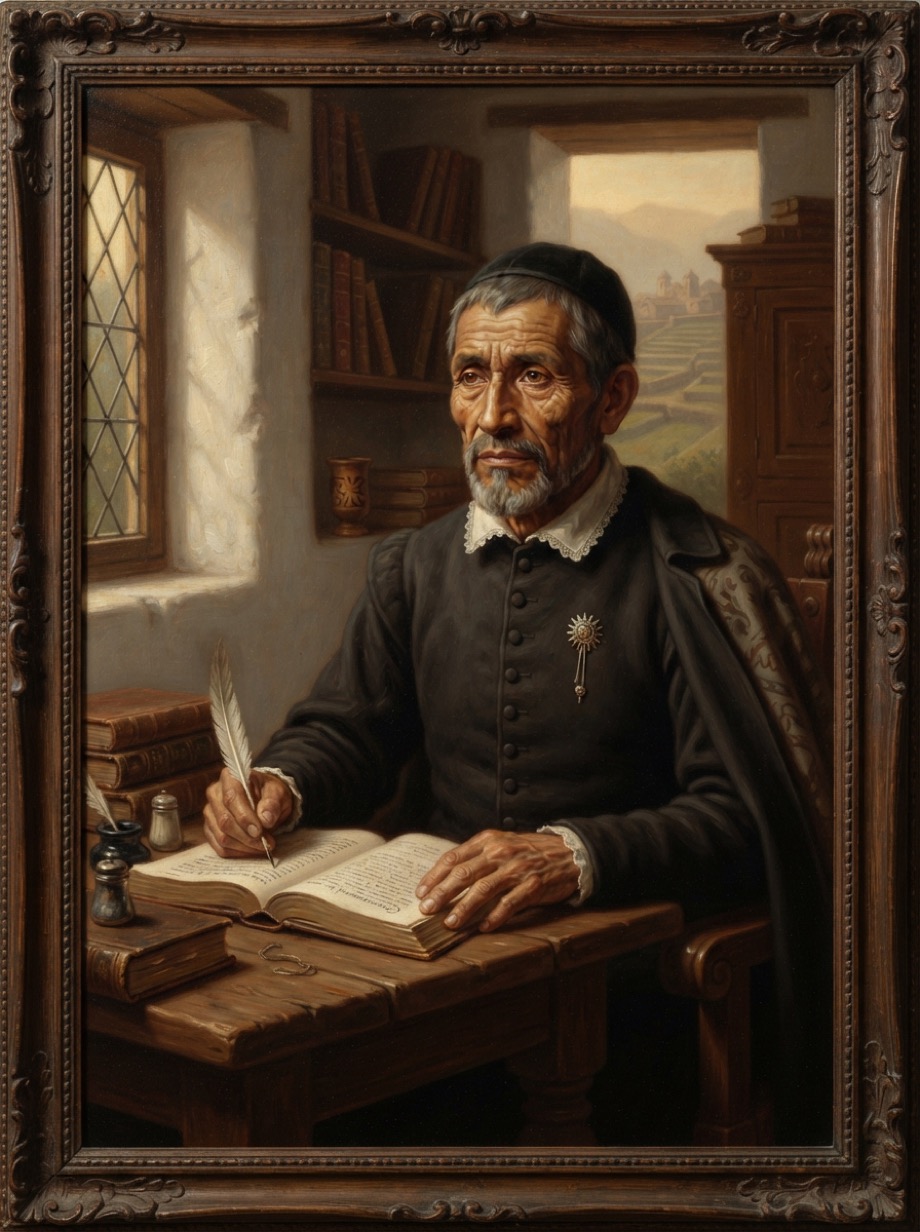
AI-assisted Portrait of Garcilaso de la Vega, el Inca
The Son Who Wrote His Mother's World Back Into Existence
He was born in Cusco in 1539, six years after the garrote closed on Atahualpa, into a house where the conquest was not history but furniture. His father was a Spanish captain; his mother was an Inca princess, a niece of Huayna Capac, and the relatives who sat in her rooms were the surviving relics of a court that had ruled from Quito to the Maule. They talked, in Quechua, about what had been lost. The boy listened — and also learned Latin, and learned early that nobody considered his two halves equal.
At twenty-one he sailed for Spain to press a claim on his father's estate and never came back. The claim failed. He soldiered briefly, settled in Andalusia, took his father's aristocratic name and appended to it, defiantly, the word Inca. Then, for forty years, he did almost nothing visible. In his sixties, from a small house in Córdoba, he wrote the book that gave Europe its picture of the Inca Empire.
The Comentarios Reales de los Incas (1609) is not a neutral chronicle. In it the Incas are rational, temperate, benevolent lawgivers who had reasoned their way toward a single God before the friars arrived. Historians have spent four centuries cataloguing what he softened — the wars of subjugation, the resettlements, the coercion inside that golden order — and they are right, and they are missing the point. The idealization is his method.
Garcilaso is the archive's purest INFP historian: dominant Fi turning exile into devotion, defending his mother's people not by proving them innocent but by refusing to let them be described by anyone who did not love them.
Loyalty as a Historical Method
Dominant Fi is not sentiment but a private tribunal — an inner standard of the worthy, held so firmly that no external authority can overrule it. Spain had officially settled the question of the Incas: usurpers, tyrants, a just conquest. Garcilaso was a minor gentleman on a small income, and agreeing would have cost him nothing. He never agreed.
The name is the first evidence. Baptized Gómez Suárez de Figueroa, he discarded it, took his father's more resonant family name — already famous in Spain as a poet's — and bolted onto that Castilian pedigree the one word that undid its safety: el Inca. He insisted on being read as both, where the world offered a clean pass for consenting to be read as one. Fi builds identity from the inside out and dares the world to correct it.
The book is written in the same key. His warrant is not documents but love and blood: he heard these things himself, in Quechua, from his mother's relatives, and no Spaniard who learned the language late could hear what he heard. That is a personal epistemology — truth transmitted through relationship, verified by devotion rather than cross-examination. Softening the Inca conquests into a civilizing mission, he is not falsifying a record; he is declining to betray the people who gave him the one he has.
A Civilization Reconstructed From Fragments
Auxiliary Ne takes scattered pieces and sees the whole they imply. Garcilaso's raw material was comically thin for the monument built on it: a childhood of overheard family talk, ended at twenty-one; a language he had not spoken daily in forty years; letters from old schoolfellows in Peru; and the printed chroniclers, whom he read less as sources than as errors to correct. Out of that came a full account of Inca law, agriculture, astronomy, marriage custom, and theology — a working society elaborated outward from remembered anecdote.
His signature move is philological and pure Ne: a chronicler reports something absurd about Inca religion, Garcilaso shows the man misheard a Quechua word, and from the corrected word unfolds a different and more coherent civilization. One syllable becomes a cosmology. The book's texture — digressive, forever wandering into an etymology or a remembered uncle and returning three pages later — belongs to a mind that thinks in expanding possibility rather than marching argument.
It is also why the portrait comes out idealized rather than merely partisan: Ne fills gaps with the most beautiful thing that could plausibly go there, and the gaps were everywhere. Not a lie — an extrapolation by a loving mind from insufficient data.
The Cusco That Stopped in 1560
Tertiary Si is memory as sanctuary — the past held in vivid sensory detail and used as the standard against which the present is found wanting. Garcilaso's Peru is frozen at the moment he left it. He describes the stones of Sacsayhuamán, the terraces, the ceremonies in the great square with the granular specificity of a man returning to a well-worn image rather than to a document, down to the rooms where the old men sat and talked.
That fidelity makes the book readable, and it is also its trap: Si preserves, it does not update. Everything he says is true of a country he had not seen since 1560 and increasingly untrue of the brutalized mining-camp Peru of Francisco de Toledo's viceroyalty. He knew of Túpac Amaru's execution and wrote of it with real grief, but the Andes he defended were always his childhood's. The forty silent years fit the pattern — an INFP's Si does not produce on schedule; it accumulates until some pressure of value forces it out whole.
The Lawsuit He Could Not Win
Inferior Te is the weak hand: proof, procedure, impersonal system. Garcilaso's one direct encounter with it was a rout. Petitioning the Council of the Indies for restitution of his father's services, he was answered with the record of that father's conduct during the rebellion of Gonzalo Pizarro — a horse lent at the wrong battle, entered in a ledger. He had come with a story about a family; the crown answered with a document. He lost, and withdrew from that arena for good.
Inside the book, Te surfaces as anxious imitated formality — endless assurances that he proceeds in order, cites his authorities, will not exceed what he can support: the vocabulary of humanist historiography deployed by a man not actually doing it. Where a strong Te would have hunted the quipu-records and the administrative surveys, he cites his uncle. The counter-case stands beside him: Polo de Ondegardo interrogated Andean informants systematically, located the royal mummies, and produced findings a viceroy could act on. Garcilaso had no answer to that machinery. He wrote something it could not touch instead, and outlasted it by three hundred years.
Why INFP Over INFJ
Why not INFJ?
The temptation is real: the Comentarios carries a single, almost prophetic vision of what Inca civilization meant, and INFJs are the great builders of such visions. But an Ni-dominant would have driven it as an argument — one unifying thesis, defended in sequence, counter-evidence anticipated and disarmed. Garcilaso digresses, remembers, corrects a word and follows it wherever it leads, and his warrant is always that he was there and these were his people. An INFJ idealizes toward a meaning the culture reveals; Garcilaso idealizes toward the dignity of specific people he loved — not a seer's convergence but a son's devotion, which is Fi.
The distinction changes how to read him. If he were INFJ, the romanticism would be a flaw in the argument, correctable by better evidence. As an INFP he is doing something evidence cannot correct: testifying. The Comentarios is closer to elegy than to treatise, and its most durable passages are the ones where a specific old man in a specific room begins to speak. He was not establishing what the Inca Empire was; he was making it impossible for Europe to go on believing his mother's people had been savages — understanding, with an artist's instinct rather than a historian's, that beauty would do that work where proof could not.
Connected Figures
Further Reading
- Comentarios Reales de los Incas (Royal Commentaries of the Incas), 1609 — Garcilaso de la Vega, el IncaThe foundational text itself — read it for the voice as much as the history.
- Incan Insights: El Inca Garcilaso's Hybrid Epistemology — José Antonio MazzottiOn the Andean oral substrate beneath the humanist Spanish prose, and how the two identities operate together.
- Language, Authority, and Indigenous History in the Comentarios Reales de los Incas — Margarita ZamoraThe sharpest critical account of how the text is built and how Europe received it.
- History of the Inca Realm — María RostworowskiThe modern reconstruction to read against him — the record Garcilaso idealized.
