 Historical Figure MBTI
#791 · 6-11-26 · The Conquest of the Andes
Felipe Guaman Poma de Ayala
1,189 Pages to a King Who Never Read Them
c. 1535 — c. 1616
8 min read
Portrait of Felipe Guaman Poma de Ayala
A Letter Three Hundred Years in Transit
Felipe Guaman Poma de Ayala spent the better part of his adult life writing one document. Not a career of documents — one. He was a provincial Andean noble, not of the Inca royal line but claiming real standing in the pre-conquest order, and he had spent decades working the seams of Spanish colonial administration as an interpreter and legal assistant, close enough to the machinery of empire to watch exactly how it ground down the people it claimed to govern. What he built from that vantage was not a memoir and not a protest pamphlet. It was a 1,189-page illustrated letter, addressed by name to King Philip III of Spain, that tried to do three things at once: narrate a full history of the Andean world before the Spanish arrived, catalog with unbearable specificity the abuses being committed under colonial rule, and lay out — point by point — what a genuinely good government of Peru would actually look like.
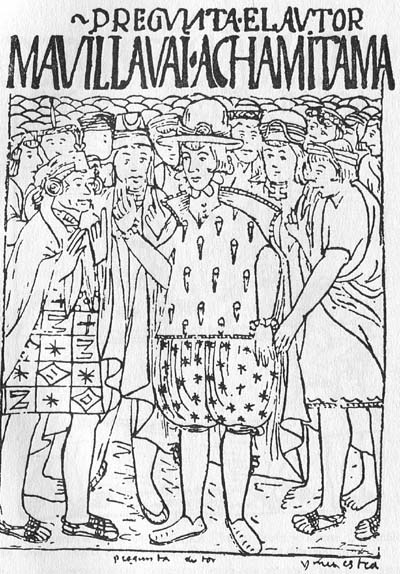
He called it El primer nueva corónica y buen gobierno, and he filled it with 398 of his own drawings — dress, ritual, labor, violence, rendered by an indigenous hand at a moment when almost no other such record exists. He arranged for it to be carried toward the coast in hope that it would reach the king. It is not clear Philip III ever opened it. The manuscript then disappeared from history entirely, only to surface by accident in the Royal Danish Library in Copenhagen in 1908 — unread, unindexed, forgotten for three centuries, waiting the whole time for a reader who might finally act on what it asked.
Guaman Poma was an INFJ, and the chronicle is what Ni looks like when it refuses to stay theoretical — a single totalizing vision of justice, built across decades, aimed at one reader, meant to change what he does.
One Book, One Argument, Thirty Years
What makes the Nueva corónica an Ni document rather than simply a long one is its refusal to be a miscellany. Guaman Poma was sitting on an almost unmanageable quantity of material — decades inside the colonial bureaucracy, a lifetime of testimony about forced labor and clerical abuse, an inherited memory of Andean history reaching back before the Incas — and he did not organize it as a chronicle of separate incidents. He organized it as a single argument with a beginning, middle, and prescription: this is what the Andean world was, this is what has been done to it, this is what must now be done to repair it. That structure is Ni doing what it always does — collapsing an overwhelming field of particulars into one coherent, load-bearing pattern, then holding that pattern steady for years without losing the thread.
The scale of the undertaking is itself the evidence. An extraverted-perceiving mind accumulating this much material tends to keep expanding outward, adding case after case; Guaman Poma's material keeps folding back toward the same destination — a plan for good government he had apparently held in view since long before he began writing it down. He was not discovering his thesis as he went. He was excavating one he had already seen whole, in the way Ni sees whole things before it has the words or the pages to show them.
It shows too in the audience he chose. He did not write for other Andean nobles, who already knew what colonial rule cost them, or for a Spanish public he had no access to. He wrote for one man, the king, because in his internal model of how the world could be repaired, the king was the single point through which the whole system could be redirected. That is a vision-first mind identifying the one lever that matters and building an entire thirty-year project around pulling it.
Written to Move a Reader, Not to Settle a Record
The clearest sign of Fe in the chronicle is what it is not. Guaman Poma had, by his own working life, everything needed to produce a dry administrative record of grievances — dates, names, the mechanics of forced labor and tribute abuse, the kind of documentation a legal assistant knows how to compile. He wrote something else. The abuses are rendered so that a reader feels their weight: named officials, named cruelties, drawings that put a human face and a specific posture of suffering in front of the king's eyes rather than leaving it as an abstraction on a page. The goal was never simply to be accurate. It was to move a specific person to act on behalf of people Guaman Poma cared for as his own.
That orientation toward the feelings and moral standing of others, and toward a harmonious restored order rather than a purely factual reckoning, is Fe in service of Ni's vision. His proposed "good government" was not a technocratic reform plan; it was a picture of Andean people treated with dignity, folded back into legitimate authority rather than simply spared from the worst abuses. He was arguing for a relationship, not just a policy — and he built the entire architecture of the document, 398 drawings included, to make a king who had never met him feel the obligation he was being asked to feel.
A Bureaucrat's Eye for How the System Actually Worked
Tertiary Ti surfaces less as theory than as competence — Guaman Poma understood colonial administration well enough, from years spent working inside it, to describe precisely how abuses were committed and by whom, using categories and distinctions a Spanish official would recognize. That internal logical grip on the machinery of governance is what let the chronicle function as an actionable reform document rather than only a lament: he could name the specific offices, procedures, and loopholes that needed correcting, not merely gesture at injustice in general.
Sent Toward the Coast, Then Silence
Inferior Se shows in the gap between the vision and its delivery. Guaman Poma could see the whole architecture of the argument and the world it wanted to build, but the concrete, present-tense mechanics of getting it into the king's hands — verifying the manuscript actually reached Spain, confirming it was read, following up — were never within his control, and there is no evidence he had any real means of ensuring them. He sent the chronicle toward the coast and then, so far as history records, simply waited. The document vanished for three hundred years not because the vision failed, but because the immediate, physical follow-through an Se-dominant operator might have forced never happened.
Why INFJ Over INTJ
Why not INTJ?
The case for INTJ rests entirely on scale: 1,189 pages and 398 drawings look, at a glance, like the output of a mind building a comprehensive analytical system. But an INTJ chronicling colonial Peru would likely have produced something closer to a taxonomy — a structural account of how the administration worked, organized for the sake of getting the picture right. Guaman Poma's chronicle is not organized that way. It is organized as testimony and appeal, built to make a specific reader feel the injustice and act on it, with the historical and administrative material in service of that emotional and moral argument rather than the reverse. The abuses are rendered for their human weight, not catalogued for their systemic pattern. That is Fe directing the material, not Te.
The distinction matters because it changes what the whole project is for. A Te-driven analytical system wants to be correct and complete on its own terms; it does not need a reader to feel anything in particular, only to understand. Guaman Poma's chronicle has no such self-sufficiency — it is incomplete without the king's response, built from the outset around persuading one person to change how he governs. That dependence on an audience's moral action, layered onto a totalizing Ni vision of what justice should look like, is the INFJ signature, and it is what the INTJ reading misses.
Connected Figures
Further Reading
- El primer nueva corónica y buen gobierno — Felipe Guaman Poma de Ayala (c. 1615)His own foundational manuscript, digitized by the Royal Danish Library.
- Guaman Poma: Writing and Resistance in Colonial Peru — Rolena AdornoThe standard scholarly study of the manuscript and its author.
- The Last Days of the Incas — Kim MacQuarrieBroader context on the colonial period Guaman Poma documented.
