 Historical Figure MBTI
#780 · 6-10-26 · The Conquest of the Andes
Gonzalo Pizarro
The Best Lance in Peru Rebels Against the Crown
c. 1510 — 1548
8 min read
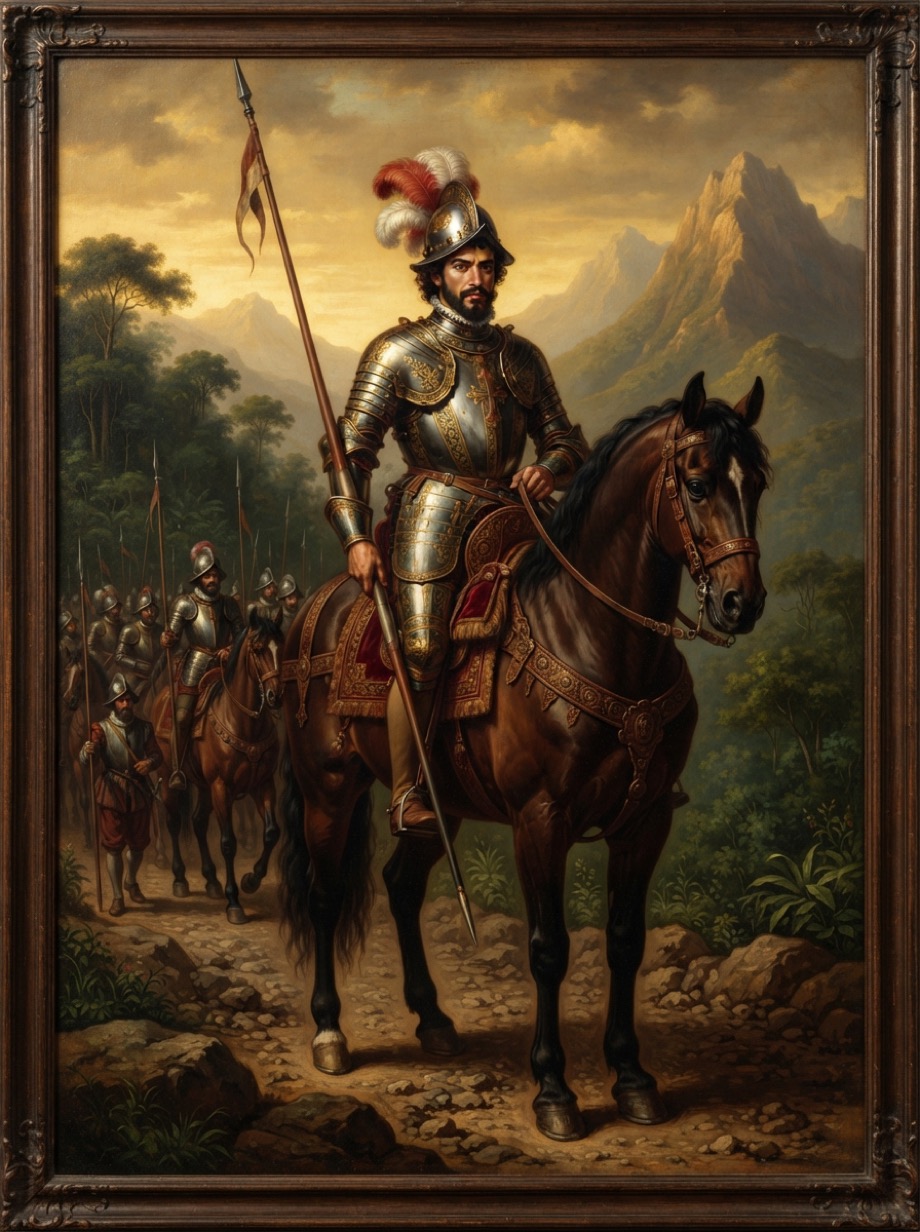
AI-assisted Portrait of Gonzalo Pizarro
The Brother Who Answered a Law With a Lance
Of the four Pizarro brothers who came out of Trujillo in Extremadura to break an empire, Gonzalo was the youngest, the handsomest, and by common agreement the best horseman in Peru. Illegitimate like Francisco, he had none of the eldest brother’s patience and none of Hernando’s taste for lawyers and paperwork. What he had was a lance. Chroniclers who agreed on almost nothing else agreed that Gonzalo Pizarro on horseback was the finest sight in the Andes — and that soldiers followed him not because he reasoned with them but because standing near him felt like standing near the front of history.
That gift carried him a long way and then destroyed him. Given the governorship of Quito, he marched east over the cordillera on a rumor — the Land of Cinnamon, La Canela, a forest of spice trees somewhere past the last pass — and spent the better part of two years in a green hell that killed most of his men, ate his horses, and produced nothing except the accident of Francisco de Orellana floating away downriver and becoming the first European to descend the whole Amazon. Gonzalo staggered back to Quito in rags. Then, when the Crown’s New Laws of 1542 threatened the encomienda system his entire class lived on, he did the thing no other conquistador quite dared: he raised an army against the King of Spain, killed the King’s viceroy in open battle, and ruled Peru as its own sovereign for four years.
No one in the Indies came closer to snapping the thread back to Madrid. And no one lost it more completely, because the man the Crown finally sent against him did not bring an army at all.
Gonzalo Pizarro was an ESTP whose dominant Se needed the biggest stage in the world and could not tell the difference between the boldest move and the right one.
Se — The Best Lance in Peru
Extraverted Sensing is the function that lives in the physical present and trusts what the body can do in it, and Gonzalo’s entire authority was built on that and almost nothing else. His reputation in Peru was not administrative or strategic; it was that he rode better and fought harder in the actual moment of contact than anyone else on the field. In a colony full of hard men, he was the one whose name meant a charge. Command came to him as a physical fact — soldiers could see what he was — rather than as a title he had argued his way into.
The Land of Cinnamon expedition is Se’s appetite in its purest and stupidest form. There was no intelligence worth the name behind La Canela, only rumor and the pull of unexplored country east of the Andes. Gonzalo did not send scouts and wait; he took thousands of men, horses, hogs, and dogs over the mountains into a rainforest nobody had mapped, on the theory that you find out what is there by going there. Se does not model the jungle in advance. It walks into the jungle and reacts, and it keeps reacting until there is nothing left to react with — which is roughly what happened, as the column dissolved into starvation, drowned rivers, and the slow loss of everything Gonzalo had brought.
And then the crucial tell: he came back from that catastrophe undeterred. A different psychology would have read the Amazon as a verdict on its own judgment. Gonzalo read it as a bad hand, shook it off, and within a year was raising the largest private army in the New World. The present moment always offered him a fresh set of stakes, and he never once declined to raise.
Ti — The Soldier’s Arithmetic
Introverted Thinking in an ESTP is not system-building; it is the fast, private, wholly practical calculation that turns a physical impulse into a workable move. Gonzalo had exactly enough of it to be dangerous. When the New Laws arrived, he understood the mechanics of his position with complete clarity: the encomienda was the only thing converting conquest into permanent wealth, the settlers of Peru would lose everything if it was abolished, and therefore an army raised in defense of the encomienda would not lack for men. That is a correct read, arrived at quickly, and he acted on it before anyone else finished drafting petitions.
On the battlefield the same faculty served him well. Against Blasco Núñez Vela he did not simply charge; he let the viceroy exhaust his legitimacy and his logistics first, then met him at Añaquito with a better-supplied, better-mounted force and destroyed him. He also knew what he did not have and hired it — attaching himself to Francisco de Carvajal, the octogenarian veteran of the Italian wars who was the most capable field commander in the hemisphere, and letting him run the war.
But Ti in the auxiliary seat serves the dominant rather than checking it. Gonzalo’s logic was excellent about the next engagement and blank about the frame around it. He could calculate how to beat a viceroy; he never worked out what a man who has killed a viceroy is supposed to become. Carvajal told him plainly: crown yourself, marry an Inca princess, declare Peru a kingdom, burn the bridge. Gonzalo kept insisting he was a loyal vassal who merely wanted the law changed — an incoherent position he was tactically too clever to hold and too shallow to abandon.
Fe — The Popularity That Was the Whole Army
Gonzalo’s hold on Peru was almost entirely a matter of charm. He was open-handed, approachable, generous with plunder, and famously willing to share the discomforts of his men — the qualities that make tertiary Extraverted Feeling in an ESTP so magnetic. Where his brothers were feared or resented, Gonzalo was liked, and in a colony where every soldier was in effect a free agent choosing which captain to follow, being liked was a strategic asset of the first order. His rebellion recruited itself.
Tertiary Fe, though, reads the room it is standing in. It is superb at the mood of the men around the fire and helpless before opinion it cannot see. Gonzalo genuinely believed that because Peru loved him, Peru was his — and he never grasped that the loyalty he enjoyed was conditional on his being the safest bet available, not on affection. He mistook applause for allegiance.
Pedro de la Gasca understood the difference exactly. The Crown sent no fleet and no general: it sent a thin, unimpressive priest carrying blank royal pardons and the authority to suspend the New Laws. Gasca simply made loyalty cheap and rebellion expensive, and let arithmetic work through every camp in Peru. At Jaquijahuana in 1548, Gonzalo’s army did not lose a battle — it walked across the field to the other side while he watched. The men still liked him. They just liked a pardon more.
Ni — The Land of Cinnamon
Inferior Introverted Intuition does not produce foresight; it produces the occasional overwhelming conviction about a future the person has not actually thought through. La Canela is the perfect artifact of it. Somewhere east there was a forest of cinnamon and, past that, a lake of gold — and Gonzalo did not weigh the claim, he was seized by it, and marched an army into the Amazon basin behind a picture in his head. Inferior functions arrive as certainties, not as hypotheses.
The same blindness governs the rebellion. Gonzalo could see the next battle with total clarity and the following year not at all. He never formed a picture of what an independent Peru would require — no plan for the sea lanes, no plan for legitimacy, no answer to the question of what happens when Charles V, master of half of Europe, finally turns his attention this way. Carvajal had that picture and pressed it on him repeatedly. Gonzalo waved it off, and kept writing loyal letters to the emperor whose viceroy he had killed.
So the trajectory that reads as tragedy is really a psychology running its course: a man magnificent at the moment of contact, adequate at the campaign, and simply absent at the level of the decade. He was executed at Jaquijahuana in April 1548, beheaded on the field he had lost without fighting, still apparently astonished that his soldiers had done sums he had never bothered to do himself.
Why ESTP Over ISTP
Why not ISTP?
The lance argues for it: a superb physical operator with fast tactical instincts looks like Ti-Se every time. But the ISTP pattern is self-contained and low-visibility — it solves its problem with the least exposure that will work, the way Rumiñahui hid the gold and melted into the mountains. Gonzalo did the opposite at every fork: handed a legal threat to his income, he did not quietly evade the New Laws as hundreds of encomenderos were already doing, he declared war on the Crown of Spain. He also needed an audience in a way no ISTP does — the reputation, the popularity, the charge at the head of the column were not incidental to his power, they were his power. That is dominant Se seeking the largest available stage, with Ti in support.
The comparison with his own family settles it. Francisco was the patient opportunist who waited years, took his openings quietly, and let others hold the stage; Hernando was the litigator who fought in Spanish courtrooms and outlived everyone. Gonzalo alone reached for the maximal, visible, irreversible move every time — the unmapped jungle, the pitched battle against a viceroy, the crown he refused to name but could not stop grasping at. He was beaten, in the end, by a middle-aged cleric with a satchel of paper, because the one thing Se-Ti extraversion cannot do is win a contest that is never brought to the field.
Connected Figures
Further Reading
- The Conquest of the Incas — John HemmingThe standard narrative, with the fullest account of the Land of Cinnamon expedition and the rebellion against the New Laws.
- Spanish Peru, 1532–1560: A Social History — James LockhartOn the encomienda economy Gonzalo's revolt was raised to defend, and the settler society that supplied his army.
- The Last Days of the Incas — Kim MacQuarrieAccessible narrative treatment of the Spanish civil wars in Peru and their Andean context.
- Francisco Pizarro and His Brothers — Rafael Varón GabaiPlaces Gonzalo inside the Pizarro family enterprise and its finances rather than treating him as a lone adventurer.
