 Historical Figure MBTI
#773 · 6-9-26 · The Conquest of the Andes
Hernando Pizarro
The Pizarro the System Did Not Eat
c. 1502 — 1578
7 min read
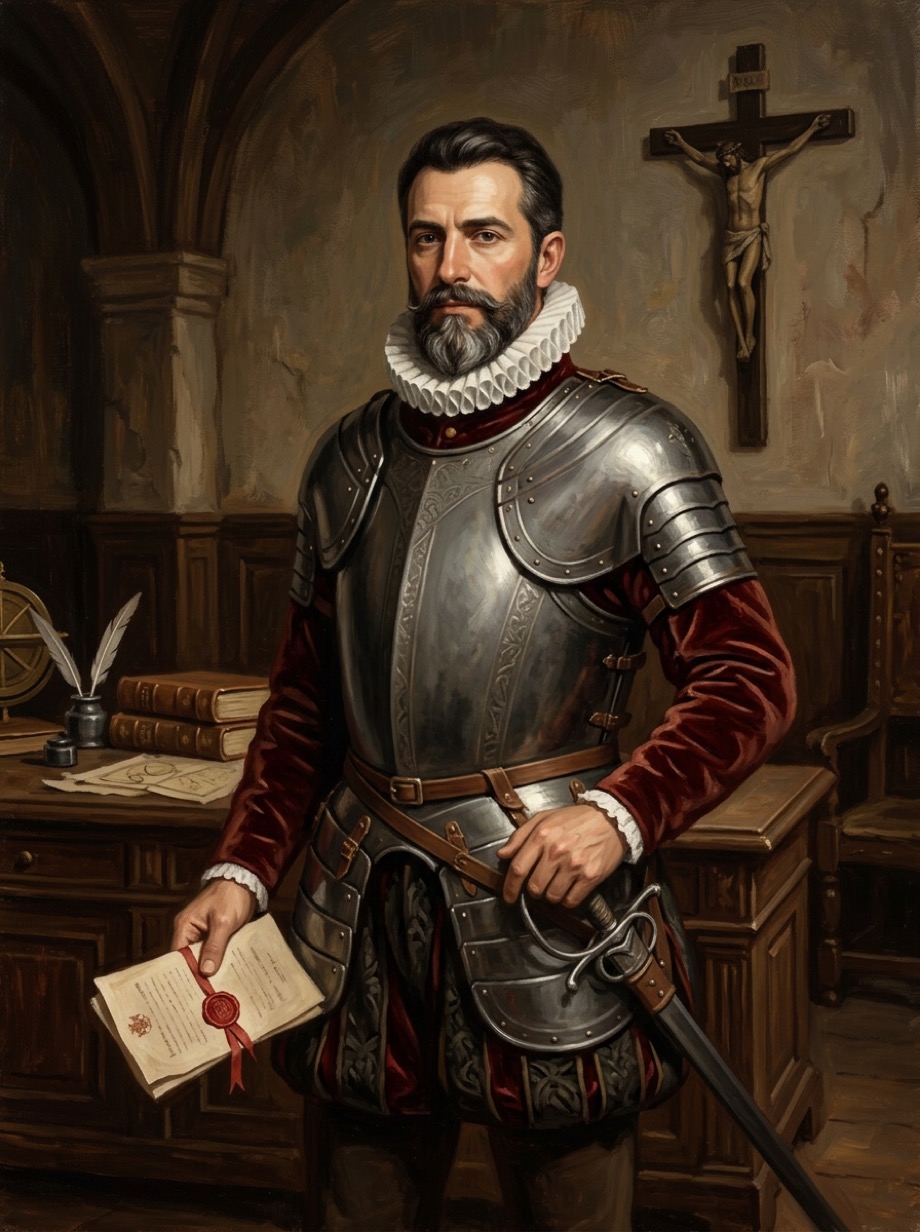
AI-assisted Portrait of Hernando Pizarro
The Brother Who Could Read
Of the four Pizarro brothers who sailed for Peru, only one was born in wedlock, and only one had been given an education. Hernando Pizarro was both. Where Francisco could not sign his own name, Hernando had been raised at Trujillo with the schooling and legal grounding his half-brother never received, and it was that single fact — literacy, and the standing it carried in a world built on notarized claims and royal petitions — that made him indispensable. Francisco supplied the will and the nerve to conquer an empire; Hernando supplied the apparatus that let a conquest survive contact with the Spanish state.
He is easy to underrate precisely because his contributions were procedural rather than visionary. It was Hernando who carried the Crown's share of Atahualpa's ransom back across the Atlantic and placed it, personally, before Charles V — an errand that converted a windfall of Inca gold into permanent royal favor for the family enterprise. It was Hernando who commanded the field at Las Salinas in 1538 and who bears direct responsibility for the execution of Diego de Almagro afterward, a decision made with the same flat, administrative certainty he brought to every other piece of unfinished business. And it was Hernando — alone among the four brothers — who died old, in bed, in Spain, having outlasted a war, a rebellion, and two decades of royal imprisonment that would have broken a lesser operator entirely.
Hernando Pizarro was the family's ESTJ: the one who took command in person, closed every account, and never once let the system intimidate him into deference.
The Family's Chief Executive
Every family enterprise needs someone to run its external relations, and among the Pizarros that someone was always Hernando. He negotiated with the Crown directly rather than through intermediaries, understood which documents needed to exist and in what form, and treated the machinery of Spanish royal bureaucracy not as an obstacle to conquest but as a tool to be operated with the same competence he brought to a battlefield. Carrying Atahualpa's ransom gold to Charles V in person was not a courier's errand — it was Hernando recognizing, correctly, that the family's long-term position depended on converting a military fact into a legal one, sealed by royal audience.
That same executive clarity governed Las Salinas. Hernando commanded the Pizarro forces against Almagro not as a subordinate carrying out Francisco's wishes but as the man making the call, and when Almagro was captured, Hernando ordered his execution with no visible agonizing over the consequences. It was a decision built entirely on present necessity — Almagro alive was a permanent rival claim to Peru's wealth and governance; Almagro dead was a closed account — and Hernando made it the way he made every other decision: quickly, on his own authority, and in a way that assumed the outcome would settle the matter for good. It did not, of course; it detonated a feud that killed Francisco three years later. But that failure of foresight is itself diagnostic. Hernando's Te is a function of execution and closure, not of long-range strategic modeling — he solves the problem directly in front of him and trusts the structure he has built to absorb what comes next.
Twenty Years, Played by the Rules
The clearest evidence for Hernando's Si sits not in his conquests but in his imprisonment. When the Crown, wary of an overmighty conquistador dynasty and holding him responsible for Almagro's death, locked him away in Spain for roughly two decades, Hernando did not rebel against the system that had jailed him. He had spent his whole career deriving his authority from that system's recognition — his legitimacy of birth, his literacy, his standing before Charles V — and he answered captivity the same way he had answered every other constraint: by working within established form rather than against it, waiting out the sentence rather than scheming to overturn the order that imposed it.
That same instinct for precedent and legitimate structure shows in how he secured the family fortune once released. Rather than gamble on a new venture, he married his own niece, Francisca Pizarro — Francisco's mestiza daughter — a transaction as unromantic and procedural as everything else he did, designed purely to keep Peru's wealth inside a legally unambiguous line of inheritance. It is the same mind that carried gold to a king rather than simply keeping it: an auxiliary Si that trusts documented, sanctioned continuity over improvisation, even when improvisation might have been faster.
Reading the Angles
Hernando's tertiary Ne shows up not as invention but as an eye for the angle nobody else in the family had the education to see — which royal officials mattered, which arguments would land at court, which move would leave the Pizarro claim strongest against the Crown's natural suspicion of it. It is a narrow, opportunistic possibility-sense rather than a broad one, deployed almost exclusively in service of consolidating what Te had already secured.
The Absent Hesitation
What is most striking about Hernando is how rarely his inferior Fi surfaces at all. The Almagro execution is the obvious test: a man with stronger access to personal values-based reasoning might have paused over killing a former partner, or at least left some record of private reckoning with it. Hernando left none. His inferior Fi appears mainly as blind spots rather than presence — an inability to anticipate how the Almagro faction's grief and rage would curdle into the conspiracy that killed Francisco, and a lifelong tone-deafness to how his own severity read to the men he governed.
Why ESTJ Over ISTJ
Why not ISTJ?
Hernando is disciplined, procedural, and deeply respectful of legitimate authority — traits that make an ISTJ misread tempting. But an ISTJ's Si-Te stack tends toward the background operator, the meticulous administrator who executes within a role rather than seizing command of it, closer to a figure like Chalcuchimac on the Inca side of this same conquest. Hernando never occupies that lane. He personally commands armies at Las Salinas, personally negotiates with a king, and personally orders an execution — visible, assertive, dominant-function Te, not an introverted judger's quiet competence operating one level below the top.
The distinction is less about temperament than about where the authority sits. An ISTJ derives confidence from mastering a system already in place; Hernando derives it from standing at the head of one and being willing to make the system's hardest calls himself. That is Te in the driver's seat, with Si as the loyal second — not the reverse.
Connected Figures
Further Reading
- Francisco Pizarro and His Brothers: The Illusion of Power in Sixteenth-Century Peru — Rafael Varón GabaiThe essential study of the Pizarro brothers as a family enterprise.
- The Conquest of the Incas — John HemmingThe standard narrative account, covering Hernando's role at Las Salinas and after.
- The Men of Cajamarca — James LockhartA study of the original conquest party, including the Pizarro brothers.
