 Historical Figure MBTI
#772 · 6-9-26 · The Conquest of the Andes
Diego de Almagro
The Men of Chile's Foundling General
c. 1475 — 1538
7 min read
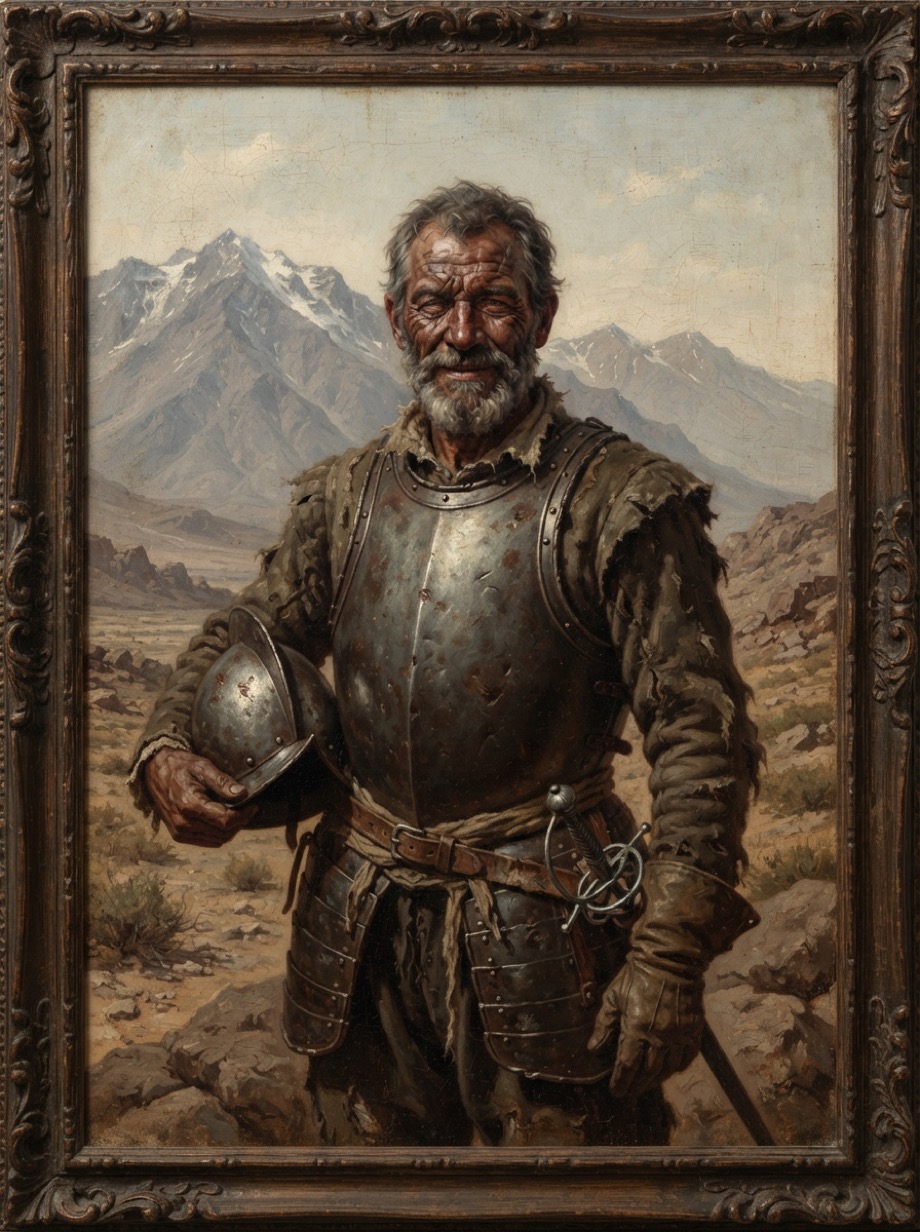
AI-assisted Portrait of Diego de Almagro
The Man Who Gave Away Peru
He began with nothing that could be written down. No parentage, no birthplace anyone bothered to record, no name but the one he took from the town where he was abandoned. Somewhere in the violent apprenticeship of the early Indies he lost an eye. By the time Diego de Almagro appears in the documents he is middle-aged, scarred, and already the kind of man other men follow — and the documents cannot explain why, because the quality that made him formidable was warmth. He was the conquistador the soldiers loved.
That love was earned in the plainest currency available: Almagro gave things away. Gold, horses, encomiendas, the whole gleaming take of a campaign went out to the men who had bled for it, habitually enough that chroniclers who agreed on nothing else agreed on this. Francisco Pizarro hoarded and calculated; Almagro spent. Through the ruinous years of failed voyages south from Panama it was Almagro who stayed behind to raise money, buy ships and sail reinforcements down to a starving Pizarro on some fever coast — the enterprise's supply line and its morale — and he never seems to have thought of that as the lesser half until a piece of paper told him it was.
That paper, the capitulación de Toledo, gave Pizarro the rich north and Cusco and gave Almagro a poorer south he had not asked for. Everything after it — the death march through the Atacama, the seizure of Cusco, the scaffold at Las Salinas — follows from his experiencing a contractual clause as a personal betrayal and never afterward holding it at any other distance. He is this archive's first honest ESFP, and a deferred correction: the previous Age of Exploration cluster closed with none at all, because the nearest candidate, Anacaona, would have had to be bent to fit. Almagro requires no bending.
An ESFP dominated by Se and steered by Fi: a man who lived in the vivid present, gave away everything he seized, and could only understand a broken contract as a wound.
Se — The Body in the Desert
Almagro's competence was physical and immediate. He did not theorize the route to Peru; he sailed it, repeatedly, into disaster and back out again, absorbing each failure as a fact about the coast rather than a refutation of the plan — provisions found, hulls repaired, men talked back aboard, an eye lost somewhere in the process. His instrument for solving problems was presence. Where he stood, things moved.
The Chilean expedition is that instinct at full, catastrophic extension. He took a great column south over the Andes and into the Atacama, and made the crossing with his men rather than behind them; horses froze in the passes, soldiers died of thirst on the salt flats, and the march produced no second Peru and no gold at all. Its only durable product was a body of survivors who called themselves the men of Chile and loved him for having suffered it beside them.
It explains his final gamble, too. When he decided Cusco was his, he did not send lawyers to Spain to argue the boundary language — he walked in and took the city from Pizarro's brothers, because for a Se dominant the decisive fact about a place is who is standing in it. That instinct won him Cusco in an afternoon and lost him everything within a year.
Fi — The Ledger He Refused to Keep
Generosity of Almagro's kind is not a policy. A calculating commander buys loyalty in measured doses and keeps a reserve; Almagro simply did not experience accumulated wealth as valuable, and the men who took from his hand understood the difference between a bribe and a temperament. That is why the men of Chile followed him into the Atacama and back out again to storm Cusco, and why his son would later kill Pizarro to avenge him. He had built the one asset Pizarro never held: a faction bound by affection.
And it is Fi that made the Toledo capitulación unbearable. Legally the document was defensible — the Crown had granted the richer half to the man who led the discovery. Almagro's objection was never legal. It was that he had put in as much and more, and that a fair accounting of what a man deserves does not care which partner happened to be standing on the beach. He held this as a private conviction rather than an argument, which is exactly why it could not be negotiated away.
Both halves came from one source. The warmth that made him beloved and the grievance that destroyed him were the same function: a private, unarguable sense of what was owed — generously discharged when he owed it, mortally nursed when he was owed. He gave Peru away and could not forgive being cheated of it.
Te — The Quartermaster of the South Sea
Almagro was not disorganized. For most of a decade he ran the logistical arm of a private conquest company: credit raised in Panama, ships fitted, crews signed, cargoes timed to reach a starving fleet on an unmapped coast. That is real Te, and it kept alive an enterprise that should have collapsed after its second failure.
But tertiary Te serves the present objective; it does not police the long-term structure of the deal. Almagro executed brilliantly and contracted carelessly. He let Pizarro carry the negotiation to Spain and accepted a division of the spoils drafted by other men, in boundary language vague enough that its interpretation would eventually be settled by cannon — and when the Te did surface under pressure, it surfaced as blunt instrumentality rather than strategy: take the city, hold the passes, put Hernando Pizarro in irons and then, disastrously, let him go. He could organize an army and could not construct a settlement.
Ni — The Second Peru That Was Not There
Inferior Ni does not produce foresight; it produces conviction. Almagro went south because he had seized on a single image — another Cusco, another mountain of gold, waiting past the Andes — and once the image had him he pursued it against every signal the ground was giving him. There was no evidence for a rich Chilean kingdom. There was a vision, and a man temperamentally unable to examine a vision from outside it.
The same blindness governs his return. He came back believing the grievance would resolve itself once he acted on it — that holding Cusco would settle the question, that the Crown would ratify what he held, that Hernando Pizarro released would behave like a man shown mercy. Each is a failure to model a future in which other people are also calculating, and Pizarro was calculating the entire time. So the end surprised no one but him: defeated at Las Salinas in 1538 and garroted in the city he had crossed a desert to claim, the old foundling died still certain of the justice of his case — which was, in a sense, the only thing he ever owned.
Why ESFP Over ESTP
Why not ESTP?
The temptation is obvious: a bold, physical, front-line conquistador who solved problems by moving his body at them. But an ESTP's Ti-Fe axis produces detached tactical opportunism — advantage weighed coolly, alliances taken up and dropped as the board changes, grievance set aside once grievance stops paying. Almagro does the opposite at every decision point: into the Atacama on a hunch rather than an angle, into Cusco out of wounded honor rather than timing, and releasing Hernando Pizarro, the one hostage worth holding, because his reasoning about people ran through feeling rather than leverage. And no Ti user gives away the spoils.
What settles it is the quality of his anger. An ESTP cheated by a contract renegotiates, litigates, or takes what he can hold and moves to the next opportunity. Almagro carried the capitulación de Toledo as an injury and organized the rest of his life around it — Fi, not Ti, sitting behind the Se. Read that way the arc coheres: the immediacy, the physical courage, the devotion he inspired and returned, and the single unappealable private verdict about fairness that he took to the garrote.
Connected Figures
Further Reading
- The Conquest of the Incas — John HemmingThe standard modern narrative — the fullest account of the Pizarro–Almagro partnership and its rupture.
- Spanish Peru, 1532–1560: A Social History — James LockhartThe social world of the early conquest, including who Almagro's followers actually were.
- History of the Conquest of Peru — William H. PrescottThe classic nineteenth-century treatment; still the most vivid telling of the Chilean march and Las Salinas.
- Francisco Pizarro and His Brothers — Rafael Varón GabaiThe rivalry reconstructed from the Pizarro family's business records and their side of the quarrel.
