 Historical Figure MBTI
#779 · 6-10-26 · The Conquest of the Andes
Diego de Almagro el Mozo
Killed Pizarro for His Father
c. 1520 — 1542
6 min read
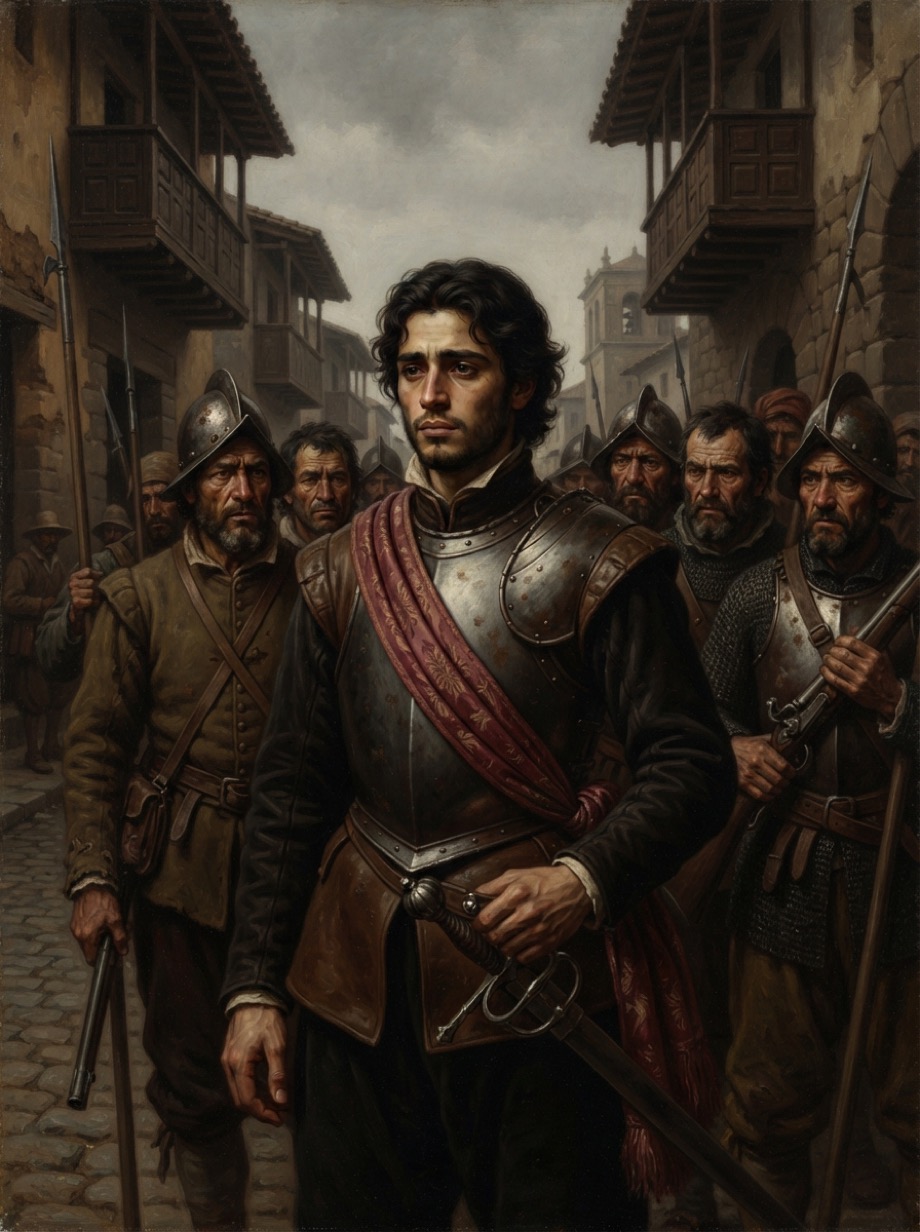
AI-assisted Portrait of Diego de Almagro el Mozo
The Son Who Was Made a Sword
He was perhaps twenty years old when a knot of armed men burst into Francisco Pizarro's palace in Lima, cut down the conqueror of the Inca Empire in his own hall, and then went looking for someone to put in his place. They found Diego de Almagro el Mozo — young, mestizo, the son of the man Pizarro's brother had strangled in a prison cell three years before — and they proclaimed him governor of Peru. He had not planned the assassination. He may not even have fully understood, in that first hour, what he had just inherited.
What he understood was narrower and older than politics: his father had been humiliated, tried in a sham proceeding, and executed on Hernando Pizarro's order in 1538, and the men who had loved the elder Almagro — the ragged, half-forgotten veterans of the Chile expedition, men with nothing left to lose — never stopped waiting for the reckoning. When it came, in June 1541, it came in Almagro el Mozo's name, whether or not it came by his hand. He wore the office for less than a year. At Chupas in September 1542, the royal governor's forces broke the men of Chile, and Almagro el Mozo was captured and beheaded in Cuzco, not yet twenty-three.
He was not a strategist avenging a cause. He was a son avenging a father — and everything about his short, doomed governorship reads as an ISFP acting on a single, unshakable loyalty rather than an idea.
A Grievance He Did Not Argue, Only Carried
What's striking about Almagro el Mozo is how little ideology attaches to his cause. He never articulates, in any surviving record, a theory of why the Almagro faction deserved Peru more than the Pizarro faction, or a vision of how the colony should be governed differently under him. His claim to power is entirely genealogical and emotional: his father was wronged, his father was killed, and the men who had served his father wanted the debt paid. That is Fi in its rawest political form — a moral compass calibrated not to abstract justice but to a specific, irreplaceable person.
It is worth noticing what he didn't do with the year of power the assassination handed him. A more externally-driven operator would have moved immediately to consolidate legitimacy — courting the Crown, building alliances beyond the Chile veterans, manufacturing a broader case for his rule. Almagro el Mozo did none of this convincingly. He stayed inside the loyalty that had made him governor in the first place, surrounded by his father's old soldiers, because that loyalty was the entire point. The office was incidental; the vindication was the substance.
Even his complicity in the killing reads this way. Almagro el Mozo did not personally strike Pizarro down, and there is no strong evidence he orchestrated the plot from the start — but he also never repudiated it, never tried to distance his name from the men who carried it out in his father's honor. He let the act stand as his own because, in the register that mattered to him, it was his own. Fi doesn't require authorship of the plan to claim ownership of the value being defended.
Governing by Presence, Not by Plan
Once installed as governor, Almagro el Mozo governed the only way the situation gave him time to: by showing up, arms in hand, wherever the fight was. He rode with his men to Chupas rather than holding Cuzco and waiting the royal governor out; when the battle turned against him he stayed in it rather than slipping away to fight another day from safer ground. This is Se doing what it does under pressure — meeting the moment physically and immediately, trusting the body and the terrain over a longer calculation of odds.
It also explains how quickly the whole venture collapsed. A year is not enough time to build durable political power from nothing, and Almagro el Mozo never tried to buy more of it through negotiation or delay. He met Vaca de Castro's royal forces in open battle at Chupas rather than maneuvering for a settlement, and when his artillery and cavalry were routed, the war for Peru was over in an afternoon. Se without a stronger long-range function behind it wins skirmishes and loses campaigns.
Why ISFP Over ENFP
Why not ENFP?
It is tempting to read a young man swept into a revenge plot and a doomed cause as an ENFP — passionate, idealistic, drawn along by the romance of the mission. But that reading requires an expansiveness that Almagro el Mozo never shows. An ENFP avenging a father would tend to reframe the act in bigger terms — as a cause, a movement, a wrong done to a whole faction of dispossessed men, argued outward and upward. Almagro el Mozo never generalizes his grievance. It stays exactly the size of his father's death, felt privately and acted on directly, with no larger vision offered for what Peru should become once the debt was paid.
The distinction matters because it's the difference between a cause and a loyalty. ENFP energy widens a personal wound into a shared story others can join for their own reasons. ISFP energy keeps the wound personal even while other people are dying for it — the men of Chile followed Almagro el Mozo because they had loved his father, not because he gave them a new idea to believe in. He was never trying to persuade anyone of anything. He was simply not going to let his father's killer go unanswered, and everything else about his brief life as governor was downstream of that single, unargued fact.
Connected Figures
Further Reading
- The Conquest of the Incas — John HemmingThe standard narrative covering Pizarro's assassination and the Battle of Chupas.
- Francisco Pizarro and His Brothers — Rafael Varón GabaiOn the Pizarro–Almagro feud across two generations.
- Spanish Peru, 1532–1560: A Social History — James LockhartOn the 'men of Chile' faction and the post-assassination civil war.
