 Historical Figure MBTI
#782 · 6-10-26 · The Conquest of the Andes
Francisco de Carvajal
The Demon of the Andes
c. 1464 — 1548
9 min read
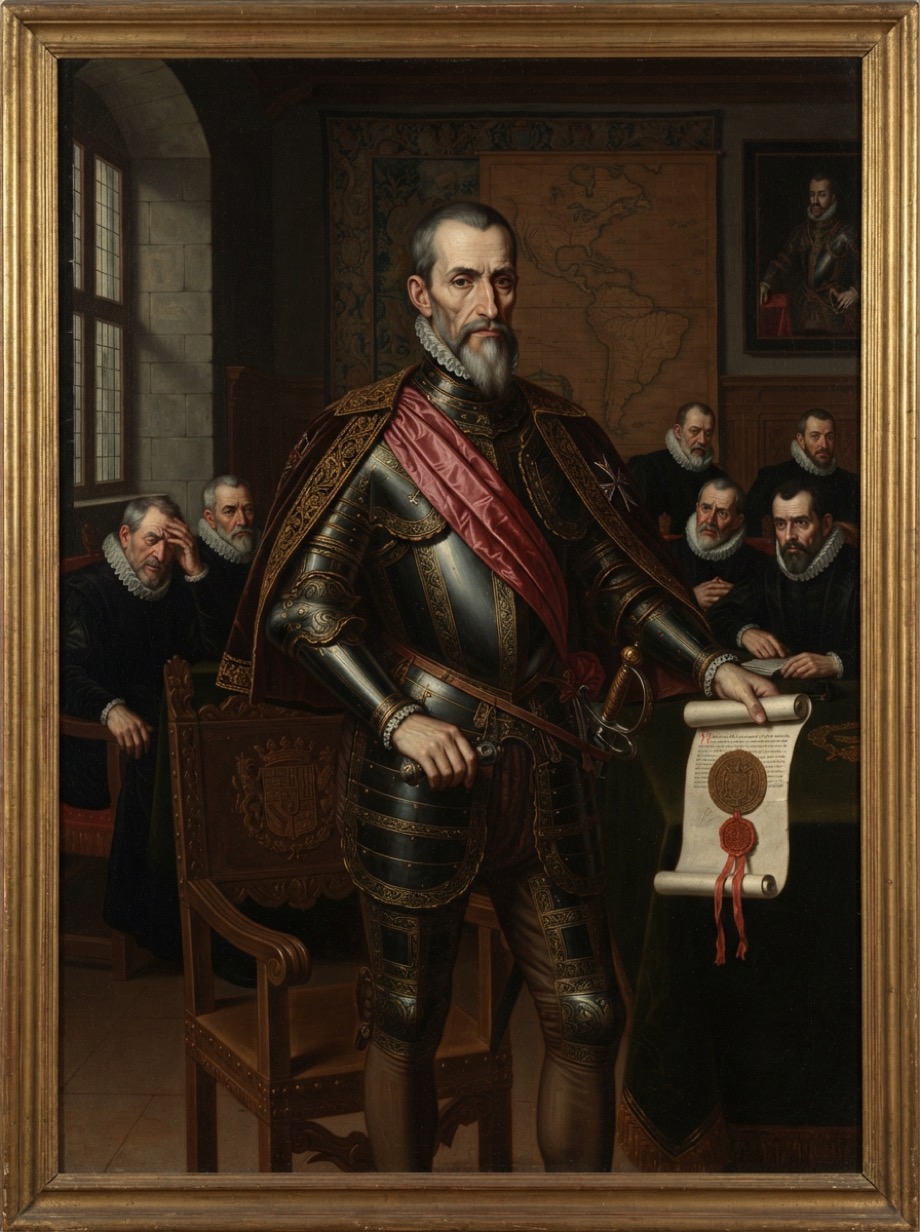
AI-assisted Portrait of Francisco de Carvajal
The Man Who Made Jokes at the Gallows
He was eighty when he took the field for the last time, and he was still funny. That is the fact about Francisco de Carvajal that survives every retelling, every hostile chronicle, every attempt to reduce him to a monster: the hangings came with punchlines. He would order a man strung up and then, while the rope was being thrown over the branch, offer a couplet about it — an improvised verse on the condemned man’s cowardice, his debts, his taste in horses, his sudden new career as fruit. Chroniclers who despised him could not stop recording what he said. The wit outlived the corpses, which is exactly the sort of joke he would have appreciated.
Almost everything about him is out of scale with the world he ended up in. The conquistadors of Peru were, by and large, gifted amateurs: swineherds and notaries and second sons who had learned war by doing it, brilliantly, against opponents who had never seen a horse. Carvajal was something else entirely. He had spent roughly thirty years in the Italian Wars — the hard European school of pike squares, arquebus lines, siege logistics and the slow professional arithmetic of supply — before he ever crossed the Atlantic. He arrived in the New World a man in his sixties, with a career behind him that most of his new colleagues could not have imagined, and he proceeded to spend his ninth decade as the most feared field commander on the continent.
When Charles V’s New Laws threatened to dissolve the encomienda system and with it the entire private empire the conquerors had built for themselves, Gonzalo Pizarro rose in rebellion, and Carvajal became his maestre de campo — the rebellion’s actual military brain. He built the columns, chose the ground, kept the arquebusiers supplied, ran the terror. He was the reason a provincial revolt of resentful settlers came within a hair of detaching Peru from Spain. And he did all of it in a running commentary, treating each atrocity, each betrayal, each collapse of fortune as fresh material.
Carvajal is the archive’s purest case of ENTP cruelty: a dominant Ne that could not stop reframing, improvising and riffing — and turned an execution yard into a stage because that was simply how the mind worked on whatever was in front of it.
Ne — The Running Commentary
The defining Carvajal anecdote is not a battle. It is a man being led to a rope while the old soldier who condemned him composes verses about the occasion. He rhymed at executions. He gave nicknames to the men he was about to kill. He greeted deserters returning to camp with mock ceremonial courtesy and then hanged them with a line about hospitality. Told that a captured officer had begged for mercy in the name of his many children, he is supposed to have observed that the man should have thought of them earlier — and to have turned even that into a small performance. The material was never the point; the improvisation was. Anything placed in front of him — a corpse, a rout, a rumour, a sacrament — immediately generated an alternate reading, a pun, an inversion.
That is dominant extraverted intuition doing what it does, running at full speed in a context that makes it monstrous. Ne is not a moral faculty. It is a generator of possibility and recombination, a compulsion to see the second meaning inside the first one, and in most people it produces jokes, inventions, arguments and restless career changes. In Carvajal it produced all of that too — he was famously inventive tactically, improvising ambushes, forced marches and river crossings that his opponents did not believe were possible — but it also meant that violence arrived pre-narrated. He was never simply inside an event. He was always half a step outside it, watching it happen and remarking on it.
This is what separates him from the ordinary cruel captain of the period, of whom there were many. Cruelty in Pedrarias Dávila is bureaucratic; cruelty in Quizquiz or Rumiñahui is strategic; cruelty in Almagro el Mozo is aggrieved. Carvajal’s is compositional. He treated the killing of human beings as an occasion requiring a good line, and he almost always had one. The wit was not a coping device layered over the horror. It was the same motion of mind that made him a superb tactician, pointed at people instead of terrain.
Ti — The Cold Arithmetic Underneath
Strip the jokes away and what remains is a machine for working out what actually has to happen. Carvajal was the only genuinely professional soldier in the Peruvian civil wars, and he behaved like one: he understood that arquebusiers were the decisive arm and organised his forces around them; he understood powder, shot, drill and the tedium of supply in a way the encomendero cavaliers around him did not; he understood that a rebellion is won by preventing defection, not by winning skirmishes. His terror was not indiscriminate. It was aimed with unpleasant precision at the specific mechanism that could destroy Gonzalo Pizarro, which was the slow leakage of men back to the Crown.
Introverted thinking is the auxiliary here because his judgements are internal, ruthless and indifferent to received frameworks. He did not appear to hold, or need, a theory of legitimacy. When the rebellion was going well he told Gonzalo the logically clean thing: stop pretending. Declare yourself king of Peru, marry into the Inca line, take the Andes as a sovereign realm, and abandon the fiction that this was a loyal protest against bad legislation. It was outrageous advice and it was also correct — a half-rebellion against Charles V was the one posture guaranteed to fail, because it left every soldier a legal road back to obedience. Gonzalo could not do it. Carvajal saw the structure of the problem exactly and was ignored.
The same detachment explains his handling of Blasco Núñez Vela, the viceroy sent to enforce the New Laws. To Carvajal the viceroy was not a sacred person or a symbol of the king’s body; he was a variable to be removed, and at Añaquito the campaign Carvajal had shaped removed him. Everyone else in Peru felt the vertigo of having killed a viceroy. Carvajal, so far as any chronicler can tell, felt the mild satisfaction of a problem correctly solved, and said something amusing about it.
Fe — The Audience He Never Stopped Playing To
A man who jokes needs listeners, and the tertiary extraverted feeling in Carvajal shows up as an acute, entirely instrumental sense of the room. He knew precisely how to work a camp. The verses at the gallows were not muttered to himself; they were delivered, and they did a job — they told several hundred watching soldiers that the old man found their terror amusing, that nothing they might attempt would rattle him, and that the safest place in Peru was standing beside him rather than opposite him. Fear and laughter were the same instrument in his hands. Troops who would not have followed a merely savage commander followed a savage commander who was entertaining.
He was also, in his blunt way, loyal — and loyalty is where tertiary Fe tends to sit in an ENTP: not as empathy but as attachment to a particular person and a particular banner, held past the point where the reasoning supports it. He had served the Pizarros since Francisco Pizarro’s day, and when Gonzalo rejected the crown he was offered, Carvajal did not defect, did not hedge, did not open a private line to the royalists as half of Peru was doing. He stayed with a losing cause he had personally diagnosed as losing.
What was missing was the other half of Fe — any felt participation in other people’s suffering. He could read an audience perfectly and move it at will, and appears never to have been moved by it in return. That combination, high social fluency with zero resonance, is what produced the nickname. The Demon of the Andes was not a man who lost control. He was a man who was excellent company right up to the moment he had you hanged, and excellent company again immediately afterwards.
Si — Thirty Years of Italy, Carried in the Body
The inferior function of an ENTP is introverted sensing, and it usually appears as an unglamorous private hoard: a set of remembered particulars that the restless mind returns to as bedrock. Carvajal’s hoard was the Italian Wars. Three decades of European campaigning had left him with an internal library of how things actually go — how far infantry marches before it stops being infantry, how much powder a company burns, how a square breaks, what a wavering line looks like an hour before it breaks. Against opponents improvising from a decade of colonial fighting, that stored catalogue was nearly unanswerable, and it is the reason a man in his eighties out-generalled everyone sent against him.
Inferior Si also shows in the grip it had on him. The habits were fixed and lifelong: the same trade, the same tactical vocabulary, the same rough soldier’s persona maintained for sixty years without visible development. He never became a governor, never accumulated a great estate, never converted his position into the settled gentility that every other conquistador in Peru was frantically chasing. Where Gonzalo wanted to be a lord and Hernando wanted to be respectable, Carvajal appears to have wanted only to keep doing the thing he had always done, at an age when doing it at all was absurd.
And it is the weak point that killed him. Si is also the function of consequence and accumulation — of noticing that the ground has shifted, that this campaign is not the previous one, that a lifetime’s method has an expiry date. Carvajal read every tactical situation correctly and misread the largest fact of all: that the war would not be settled by soldiers. He was still solving for the battlefield when the battlefield stopped being where the answer lived.
Why ENTP Over ESTP
Why not ESTP?
The ESTP reading is genuinely tempting, and it is the one most readers reach for: here is a battle-hardened field commander of eighty, physically fearless, reading terrain by instinct, thriving on danger, morally unbothered. That is a recognisable Se-Ti profile, and half of Carvajal fits it. But an ESTP’s signature is direct engagement — the commander who is fully inside the moment, responding to what is physically in front of him, and whose humour is situational rather than constant. Carvajal’s signature is the opposite: he is never fully inside the moment, because part of him is always narrating it. The compulsive verbal reframing — the rhymes, the nicknames, the mock courtesies, the running gloss on his own executions and finally on his own dismemberment — is Ne-Ti recombination, not Se immediacy. Se registers what is; Ne cannot stop producing what else it could be called.
The distinction matters because it changes what kind of monster he was. Read as an ESTP, Carvajal is a brute with a talent for war and a nasty sense of humour — the humour incidental, a garnish on the violence. Read as an ENTP, the humour is structural: the same faculty that generated the ambush generated the couplet, and both came from a mind that treated every situation, including catastrophic and lethal ones, as raw material for improvisation. That is why the jokes never stopped when his own fortunes collapsed. At Jaquijahuana, watching Gonzalo’s army walk over to Pedro de la Gasca without a fight, he is said to have hummed a ballad about a shepherd whose flock had wandered off. Captured, dragged in a basket because he could no longer sit a horse, sentenced to be drawn and quartered at eighty-four, he went on making remarks. Bloodthirstiness does not survive that kind of reversal. A cognitive habit does.
Connected Figures
Further Reading
- The Conquest of the Incas — John HemmingThe standard narrative of the conquest and its aftermath, including the New Laws rebellion and Carvajal's role in it.
- Spanish Peru, 1532–1560: A Social History — James LockhartSocial-historical anatomy of the settler world that rebelled — who these men were and what the encomienda meant to them.
- The Last Days of the Incas — Kim MacQuarrieAccessible narrative treatment, vivid on Carvajal's reputation and the collapse at Jaquijahuana.
- Francisco Pizarro and His Brothers: The Illusion of Power in Sixteenth-Century Peru — Rafael Varón GabaiThe Pizarro family enterprise and the economics behind the conquistador civil wars.
