 Historical Figure MBTI
#781 · 6-10-26 · The Conquest of the Andes
Blasco Núñez Vela
The Viceroy Too Rigid to Bend
c. 1490 — 1546
8 min read
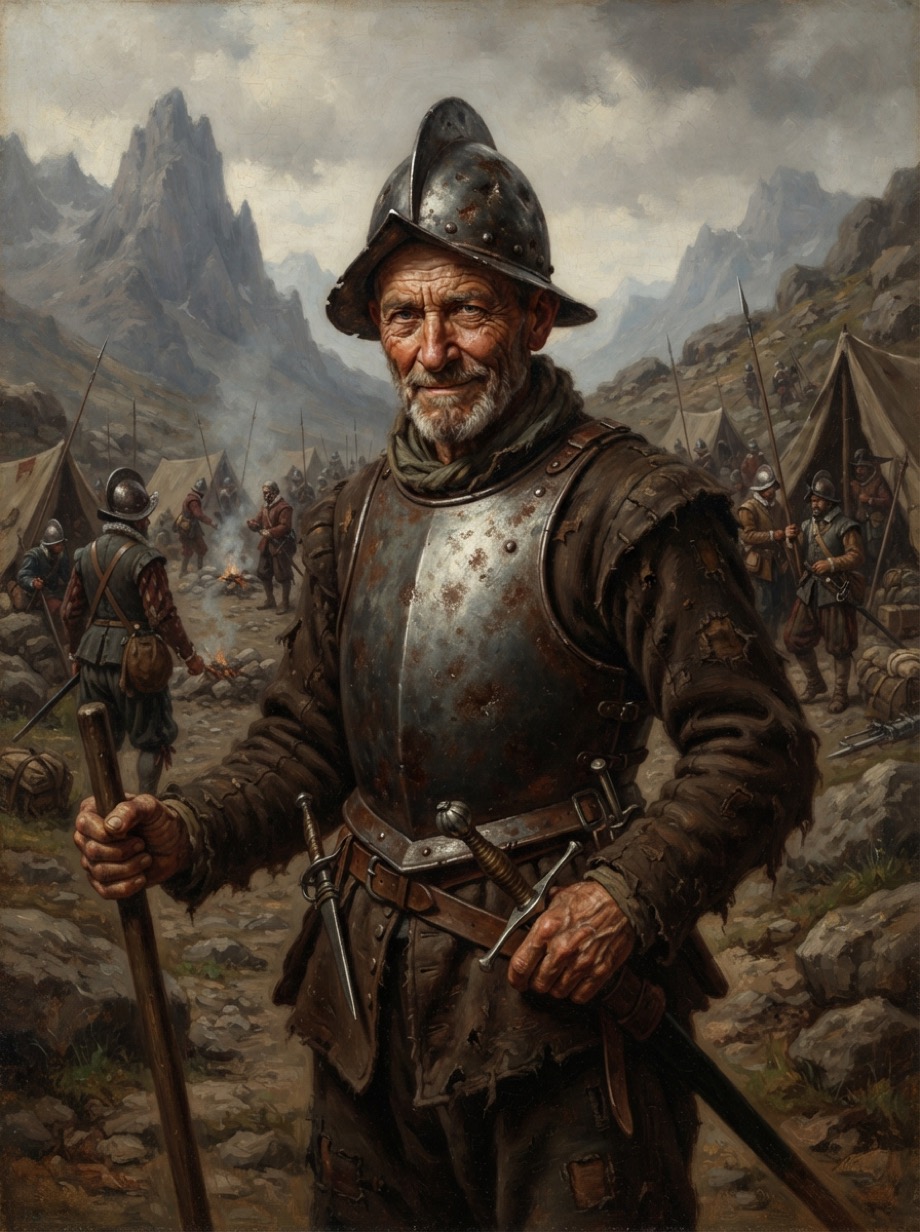
AI-assisted Portrait of Blasco Núñez Vela
The Letter of the Law, and Nothing Else
In 1544, Blasco Núñez Vela stepped off a ship at Tumbes carrying a royal commission and a document that no one in Peru wanted enforced: the New Laws of 1542, Charles V's attempt — pushed hard by the friar Bartolomé de las Casas — to phase out the hereditary encomienda, the forced-labor grant on which every conquistador fortune in the Andes was built. Núñez Vela was the Crown's first viceroy of Peru, and he had been sent, in effect, to dismantle the economic foundation of the very colonial elite he was meant to govern. He read this as a straightforward assignment: the king had written a law, and the law was to be carried out. Nothing in the eighteen months that followed suggests he ever seriously entertained another way of reading it.
That single-mindedness is the whole story. Every advisor around him — the audiencia judges sent to counsel him, the encomenderos who begged for a phased transition, even his own allies — urged some accommodation with reality: suspend enforcement, write to Spain, buy time. Núñez Vela refused, publicly and repeatedly, and pressed forward with a literalism that had no political instinct in it at all. When a royal factor named Illán Suárez de Carvajal argued with him inside his own palace, the viceroy did not out-argue him or dismiss him — he stabbed him to death with his own hand. It was the act of a man for whom deviation from what he understood to be correct was not merely wrong but somehow unbearable, and it cost him nearly all the authority he had left. Within months the audiencia itself, the body meant to serve him, arrested its own viceroy and shipped him toward Panama. He fought his way back to Peru, rallied a loyalist army, and in January 1546 was killed and beheaded on the field at Añaquito by the rebel forces of Gonzalo Pizarro — his head reportedly set on a pike as the final judgment on his refusal to bend.
Núñez Vela is ISTJ in its most unyielding register — a dominant Si so absolute that the written instruction becomes the only reality worth acting on, no matter what it costs him.
The Text as the Only Fact That Matters
Dominant Si in Núñez Vela shows up as a near-total identification with the document itself. The New Laws were not, for him, a policy with a purpose to be judged against outcomes — they were a fixed and settled precedent, issued by legitimate authority, and therefore not subject to renegotiation by anyone standing in front of him in Lima. Where a more adaptive administrator might have treated the law as a target to be approached gradually, Núñez Vela treated it as a fact already established, something to be implemented rather than interpreted. That is the Si signature: reality is what was written down and ratified, not what the room is telling you.
This is also why negotiation read to him not as prudence but as betrayal. The colonial elite's pleas for a transition period, the audiencia's warnings that rigid enforcement would trigger rebellion, Gonzalo Pizarro's open defiance — none of it functioned, in his mind, as new information that should update the plan. It functioned as noise to be endured until the correct, already-known course could be completed. Even after the audiencia deposed him and the rebellion metastasized into open war, his response was not to reconsider the law but to try to enforce it by other means — raising a loyalist force and marching back toward Quito. The instruction from Charles V remained, in his own accounting, the only thing that had ever actually happened.
Enforcement Without Persuasion
Auxiliary Te is what turned Núñez Vela's fidelity to the text into action rather than mere conviction. He did not simply believe the New Laws were correct — he moved immediately and concretely to implement them: seizing encomiendas, freeing indigenous laborers held in violation of the statute, refusing to soften the rollout even for men who had personally fought to win Peru for the Crown. That is Te doing what it does — converting a settled premise into visible, structural change in the world, briskly and without much interest in the emotional cost to the people on the receiving end.
But it is Te stripped of the political calibration that makes it effective in a crisis. He commanded, but he did not build consent; he issued orders, but he did not build a coalition capable of surviving contact with an armed uprising. And when the machinery of enforcement met a human being who argued back — Illán Suárez de Carvajal, inside the viceroy's own chambers — the Te impulse to force the outcome did not stop at rhetoric. It became a blade. That killing is the auxiliary function at its most exposed: the drive to make the world match the directive, with no remaining check on how far that drive was permitted to go.
A Conviction That Could Not Be Argued Out of Him
Under the visible enforcement machinery sat a tertiary Fi that gave the whole campaign its moral temperature. Núñez Vela was not merely following orders the way a careerist bureaucrat might, hedging and covering himself as the ground shifted beneath him. He appears to have genuinely believed the New Laws were right — that the encomienda's cruelties toward the indigenous population were an injustice the Crown was obligated to end — and that private, interior certainty is what kept him marching forward long after every external signal told him to stop. It also explains why compromise felt to him like a moral failure rather than a tactical adjustment: to soften the law would have meant betraying something he held as personally, not just officially, correct.
That is also the crack through which the violence came. Tertiary Fi, under enough pressure, does not negotiate with an insult to its own convictions — it reacts. Suárez de Carvajal's challenge inside the audiencia chambers was not simply an administrative disagreement; it was, in the moment, an affront to a certainty Núñez Vela could not set aside. The stabbing scandalized his own supporters precisely because it read as personal rather than political — a man defending something inward, not merely enforcing a policy.
Why ISTJ Over ESTJ
Why not ESTJ?
ESTJ is the tempting label because Núñez Vela was undeniably forceful, commanding, and willing to impose his authority against fierce resistance. But an ESTJ pattern would typically pair that force with pragmatic flexibility about method — extraordinary command style is Te-dominant precisely because it reads the room and adjusts tactics while holding the objective fixed. Núñez Vela did the opposite: he held the method as fixed as the objective, refused every offered adjustment from his own advisory council, and alienated the very body meant to help him govern. That is Si leading Te, not Te leading Si — a man enforcing the letter because the letter was sacred, not commanding a room because command was natural to him.
The clearest tell is the audiencia's revolt against its own viceroy. An ESTJ under siege typically tightens command and rallies subordinates around a pragmatic plan; Núñez Vela instead drove away the officials who were supposed to be extensions of his authority, because he would not treat their counsel as anything but obstruction. The stabbing seals it — an act with no strategic value whatsoever, born entirely of a rigidity that had nowhere left to bend.
Connected Figures
Further Reading
- The Conquest of the Incas — John HemmingThe standard narrative covering the New Laws crisis and Núñez Vela's viceroyalty.
- Spanish Peru, 1532–1560: A Social History — James LockhartOn the encomienda system and colonial resistance to the New Laws.
- The Last Days of the Incas — Kim MacQuarrieAccessible narrative treatment of the Spanish civil wars in Peru.
