 Historical Figure MBTI
#768 · 6-8-26 · The Inca Empire
Chalcuchimac
Huáscar's Strategist · Burned Refusing Baptism
d. 1533
6 min read
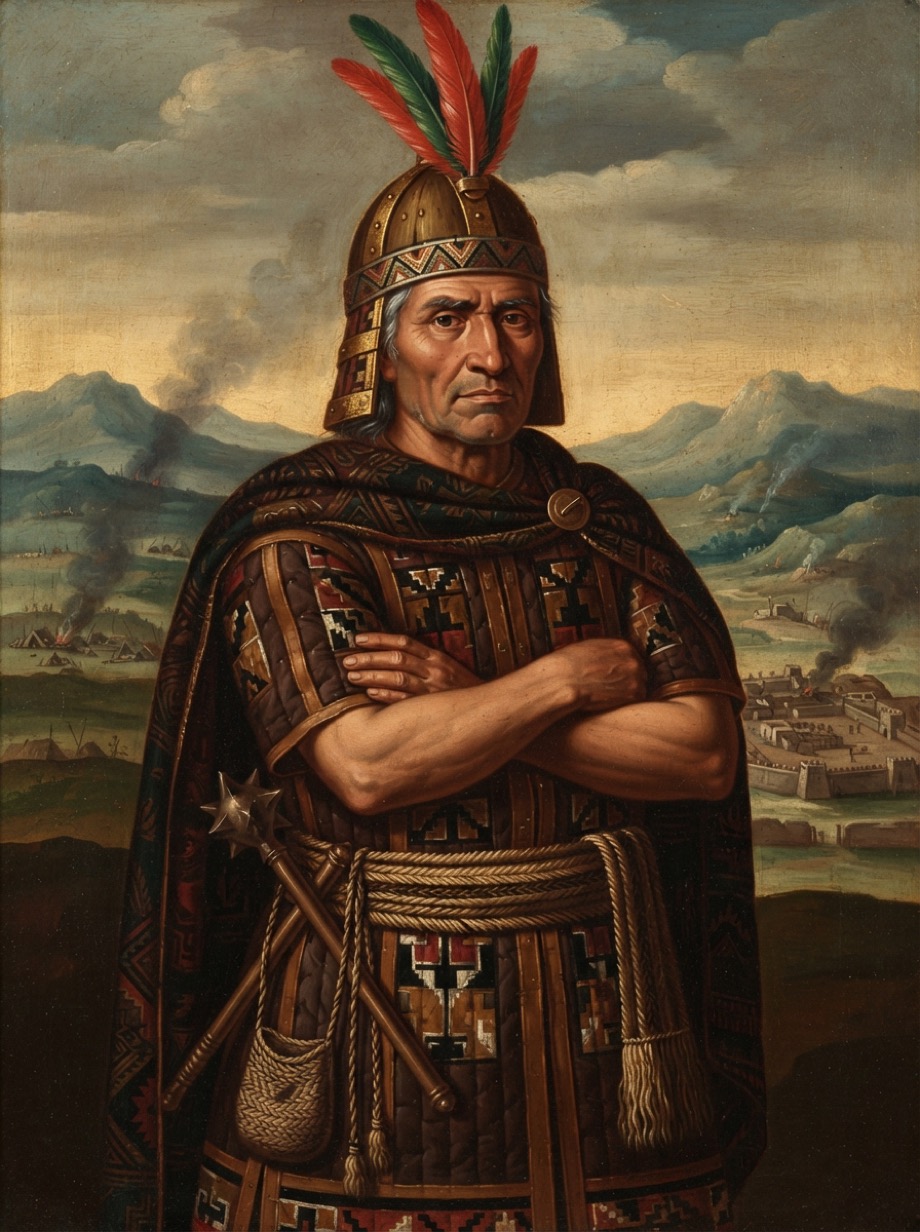
AI-assisted Portrait of Chalcuchimac
The General Who Would Not Kneel Twice
Of the three generals who won the Inca civil war for Atahualpa, Chalcuchimac was never the one the chroniclers reached for first. Quizquiz held the north. Rumiñahui would later hold Quito against the Spanish long after there was any realistic hope of holding it. Chalcuchimac held something less visible and, in practice, more decisive: the machinery. He was the officer who moved armies the way a good administrator moves grain — on schedule, along routes already proven to work, with losses kept to what the campaign could absorb. It was his columns, more than any single battlefield stroke, that ran Huáscar's forces down and delivered the rival Sapa Inca into Atahualpa's hands in 1532.
That competence became a liability the moment the war it served became irrelevant. When Atahualpa was seized at Cajamarca, Chalcuchimac came toward the Spanish camp — by most accounts to assess and possibly negotiate — and was taken himself, chained, and marched south as a hostage and forced guide, his authority over the remaining Inca forces treated by Francisco Pizarro's men as a lever to be worked rather than a man to be reasoned with. He gave them almost nothing. Not conversion, not the location of resistance, not even the theater of cooperation. When the accusations came that he was still directing Inca forces from his chains, the Spanish burned him alive at Jaquijahuana — and at the stake, where Atahualpa had accepted baptism months earlier to escape exactly this death, Chalcuchimac refused it to the end.
He was not built to improvise a new order. He was built to execute, without deviation, the one he already had — which is the whole of ISTJ, dominant Si, distilled into a single refusal at a stake in the Andean cold.
The Campaign That Repeats What Worked
Dominant Si is often described in the archive's more expansive types as a love of precedent for its own sake — but in a general at war, that same orientation becomes a battlefield asset. Chalcuchimac's reputation was built on reliability under repetition: the same disciplined march order, the same conservative husbanding of supply, the same refusal to gamble a won position on a clever improvisation. Against Huáscar's less coordinated forces, that steadiness was not dull — it was the reason the civil war ended in 1532 rather than dragging on. He fought like a man executing a plan he had already rehearsed in his head many times over, because in the Inca military tradition of extensive logistical preparation, he likely had.
The same Si shows in what he was loyal to after his capture. Atahualpa was dead within months of Chalcuchimac's own seizure, and the practical case for currying favor with the Spanish — who controlled his life, his rank, and the fate of what remained of the Inca military — was obvious. He did not take it. Si does not only store procedure; it stores obligation, the felt weight of what has already been sworn and done, and Chalcuchimac's continued deference to a chain of command that no longer had the power to protect him reads less as strategic miscalculation than as a man who simply could not process loyalty as a variable to be renegotiated.
Even the accusation that ultimately killed him — that he was still secretly directing resistance from captivity — fits the pattern more than it contradicts it. Whether or not the specific charge was true, it was entirely plausible of him, because continuing to run the war he had always run, by the only methods he had ever used to run it, was exactly the kind of thing dominant Si does not know how to stop doing simply because the strategic ground has shifted underneath it.
Results, Not Rhetoric
Auxiliary Te is what made Chalcuchimac dangerous rather than merely dutiful. He did not simply preserve procedure for its own comfort; he applied it toward outcomes, and the outcome that mattered — the destruction of Huáscar's field armies and the capture of Huáscar himself — is the single clearest achievement credited to him by name in the chronicles. Where Si supplied the discipline, Te supplied the results, converting steady procedure into a war actually won.
It is Te, too, that explains the specific shape of his resistance in captivity. He did not rage at Pizarro's men or attempt grand defiance; he simply withheld the one thing they wanted from him — functional cooperation — with the flat efficiency of a man denying an enemy a resource. Refusing to convert, refusing to hand over resistance, refusing to perform the obedience his captors needed from him to pacify the road to Cusco: each refusal was a small, effective act, executed with the same economy he had once brought to logistics. He managed his own captivity the way he had managed a campaign — by giving the opposition as little as possible to work with.
Why ISTJ Over ESTJ
Why not ESTJ?
ESTJ is the obvious first guess for any general who wins wars through discipline and logistics rather than flair — and Chalcuchimac's effectiveness in the field makes the case tempting. But an ESTJ pattern would show itself in visible command presence: public assertion of authority, a habit of directing others openly, a comfort with being the one who speaks for the group. Chalcuchimac is never described that way. He is the strategist working within Atahualpa's authority, not asserting his own — the reliable executor rather than the commanding voice. That is dominant Si organizing itself around an external structure it serves, not extraverted Te building and projecting one.
The clearest evidence comes at the very end, where an ESTJ's instinct toward outward command would be expected to surface loudest — and instead produces almost nothing. No speeches at the stake, no attempt to rally or command anyone in his final hours, just a quiet, stubborn refusal that asked nothing of an audience and needed no one's agreement to hold. That is not the shape of an extraverted judging function making one last public stand. It is the shape of an inward conviction — Si banked against a lifetime of loyalty, with a thread of tertiary Fi underneath it — simply declining to move, right up until it no longer had to.
Connected Figures
Further Reading
- The Conquest of the Incas — John HemmingThe standard narrative account of Chalcuchimac's capture, his use as a hostage on the march to Cusco, and his execution at Jaquijahuana.
- History of the Inca Realm — María RostworowskiOn the structure of Inca military command and the generals of the Huáscar–Atahualpa civil war.
- The Men of Cajamarca — James LockhartA close study of the immediate post-Cajamarca period, including Spanish treatment of captured Inca commanders.
