 Historical Figure MBTI
#777 · 6-9-26 · The Conquest of the Andes
Hernando de Soto
Rich at Cajamarca, Sunk in the Mississippi
c. 1500 — 1542
7 min read
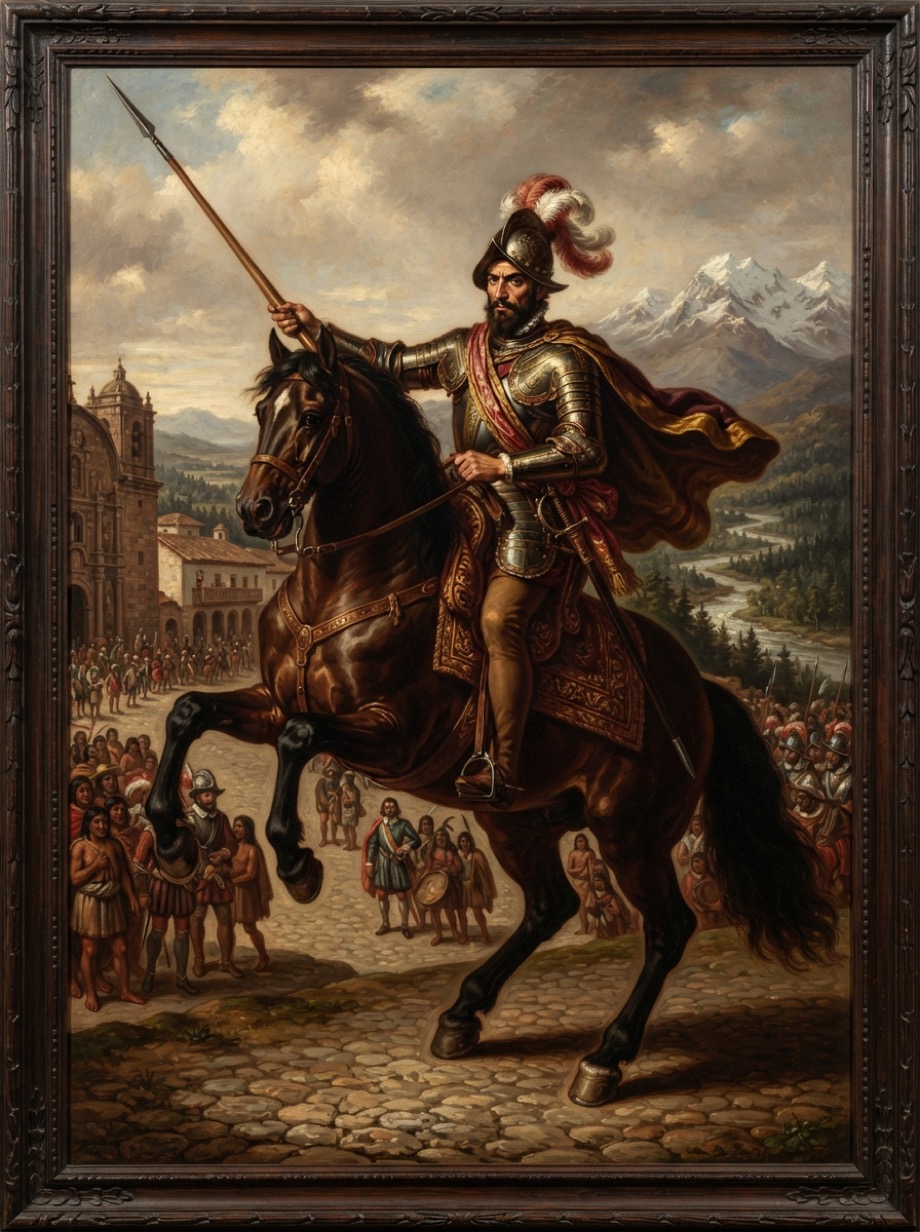
AI-assisted Portrait of Hernando de Soto
The Man Who Could Not Stop Riding
In November 1532, outside Cajamarca, a Spanish cavalryman rode straight at the most powerful man in South America and did not stop. Hernando de Soto had been sent with an invitation; what he delivered was a performance — a horse worked into a rear and a charge, hooves brought so close that the animal's breath moved the fringe on Atahualpa's forehead. The Sapa Inca did not blink, and when the audience ended he had the attendants who had flinched killed for it. Two men had introduced themselves in the only language either fully trusted: what the body does when it is frightened.
That moment is the whole of de Soto in miniature. He was not a strategist like Francisco Pizarro or an administrator like his father-in-law Pedrarias Dávila. He was the man you sent forward — the finest horseman in the party, the first into a strange plaza, the one who read a room by walking into it and applying pressure until it revealed its shape.
He came out of Panama as Pedrarias's protégé, married Isabel de Bobadilla into that family's fortunes, and rode into Peru as one of Pizarro's best lances. Cajamarca made him rich beyond reckoning; he took the money home to Spain and lived exactly the life every conquistador claimed to want, and lasted a few years. Then he spent nearly all of it on ships and horses and war dogs and sailed for Florida to find a second Peru — and found instead a death so inconvenient that his own men sank his body in the Mississippi rather than let anyone see that the god had a corpse.
De Soto is the archive's purest conquistador ESTP: a dominant Se that could win any single afternoon by walking into it, wired to a psyche that could not convert a won afternoon into a life worth keeping.
The Horse as an Argument
Extraverted Sensing treats the physical present as the only fully real thing — and as workable material. De Soto did not send Atahualpa a message about Spanish power; he brought the horse into the emperor's face and let the animal make the case, improvising, calibrating to the crowd, using the one instrument in the Andes with no counterpart on the other side. That is Se as statecraft: no theory of empire, just a body and a beast applied with exact force at exact range.
The same faculty made him the best field officer Pizarro had. He was repeatedly sent out ahead — into Túmbez, into Cajamarca first, later up the road toward Cuzco — because he could enter an unmapped situation and react at its speed. Se dominants excel exactly where the plan runs out. In Florida the trait curdled into something uglier but recognizably the same: the sudden raid, the chief seized mid-conversation.
And Se is an appetite as well as a skill: it wants motion and goes flat in comfort. A rich man in Seville with a title and a household had, in Se terms, nothing left to do — and three years into the good life de Soto was liquidating it. The 1539 entrada was not a calculation but a hunger, a Cajamarca fortune spent to be back on a horse in unknown country.
The Tactician's Private Arithmetic
Introverted Thinking gives the Se dominant its edge: a fast, silent, self-owned model of how a situation actually works, run while the body acts. De Soto understood better than most of Pizarro's captains what a horse was worth against infantry that had never seen one — not a mystical advantage but a mechanism of reach and shock and the narrow window before an enemy learns. He built a career on knowing how wide that window was.
Ti is also why the Florida gamble looked rational from the inside. He had studied the failure of Pánfilo de Narváez, whose 1528 expedition into the same country dissolved into starvation, rafts, and four survivors out of three hundred. De Soto did not conclude that Florida was empty; he concluded that Narváez had been incompetent — too few horses, no supply discipline, a fatal separation of fleet from land column — and that a better-run march would reach what Narváez never did. That is the characteristic Ti move: locate the flaw, correct it, trust the corrected machine. Airtight logic on an unexamined premise.
Ti also made him a poor company man. He argued with Pizarro over the killing of Atahualpa, whose usefulness he had privately assessed and found undervalued, and returned from a scouting ride to find the sentence already carried out. He would not defer to a judgment he had not reached himself — which is why he eventually bought his own commission from Charles V.
Charm, Marriage, and the Cult of the Undying Captain
Tertiary Extraverted Feeling in an ESTP is a real and often charming social instinct held in the service of the enterprise. De Soto was the diplomat of the Peru party, sent to make first contact because he could carry himself as an ambassador as well as a threat; in Spain he converted gold into standing with total fluency — a good marriage, an adelantado's title, six hundred gentlemen-adventurers recruited on reputation alone.
But tertiary Fe is the shallow water in the stack, and it drained fastest under pressure. On the march his people-reading turned purely instrumental: seize a chief as hostage-guide, extract porters and corn and safe passage, discard him at the next province's border — a man who grasped exactly what a local political order needed in order to cooperate, using the knowledge to strip it.
The most vivid Fe artifact of his life is posthumous. He had spent the entrada letting the Mississippian chiefdoms believe the Spanish captain was undying, a son of the sun. When fever killed him in May 1542 his officers knew the expedition's survival rested on that impression — so they buried him quietly, dug him up, weighted the body, and sank it in the river at night. His last act of social management was to vanish, so no one could see that the god had ended.
The Second Peru
The inferior function is where a personality is credulous. For the ESTP it is Introverted Intuition — the sense of one hidden pattern beneath events. Se-Ti handles the present with lethal competence and has almost no apparatus for evaluating the future, so when a vision of the future does arrive it arrives whole, unargued, and immovable. De Soto's was called the second Peru.
He had been present at the most improbable windfall in the history of European conquest: a hundred and sixty-eight men walked into a continent and came out with a room of gold. Having lived it once, he could not hold it as an accident — it became a template. Somewhere north of the Gulf there had to be another Cuzco, and every Cofitachequi that proved to be a farming chiefdom with freshwater pearls instead of bullion was not evidence against the vision but a wrong turn on the way to it.
That is the inferior function's signature failure: not the absence of a long view but a rigid, unexaminable one, defended past the point where the Se dominant's own great gift — noticing what is actually in front of him — could rescue him. The man who could read a plaza in a heartbeat could not read three years of country.
Why ESTP Over ESTJ
Why not ESTJ?
The case for ESTJ is real: de Soto raised, financed, and commanded a six-hundred-man expedition across half a continent for three years. But Si-Te consolidates what it wins — it secures the gain and administers the territory, which is what Pedrarias did in Panama, what Hernando Pizarro did with the family's Peruvian holdings, and what Pedro de Valdivia did in Chile. De Soto did the opposite: handed a fortune and a settled place in the nobility, he sold it to buy a march into unmapped country. An ESTJ builds on the won position; de Soto could not tolerate occupying one.
The distinction is not competence — both types can run an army — but what the competence is for. Te measures itself by what stands afterward; de Soto founded no city, held no governorship he did not immediately vacate, and measured himself by whether he was in motion. Se-Ti built him for the sharp end of the unknown, gave him no reason to stay anywhere already conquered — and no way to notice that the thing he was riding toward did not exist.
Connected Figures
Further Reading
- Knights of Spain, Warriors of the Sun — Charles HudsonThe definitive reconstruction of the 1539–1542 entrada and the Mississippian chiefdoms it passed through.
- The Conquest of the Incas — John HemmingThe standard narrative of Peru, including de Soto's ride at Cajamarca and his quarrel over Atahualpa's death.
- Hernando de Soto: A Savage Quest in the Americas — David Ewing DuncanThe most readable full-life biography, tracing Panama and Peru through to the Mississippi.
- The Men of Cajamarca — James LockhartA collective biography of the 168 conquistadors at Cajamarca, placing de Soto precisely among them.
