 Historical Figure MBTI
#776 · 6-9-26 · The Conquest of the Andes
Felipillo
The Interpreter History Gave No Dignity
d. c. 1536
3 min read
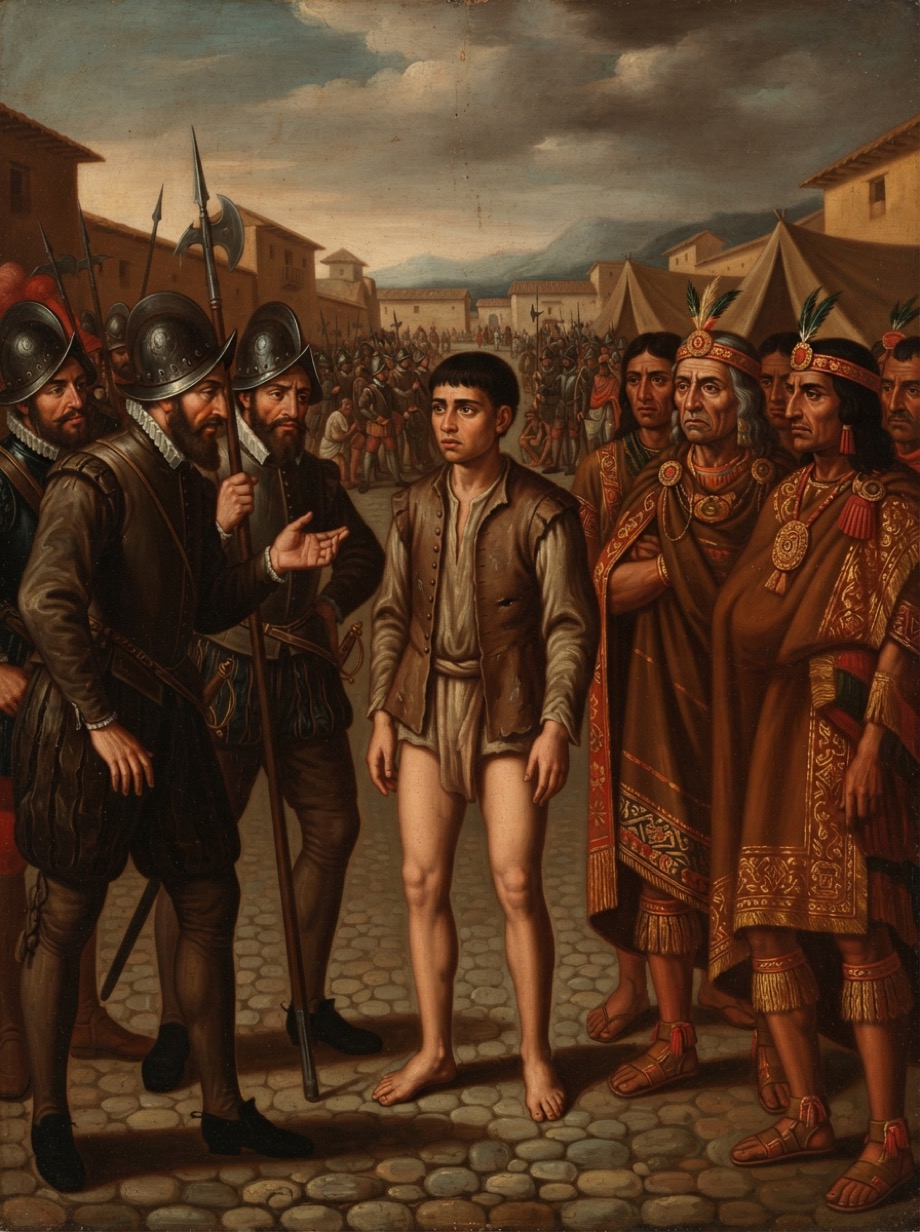
AI-assisted Portrait of Felipillo
A Boy Between Two Languages He Did Not Choose
Felipillo did not volunteer for the role that killed him. Taken as a captive boy from the Tallán coast during one of Pizarro's early scouting voyages south, he was carried off to Panama, taught Spanish by men who needed a mouth they could use, and handed back into history as an interpreter — a human bridge between a language he had been forced to learn and a second one, Quechua, that was not his native tongue either. By the time the Spanish column reached Cajamarca in 1532, Felipillo was still barely more than a teenager, and the words passing through him in that plaza — Valverde's reading of the requerimiento, Pizarro's demands, Atahualpa's replies — carried the weight of an empire's collision, rendered by someone with no formal training, no diplomatic standing, and no time to get any of it right.
What survives of him afterward is mostly blame. When the encounter curdled into massacre and the massacre into conquest, Felipillo became the explanation everyone reached for: the interpreter who garbled the message, who — in the more lurid tellings — deliberately twisted Atahualpa's words out of jealousy over one of the Inca's wives. None of that is verified; all of it stuck. He kept translating on later expeditions, useful because he was rare, and expendable for the same reason. On the march toward Chile he was accused of conspiracy — or simply became convenient to remove — and was executed around 1536, a young man who had spent his whole adult life saying other people's words back to them in a tongue that was never quite his own.
Felipillo was improvisation under impossible pressure — the quick, associative reach of ENTP Ne, groping in real time for equivalents that didn't exist, steadied only by a Ti that had no leisure to be careful.
The Interpreter Without a Script
There is not enough of Felipillo's inner life on record to build the usual four-function case, and an obscure entry does not need one. What the record does support is a psychological shape: a boy thrown into a job with no manual, forced to invent meaning on the spot between two imperial languages under the eyes of men who would kill over a misunderstanding. That is Ne-Ti stripped to its bones — fast, associative leaps toward whatever equivalent might hold (Ne), disciplined only enough to sound coherent in the moment (Ti), with no time for the careful deliberation a more Judging or Sensing temperament would have needed and simply did not have. It is not a portrait of brilliance under pressure so much as survival under it — which is its own kind of case for the type.
Connected Figures
Further Reading
- The Conquest of the Incas — John HemmingThe standard narrative history, covering the interpreters present at Cajamarca and Felipillo's eventual fate.
- The Men of Cajamarca — James LockhartA prosopography of the Spaniards present at Cajamarca, with detail on the interpreters who made the encounter possible.
- Malintzin's Choices: An Indian Woman in the Conquest of Mexico — Camilla TownsendOn La Malinche — the essential counterpoint for the asymmetry this entry draws between the conquest's two most famous interpreters.
