 Historical Figure MBTI
#775 · 6-9-26 · The Conquest of the Andes
Vicente de Valverde
The Friar Who Handed Over the Breviary
c. 1498 — 1541
6 min read
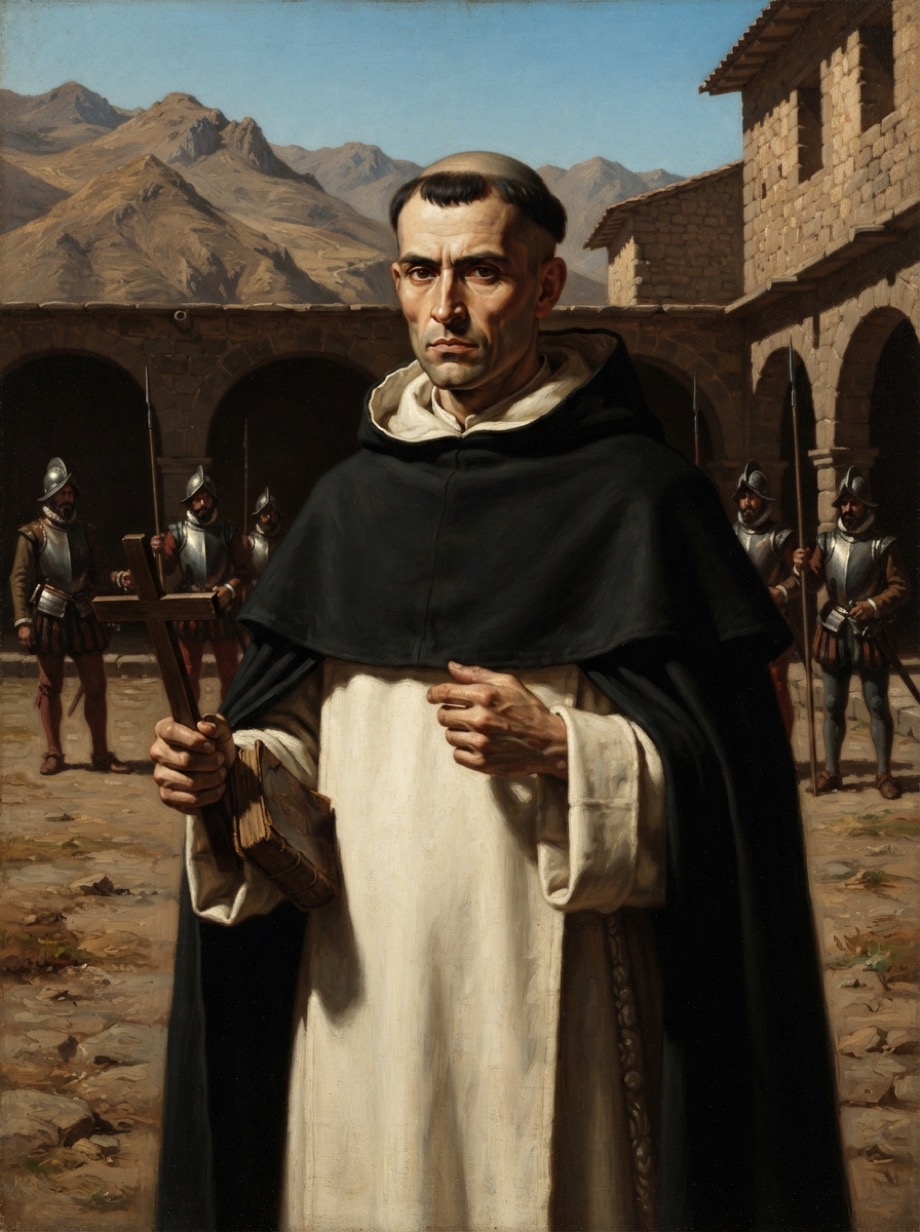
AI-assisted Portrait of Vicente de Valverde
The Book That Would Not Speak
At Cajamarca, on November 16, 1532, it was the friar who went first. Francisco Pizarro held his men back in the arcades ringing the plaza; the Inca Atahualpa approached at the head of an unarmed retinue, borne on a litter, expecting a diplomatic reception. Vicente de Valverde walked out to meet him carrying a breviary — or, by some accounts, a Bible — and, through the interpreter Felipillo, delivered a compressed version of the requerimiento: a formal Spanish declaration that Atahualpa submit to the Pope and to the Crown of Castile, on pain of a war the document itself pronounced just. Atahualpa took the book, examined it, and found in it nothing that answered to anything he knew. He dropped it, or threw it down — the sources disagree on the gesture, not on what followed. Valverde turned back toward the Spanish line and called out that the Inca had defiled the word of God. Within minutes, the massacre began.
It would be easy to read Valverde as a man swept along by an ambush already decided — a supporting actor handed a script and a prop. The record does not support that reading. Valverde did not fade from the story once the killing started; he became one of its most committed institutional authors. During Atahualpa's eight months of captivity, as Pizarro extracted the largest ransom in recorded history and then, ransom paid, moved to have his prisoner killed anyway, it was Valverde who supplied the doctrinal machinery that made the execution defensible on paper — idolatry, a lapsed baptism, apostasy — categories many of Pizarro's own soldiers, by their own often brutal standards, found hard to square with a man who had just bought his freedom in gold. Rome rewarded the friar for his service with a mitre: Valverde became the first bishop of Cusco. He did not long enjoy it. In 1541, traveling near Puná, he and several companions were killed by islanders in an attack whose motive the record leaves thin.
Valverde was not the man who decided Atahualpa should die. He was the man who supplied the citation — an ISTJ whose introverted sensing treated doctrine as a fixed inheritance to be applied, and whose extraverted thinking turned that inheritance into a verdict.
The Requerimiento, Read Aloud
The requerimiento was, by 1532, already a well-worn instrument of Spanish conquest — a formula composed decades earlier, read (often in Spanish, to listeners who understood no Spanish) before dozens of prior engagements across the Americas, its language and its logic fixed long before Valverde ever set foot in Peru. What is notable about Cajamarca is not that the friar carried it, but how completely he trusted it to do its work unmodified. He did not improvise an approach suited to an Inca emperor who ruled an empire larger and more administratively sophisticated than Spain itself. He delivered the standard script — submission to a pope Atahualpa had never heard of, obedience to a king he owed nothing — as though the ritual's prior success elsewhere guaranteed its meaning here. This is introverted sensing at its most consequential: a mind that reaches first, and almost exclusively, for the precedent already on file.
The same reflex explains what came after the book hit the ground. Valverde did not pause to interpret the gesture — did Atahualpa understand what he held, did he reject it deliberately or merely fail to see the point of it — he filed it immediately under an existing category: sacrilege, the desecration of scripture. The category was ready before the incident was. It is this that separates Valverde's Si from mere caution or conservatism; it is a positive dependence on inherited frameworks as the primary source of truth, applied so automatically that a genuinely novel encounter — first contact between a Dominican friar and an Andean god-king — collapsed instantly into a familiar Iberian story about heretics and holy books.
The pattern held for the rest of his career. As bishop of Cusco, Valverde's surviving correspondence shows a man occupied with jurisdiction, precedent, and the proper administration of doctrine in a land whose religious life he had done more than almost anyone to shatter — a caretaker of institutional order laid over the wreckage his own certainty had helped produce.
Building the Case for Execution
Si supplied Valverde's categories; Te is what turned them into an outcome. Once Atahualpa's ransom had been paid — a room filled with gold and two with silver, by the terms the Inca himself had proposed — Pizarro faced a captive he no longer had an obvious pretext to hold, and a growing unease among his own men about killing a king who had honored his side of the bargain. Valverde did not share that hesitation, and he did not merely counsel it away in private. He built, in explicit and actionable terms, the legal-religious case that let the execution proceed under color of law: Atahualpa was guilty of idolatry; his nominal conversion and baptism, administered in his last hours, made any relapse into his own religion apostasy; apostasy was a capital offense the Church itself could sanction.
This is extraverted thinking doing exactly what it does — taking an internal doctrinal conviction and converting it into an external, procedural, defensible result, one that other men could sign off on without feeling they had simply murdered a defeated king. It is worth noting what Te, subordinated here to Si, did not do: it did not originate the goal. Valverde was not staging a coup or angling for personal power over Pizarro's expedition; an ESTJ in his position would more plausibly have tried to command the outcome directly, to own the decision as his. Valverde instead worked the machinery from inside — providing the justification apparatus a decision already leaning toward execution needed to proceed cleanly. He was rewarded for the service, not for the command.
Why ISTJ Over ESTJ
Why not ESTJ?
ESTJ is the tempting label because Valverde was undeniably assertive in pushing for Atahualpa's death — this was not a passive or reluctant participant. But an ESTJ organizes reality around his own extraverted judgment first and reaches for supporting precedent second; he would more visibly have commanded the decision itself, staked his authority on it, and treated doctrine as a tool he wielded rather than a script he executed. Valverde's conduct runs the other way: the requerimiento, the doctrinal categories of idolatry and apostasy, the entire justification for execution, existed as fixed inheritance before he ever applied them to Atahualpa. He supplied the citation, not the command.
The distinction matters because it is exactly what makes Valverde legible as a type rather than simply as a villain. He was not improvising cruelty or chasing personal dominance over the expedition — Pizarro held that role, and held it without Valverde's help. What Valverde brought was something narrower and, in its way, more chilling: a mind for which the existing rulebook was authoritative enough that a living emperor could be tried and executed by reference to it, without the friar ever needing to originate the verdict himself.
Connected Figures
Further Reading
- The Conquest of the Incas — John HemmingThe standard narrative history, covering the requerimiento scene at Cajamarca and Valverde's role in Atahualpa's trial in close detail.
- The Men of Cajamarca — James LockhartA prosopography of the original conquest party, situating Valverde among the men who stood in the plaza that day.
- Religion in the Andes — Sabine MacCormackOn the religious and legal frameworks — including the requerimiento — that Spanish clergy used to justify conquest and its aftermath.
