 Historical Figure MBTI
#401 · 4-5-26 · The Mongol Empire
Jebe
The Arrow · From Enemy to General · The Great Raider
c. 1175 — 1225
7 min read
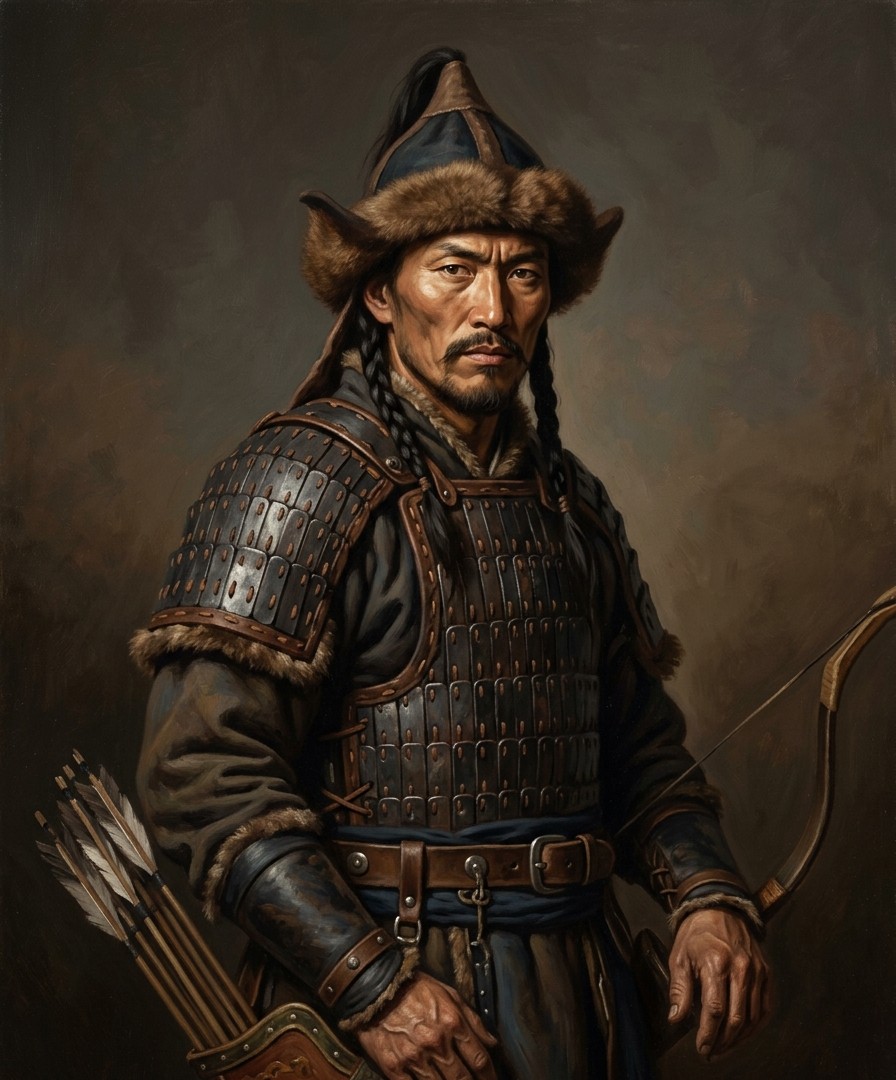
AI-assisted Portrait of Jebe
The Arrow That Flew From Enemy to Legend
The story of how Jebe became one of the greatest generals in history begins with him trying to kill the man who would make him great. In a battle against the Tayichiud, an enemy archer loosed an arrow that struck down the future Genghis Khan's warhorse. When the survivors were brought before Temüjin, he asked who had fired it—and instead of hiding in the crowd, a young warrior stepped forward and declared, without flinching, that the shot was his. He offered the Khan a choice: execute him, or spare him and watch what he could do.
Temüjin took the gamble. He pardoned the archer, renamed him Jebe—“the Arrow”—and gave him a command. The bet returned impossible interest: Jebe destroyed Kuchlug by proclaiming religious freedom to a persecuted population, which opened its gates to him. He ran the Khwarazmian Shah to his death on a Caspian island. Then, around 1221–1223, with Subutai, he led the great raid—tens of thousands of miles around the Caspian, ending at the Kalka River where a feigned retreat annihilated a Russian-Cuman host. He died on the return journey, in the saddle as he had lived. It is a textbook ESTP: dominant Se in the horsemanship and battlefield daring; auxiliary Ti in the cold read of terrain and enemy; tertiary Fe in the bold public honesty that won him his life; inferior Ni in a man who lived for the next charge rather than the long view.
Jebe was the ESTP made flesh—the enemy archer who won his life on a single act of nerve and then spent it at a gallop, dominant Se in the horsemanship and the daring, auxiliary Ti in the cold read of the field, the swaggering blade who flew from enemy to legend faster than anyone could see him coming.
The Body That Lived at a Gallop
Se — dominant
Dominant Se is the mind fused to the body, reading the immediate field and responding faster than thought. Everything we know of Jebe is this faculty at its limit: a horseman and archer of almost supernatural quality, his genius kinetic and physical, a body trained to the absolute edge of what a steppe warrior could do. When the Khwarazmian Shah fled, Jebe and Subutai drove their men across mountains and deserts until the Shah died, hunted and exhausted, on a Caspian island. At the Kalka, the feigned retreat worked because it was executed with exact real-time control of distance and pace—judgment that lives in the body of a master horseman, not in a written plan. Where Subutai thought in years and continents, Jebe thought in the next valley, the next charge—and answered each with a speed that made the Mongols seem to materialize out of nowhere.
The Cold Read of the Field
Ti — auxiliary
Raw boldness without judgment is recklessness. Jebe's Se was governed by auxiliary Ti—the cold faculty that finds the structural fault line and works out how to make a situation break. The Kuchlug campaign is the clearest case: rather than hunting him by force, Jebe read the political mechanism of the Kara-Khitai, saw that the usurper's real weakness was his subjects' brittle disloyalty, arrived proclaiming freedom of worship, and the population opened its gates. At the Kalka, the Russian-Cuman coalition was internally incoherent, and Jebe and Subutai read that incoherence exactly, drawing contingents forward at different speeds until the whole army came apart in detail—the lethal applied analysis of a tactician who saw precisely how a given enemy could be made to destroy himself.
The Bold Confession That Won a Life
Fe — tertiary
When Temüjin demanded to know who had shot his horse, Jebe could have stayed silent and likely lived. Instead he read the man in front of him—understood that this was a leader who prized open courage—and made the bold public declaration that he was the one. Not naive honesty; a shrewd social read of exactly what would move his audience. Fe in the ESTP surfaces as this charismatic, crowd-facing boldness—the instinct for the grand gesture that wins a room. The Se-Ti core could have produced a deadly lone warrior; what made Jebe a commander tens of thousands would follow was the swaggering confidence that made others want to ride behind him. Tertiary Fe is presence—the ability to project certainty so vividly that a whole column catches fire from it. Its limits are honest: capable of slaughter on a scale no charisma should soften. But it is decisive.
The Man Who Lived for the Next Charge
Ni — inferior
Inferior Ni—the long, single-vision foresight—sits at the bottom of Jebe's stack, underdeveloped and largely uncalled-upon. The next charge was always more real than the long campaign. This is why the partnership with Subutai is so illuminating: the two were a single complete commander split in two, Subutai supplying the dominant Ni that saw whole wars in advance, Jebe supplying the Se that executed them at a gallop. The detail that the Caspian loop doubled as an intelligence survey is most naturally Subutai's Ni at work; Jebe's contribution was the fighting itself. He died on the return journey, around 1225, having spent himself in the saddle—burning bright and fast, leaving behind not a doctrine but a string of impossible rides and a name that meant the weapon itself.
Why ESTP Over ISTP
Why not ISTP?
The ISTP and the ESTP share the same Se-Ti core, which is why the two are often confused. But the ISTP leads with Ti, works best alone, and tends to hang back from the crowd. Jebe was the reverse: outward, loud, and crowd-facing. The defining act of his life was a public declaration to win a room—he stepped forward and announced himself rather than withdrawing. His whole career was lived at the swaggering front of a charge, leading tens of thousands by the magnetism of visible daring. That audience-seizing boldness is dominant Se with extraverted feeling in support, not the inward Ti-lead reserve of the ISTP.
The ISTP's competence is private and self-contained. Jebe's was a performance: the open declaration, the charge his men could see and follow, the conqueror riding into a city proclaiming liberation. He is the ESTP, fully extraverted, fully in motion.
Connected Figures
Further Reading
- The Secret History of the Mongols — Anonymous (trans. Igor de Rachewiltz)The primary Mongolian source — the only chronicle written from inside the empire, containing the famous episode of Jebe's confession to Temüjin.
- Genghis Khan and the Making of the Modern World — Jack WeatherfordA widely read account of Genghis Khan's campaigns and the generals — including Jebe — who carried them out.
- The Mongol Art of War — Timothy MayA focused study of Mongol military tactics and commanders, giving context for Jebe's role as an independent raiding general.
- The Devil's Horsemen: The Mongol Invasion of Europe — James ChambersCovers the great Caspian raid of 1221 – 1223 — the campaign Jebe and Subutai led — and the battle of the Kalka River.
