 Historical Figure MBTI
#400 · 4-5-26 · The Mongol Empire
Subutai
The Mongols' Greatest General · The Dog of War · Conqueror of Nations
c. 1175 — 1248
6 min read
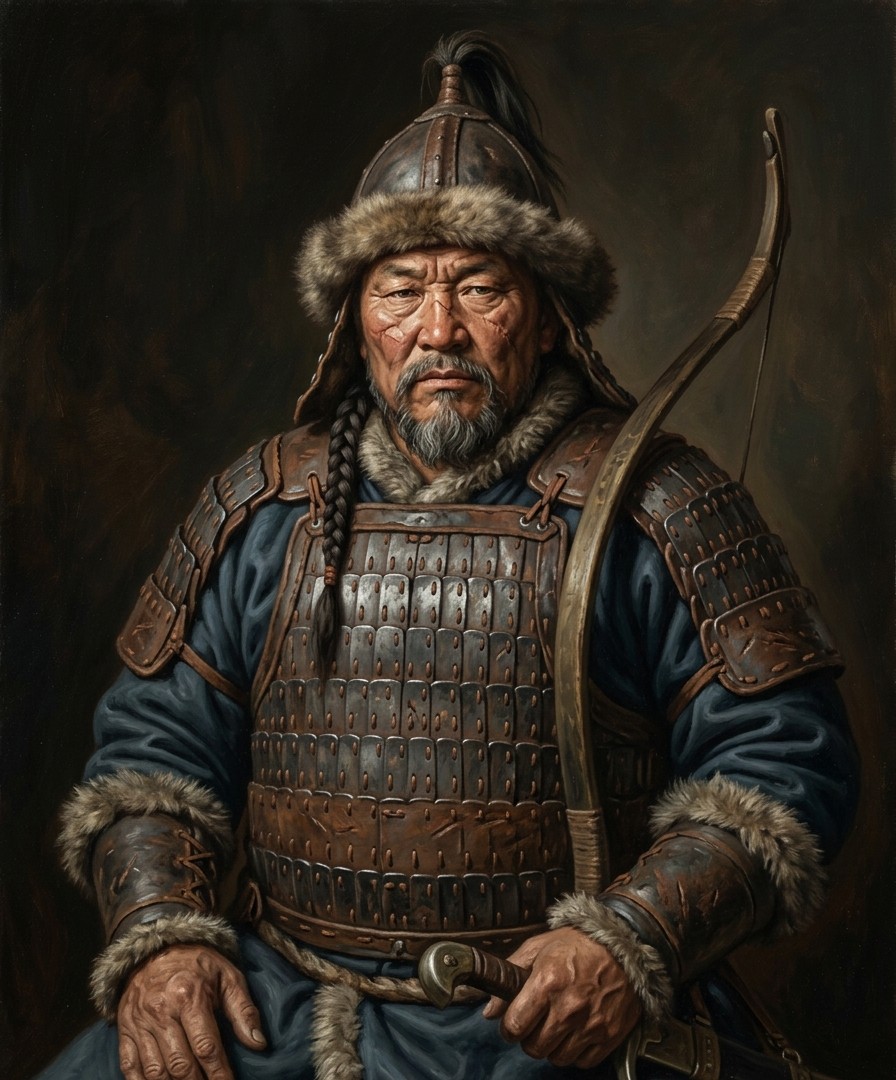
AI-assisted Portrait of Subutai
The Blacksmith's Son Who Conquered the World
Born around 1175 into the Uriankhai, a Siberian forest clan, Subutai had no noble blood and no army to inherit. He came of age in the one place where birth had been demolished as the measure of a man: the army of Genghis Khan, whose meritocracy let a herder's son command ten thousand men if he could win. Subutai proved he could. He rose to become the supreme field commander of the Mongol Empire—twenty campaigns, thirty-two nations overrun, sixty-five pitched battles won. By territory conquered, no field commander in recorded history has matched him.
In 1221–1223, with Jebe, he looped a reconnaissance-in-force around the Caspian Sea—fighting and surveying at once—and annihilated a Russian-Cuman army at the Kalka River. Eighteen years later he made good: a conquest of the Rus, then in 1241 a two-pronged invasion of Central Europe that destroyed the Hungarians at Mohi and the Polish-German chivalry at Liegnitz within days, the two wings hundreds of miles apart yet timed to perfection. What halted the Mongols was not an army but the death of Great Khan Ögedei, calling the princes home. The type behind all of this is the INTJ: dominant Ni that saw campaigns complete before they were fought, auxiliary Te turning vision into logistics, tertiary Fi as unshakeable loyalty, inferior Se as a distrust of the spontaneous.
Subutai was the INTJ war-architect at his purest—dominant Ni designing multi-army campaigns across continents from foresight and intelligence, auxiliary Te grinding them into roads, rations, and converging columns, a strategist who conquered a third of the known world from behind the map and never once needed to be the man at the front of the room.
The Campaign Seen Years Before It Was Fought
Ni — dominant
Dominant Ni forecloses options: it sifts information until one inevitable outcome crystallizes, then works backward from that ending. Subutai did not improvise battles; he saw whole wars complete in his mind and spent months arranging reality to match the picture. The Caspian raid of 1221–1223 was an act of foresight—fight and see, gathering intelligence for an invasion still eighteen years away. The 1241 European campaign makes this explicit: two armies into Poland and Hungary, divided by hundreds of miles, converging to crush two hosts within days. He had timed it for winter because frozen rivers Europeans assumed would protect them became, in his calculation, highways. The feint at Liegnitz, the false retreat at Mohi—not battlefield inspirations but predetermined moves of a plan conceived whole.
Logistics as the Soul of Victory
Te — auxiliary
A vision that cannot be executed is a daydream. Auxiliary Te breaks the picture Ni has formed into concrete operations: horses, grain, march-days, roads, engineers, rendezvous. The Mongols moved at speeds that seemed supernatural not because their horses were faster but because Subutai had worked out supply and routes in advance and imposed a communication system—riders, signal flags, prearranged rendezvous—that let separated columns behave as a single organism. He absorbed Chinese and Persian siege engineering wholesale—catapults, trebuchets, naphtha—so fortified towns became scheduled objectives, and made information-gathering a permanent department of his army. Te does not care where a useful method comes from; it cares only whether it can be systematized.
The Loyalty That Never Sought the Throne
Fi — tertiary
A man who had conquered thirty-two nations never once reached for power of his own. Tertiary Fi is the quiet, private compass of core values, and in Subutai it expressed itself not as warmth but as unshakeable loyalty. He had decided, early and apparently for good, where his devotion belonged—to Genghisand the Mongol cause—and that commitment held with the immovable quality Fi gives its core allegiances. He served, and the service was the value. When Genghis died, he transferred the same loyalty to Ögedei and kept winning wars for a master a generation younger than himself.
The Planner's Distrust of the Bold
Se — inferior
Inferior Se sits at the bottom of the INTJ stack, and Subutai's method is an argument against it. He did not believe in the bold stroke; he believed in the plan, the arrangement of advantages until victory was not a gamble but a certainty. The actual battle was the least interesting part of war—collection of a debt already paid in preparation. In his later years he traveled by cart, directing armies from a remove; the thrill of combat held no interest. He could not out-Se the bold men of his age, so he refused to fight them on that ground—he made their boldness a weapon, baiting impulsive enemies into killing-grounds his patience had prepared.
Why INTJ Over ENTJ
Why not ENTJ?
The ENTJ leads from the front of the room—dominant Te organizing people in real time, bending the world by force of visible authority. Subutai worked from behind the map, designing campaigns in his own mind years before they were fought. His Te was real but auxiliary, a servant to the Ni that came first. His contentment to serve—making other men's conquests possible without ever reaching for command—is foreign to the ENTJ's instinct to rule.
Genghis founded and led; Subutai foresaw and executed. Genghis was the man the world looked at; Subutai was the mind behind the operations—the architect the monument erases. That difference between dominant Te and dominant Ni is why Subutai, who conquered more territory than any commander in history, remains a quintessential INTJ rather than the ENTJ he served.
Connected Figures
Further Reading
- Subotai the Valiant: Genghis Khan's Greatest General — Richard A. GabrielThe most thorough English-language study of Subutai's campaigns and operational methods.
- The Mongols — David MorganA concise scholarly overview of the Mongol Empire; situates Subutai within the broader military and political context.
- Genghis Khan and the Making of the Modern World — Jack WeatherfordAccessible narrative history of Genghis and his commanders, with substantial coverage of Subutai's role.
- The Mongol Art of War — Timothy MayDetailed analysis of Mongol military organization, tactics, and strategy — essential background for understanding Subutai's methods.
