 Historical Figure MBTI
4 min read
#87 · 3-3-26 · The Founding Generation of USA
John Barker Church
British-born merchant, financier, and transatlantic political operator of the Revolutionary era.
1748 — 1818
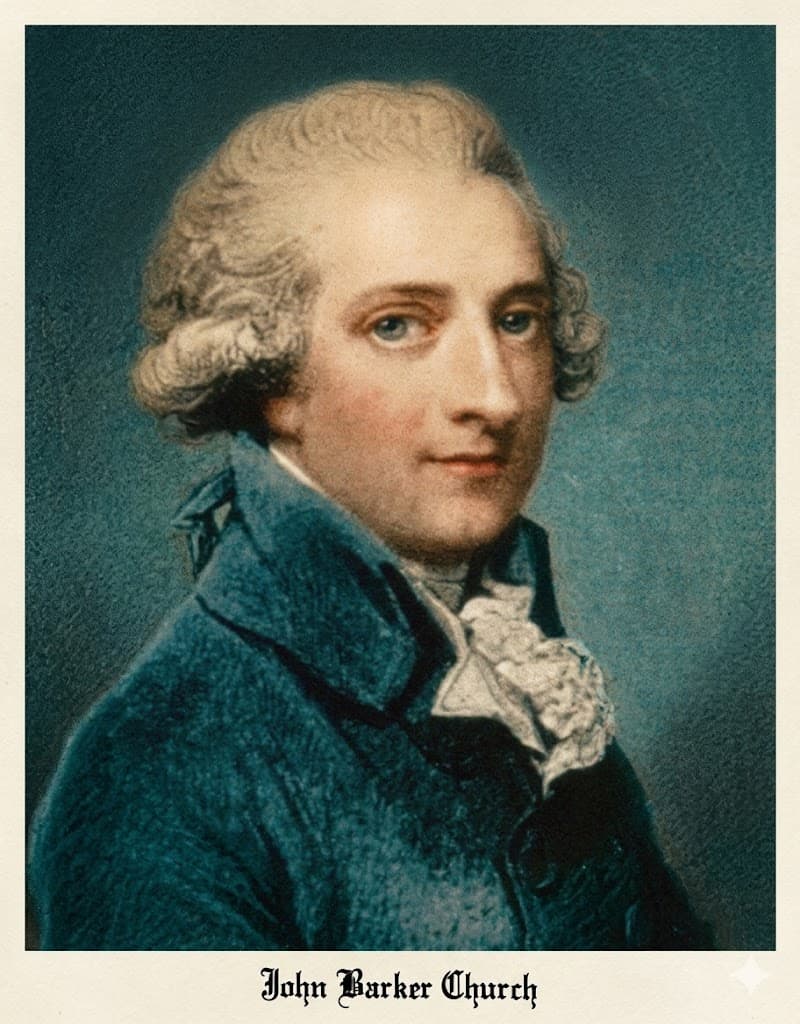
Ai-assisted Portrait of John Barker Church.
The Opportunistic Financier of the Revolutionary World
Born in 1748 in England, John Barker Church emerged as one of the most adaptable and financially successful figures moving between the political worlds of Britain, America, and Europe during the late eighteenth century.
Before establishing himself under his real name, Church initially operated in North America under the alias John Carter, engaging in wartime trade and military supply contracts during the American Revolution. These ventures proved highly profitable, allowing him to accumulate substantial wealth during a period when political and economic systems were rapidly shifting.
Rather than emerging as an ideological revolutionary, Church thrived in the practical realities of wartime commerce.
He supplied goods to the Continental Army, navigated volatile markets, and built connections across the political factions shaping the revolutionary world. His success depended less on political theory and more on his ability to recognize opportunity in unstable circumstances.
In 1777 he married Angelica Schuyler Church, the brilliant eldest daughter of Philip Schuyler, linking him to one of the most influential families in the American revolutionary generation.
Together the couple moved easily between the political societies of New York, Paris, and London. Their social network included figures such as Benjamin Franklin, Thomas Jefferson, and Alexander Hamilton.
Church eventually returned to Britain and entered formal politics, serving as a Member of Parliament. Yet even in this role he remained less a political theorist than a practical operator navigating the financial and diplomatic currents of his time.
He did not seek to reshape political ideology.
He sought to move successfully within the systems that already existed.
The Psychological Verdict
John Barker Church is best understood as ESTP.
Historical accounts portray him as confident, opportunistic, and highly adaptable across social and political environments. His rise to wealth during the Revolutionary War relied on practical decision-making, fast-moving trade, and the ability to recognize opportunities in chaotic circumstances.
Rather than pursuing long-term ideological visions or abstract political theories, Church’s actions consistently centered on real-world strategy, financial maneuvering, and situational awareness.
These patterns align closely with the Se–Ti cognitive framework.
Where many figures of the revolutionary generation were motivated by political philosophy, Church was motivated by action and opportunity.
Se — dominant
Church’s career reflects the strengths of dominant Extraverted Sensing (Se).
He thrived in environments characterized by uncertainty and rapid change. Wartime commerce required quick decisions, flexible alliances, and a willingness to act decisively when opportunities appeared.
Church did not build his success through long theoretical planning.
He responded to immediate circumstances and turned them to his advantage.
This opportunistic engagement with the present moment is a hallmark of Se-dominant personalities.
Ti — auxiliary
Behind Church’s bold financial ventures was a sharp analytical mind.
Managing supply contracts, negotiating trade arrangements, and navigating political alliances required careful analysis of risk and reward. These decisions reflect Introverted Thinking (Ti) operating in support of his actions.
Church demonstrated the ability to quickly assess complex situations and determine the most effective course forward.
Fe — tertiary
Church also moved comfortably within elite social circles.
Through his marriage to Angelica Schuyler and his later life in Europe, he maintained relationships with political leaders, diplomats, and aristocrats across multiple countries.
This ability to build and maintain influential social connections reflects Fe operating in a supporting role, enabling him to navigate the interpersonal dynamics of political society.
Ni — inferior
Unlike many revolutionary thinkers who were driven by sweeping visions of political transformation, Church’s focus remained grounded in immediate opportunities rather than long-term ideological projects.
His career demonstrates relatively little interest in philosophical speculation about the future.
Instead, he concentrated on navigating the realities of the present — a pattern consistent with inferior Ni.
Church was not attempting to design a new political order.
He was mastering the one that existed.
The Cosmopolitan Partnership
The marriage between Angelica Schuyler Church and John Barker Church produced one of the most cosmopolitan partnerships of the revolutionary generation.
Angelica, with her intellectual wit and conversational brilliance, thrived in the salons and political discussions of elite society.
Church, by contrast, excelled in the practical worlds of finance, trade, and political maneuvering.
Together they moved across continents and social circles with remarkable ease.
Where Angelica explored ideas, Church recognized opportunities.
And in the complex political landscape of the late eighteenth century, both talents proved invaluable.
Connected Figures
Further Reading
- Alexander Hamilton — Ron ChernowThe definitive biography of Hamilton — traces Church's role as brother-in-law, business partner, and owner of the dueling pistols.
- Founding Mothers: The Women Who Raised Our Nation — Cokie RobertsProfiles Angelica Schuyler Church among the women central to the founding generation's social and political networks.
- The Schuyler Sisters: A Story of the American Revolution — Mary Gay HumphreysAn early account of the Schuyler family that illuminates the world Angelica and John Barker Church moved in.
