 Historical Figure MBTI
#322 · 3-27-26 · The Enlightenment
Madame Vernet
Boarding-House Keeper · Protector of Condorcet · 'Not Outside Humanity'
fl. 1793 — 1794
6 min read
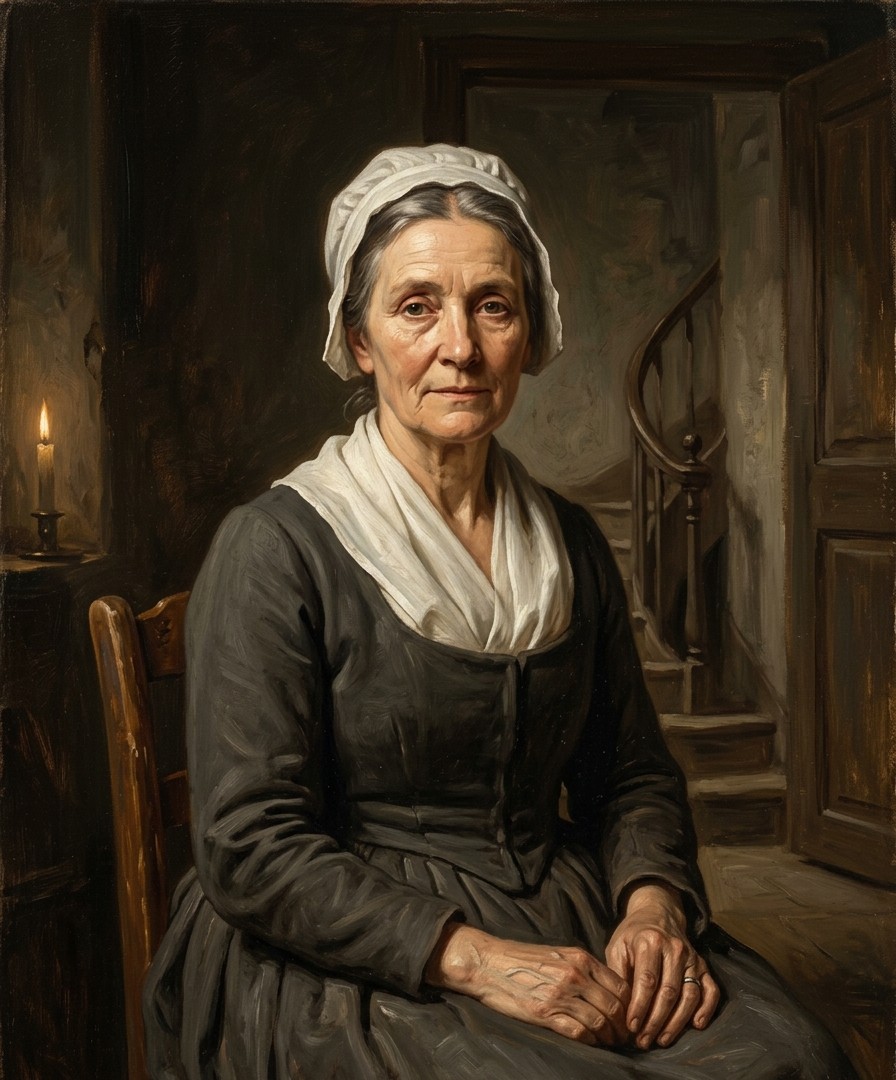
AI-assisted Portrait of Madame Vernet
The Woman Who Said You Will Stay
In July 1793, a frightened man knocked at a boarding house on the rue des Fossoyeurs and a widow named Vernet opened the door. The man was Condorcet — mathematician, philosophe, and, as of three weeks earlier, a fugitive under decree of arrest. To shelter a proscribed deputy was a capital crime; she took him in regardless and kept him for eight months through the worst winter of the Terror. Of the rest of her life — her first name recorded only as Rose, her dates lost — we have almost nothing. History keeps her for a single sentence and a single deed.
The deed has a precise shape. Condorcet, unable to forgive himself the danger he posed to her, resolved at one point to leave. She would not allow it. The Convention, she told him, might have the right to place him outside the law, but it had no right to place him outside humanity; and so he would stay. Hidden under her roof, he wrote the Esquisse d'un tableau historique des progrès de l'esprit humain — the most hopeful book of the century, composed in a back room while its author waited to die. The visionary supplied the vision. She supplied the door that did not open.
“The Convention has the right to put you outside the law, but it has not the right to put you outside humanity. You will stay.” It is the purest sentence the ISFJ ever speaks — protection as a concrete duty of the heart, not an abstraction; one specific man, kept safe behind one specific door, at the cost of one's own life if it came to that.
The Roof, the Meal, the Closed Door
Si — dominant
Dominant introverted sensing is the faculty of the concrete and the dependable — the mind that knows what must be done each day to keep a household running and builds its sense of duty from the specific and the near. A widow who kept a boarding house lived entirely in this register. When the Terror came, Vernet did not face it as a question of revolutionary principle. She faced it as a set of daily tasks: a man to be fed without arousing neighbors, a presence concealed across eight months, a routine held steady so that nothing looked different from the week before.
This was not a single brave gesture but a long one — eight months of sustained, unglamorous risk, held without the relief of an audience or the momentum of a public cause. The Si temperament is the one that keeps rising to the same moment morning after morning, carrying an obligation through the dull, frightened weeks when nothing is happening and everything is at stake. Vernet's courage was the courage of duration.
Not Outside Humanity
Fe — auxiliary
Auxiliary extraverted feeling registers another person's need as a claim on the self and responds as a matter of plain human obligation. Her famous answer is auxiliary Fe made audible: Condorcet had reasoned his way to leaving — a cold calculation of risk, abstract and self-effacing. She answered him not with a counter-argument but with a moral fact about persons. The obligation she had taken on by feeding him was not a thing she would discard for her own safety.
The men of the Terror loved humanity in the aggregate and fed particular humans to the blade in its name. Vernet did the reverse. She had no visible position on the abstraction; what she had was a particular man in her particular care and an unshakable sense that to abandon him would be a betrayal she would not commit. Auxiliary Fe in an introvert does not perform its goodness — it simply does it, behind a closed door, for reasons it does not feel the need to announce.
The Logic of the Decision Already Made
Ti — tertiary
Tertiary introverted thinking is the private capacity to reason a thing through to its conclusion and hold to it. Her answer to Condorcet was not a burst of feeling that overrode judgment — it was a small, complete argument: the Convention has a certain authority; that authority has limits; the limit falls short of the claim of one human being on another; therefore you stay. What tertiary Ti gives the ISFJ is the firmness to refuse a clever argument that points the wrong way. Condorcet had constructed the case for his own departure. She met his logic with a firmer logic and did not yield the point.
What She Could Not See Coming
Ne — inferior
Inferior extraverted intuition is the blind spot of the ISFJ — the realm of branching futures the present-bound Si mind tends to underweight. Vernet could manage every concrete fact of the household, but she could not manage the proliferating contingencies of the Terror. Condorcet talked himself out of staying and fled into the countryside to spare her — and was caught within days. She could keep a man alive behind a door. She could not keep him alive in a world of possibilities he chose to walk into, to protect her.
Why ISFJ Over ESFJ
Why not ESFJ?
The ESFJ shares the ISFJ's warmth but expresses it in a public, socially organizing register. Vernet's courage was the opposite: quiet, private, behind a closed door. She did not rally a network or mobilize a community; she hid one man under her own roof, alone, at mortal risk, asking nothing and announcing nothing. Dominant Si keeping faith with one specific person — not the outward, group-attuned warmth of dominant Fe.
With a figure recorded this thinly, the typing rests on the single act — and the act points cleanly to the ISFJ: the concrete, sustained, unannounced protection of one person placed in her care, driven by dominant Si and the auxiliary Fe of a woman who would not put a man outside humanity.
Connected Figures
Further Reading
- Condorcet: From Natural Philosophy to Social Mathematics — Keith Michael BakerCovers the fugitive Condorcet's months in hiding — the very refuge Madame Vernet provided.
- Citizens: A Chronicle of the French Revolution — Simon SchamaSets the mortal risk Madame Vernet ran by sheltering a proscribed deputy during the Terror.
- The Enlightenment: The Pursuit of Happiness, 1680-1790 — Ritchie RobertsonFrames the world of ideas that Madame Vernet's quiet act of protection helped keep alive.
