 Historical Figure MBTI
#875 · 6-24-26 · The American Civil War
Nathan Bedford Forrest
Cavalry General · Fort Pillow · The Wizard of the Saddle
1821 — 1877
10 min read
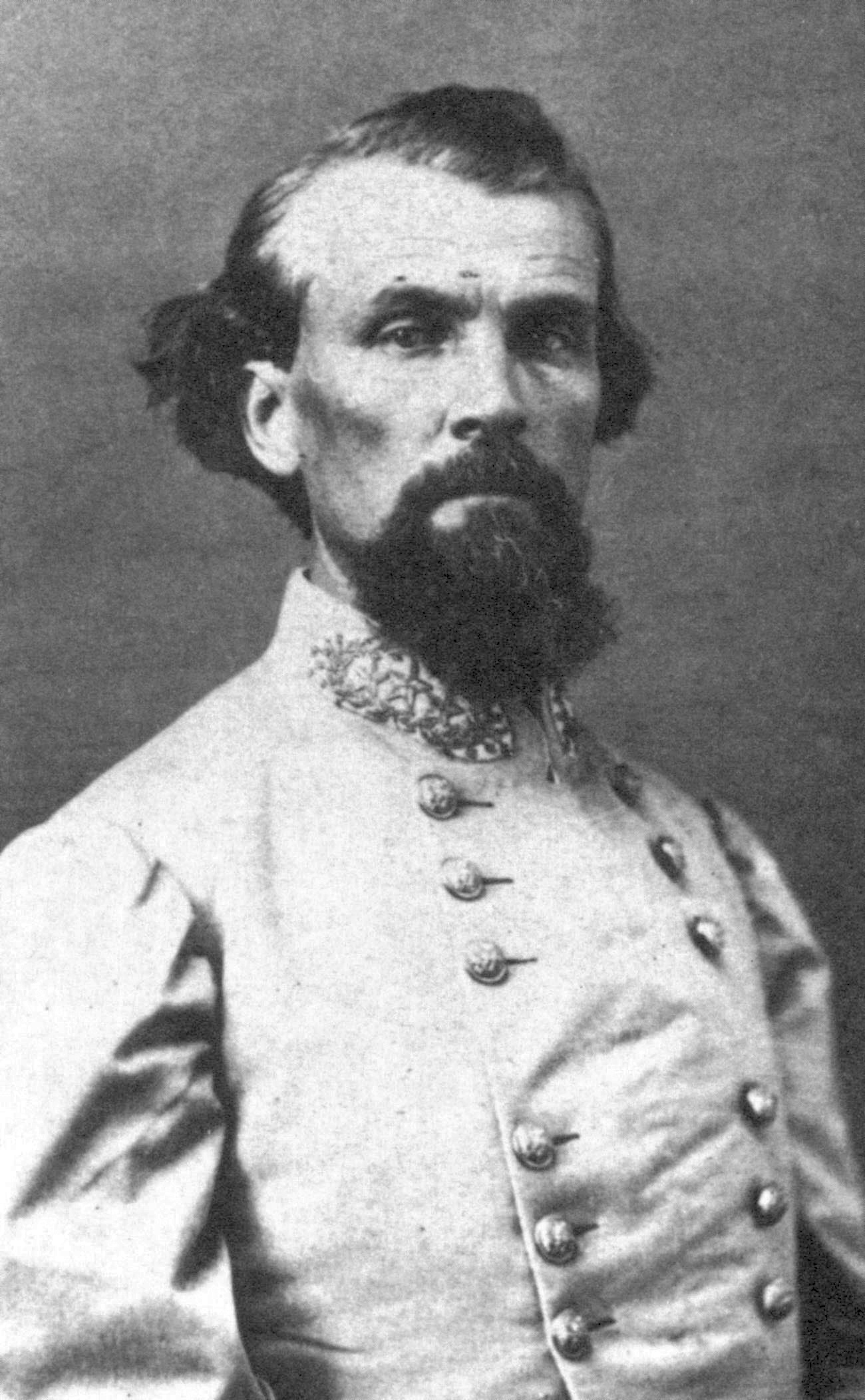
Portrait of Nathan Bedford Forrest
Get There First, With the Most Men
Nathan Bedford Forrest never sat through a lecture on strategy, never read a manual of arms, never held a commission before the war made him improvise one. He enlisted as a private in 1861 at age forty, a self-made slave trader and planter with a sixth-grade education and a reputation for settling arguments with a knife or a pistol. Four years later he was a lieutenant general, arguably the most feared cavalry commander the war produced on either side — a man Union officers spoke of the way sailors speak of weather. He did this with no theory of war at all, only an instinct for reading a field, a column, a moment, and acting on it a half-second before anyone else in the room had finished thinking.
That instinct is the whole man. Forrest fought from the front, was shot repeatedly, had nearly thirty horses killed under him, and by his own tally killed more than two dozen men hand to hand — one of them a subordinate he ran through with a penknife in a battlefield argument. This was not the record of a planner. It was the record of a nervous system tuned to the immediate physical world with a violence that bordered on the pathological, and it is also, inseparably, the record of the same instinct turned toward atrocity: at Fort Pillow in April 1864, troops under his command slaughtered surrendering soldiers, most of them Black, in a massacre Forrest never disowned and never paid for. After the war he became the first Grand Wizard of the Ku Klux Klan. Any honest account of his cognition has to hold the tactical genius and the terror together, because they came from the same place.
Forrest was an ESTP almost too purely — a man who lived entirely in the felt, present instant, and whose dominant Extraverted Sensing gave him both his battlefield genius and the reflexive, unexamined brutality that made him one of American history's most dangerous men.
The Field, Read at a Gallop
Forrest's tactical maxim — "get there first with the most men" — sounds like folk wisdom, but it describes a real cognitive process: an unbroken loop of perceiving terrain and enemy disposition and acting on the perception without the mediating step of a plan. He did not calculate troop ratios on paper; he looked at a road, a ford, a treeline, and a line of blue uniforms, and he moved. At Brice's Cross Roads in June 1864, badly outnumbered, he read the country before Samuel Sturgis's larger force could organize in it, funneled the Union column into a narrow, swampy road where its numbers meant nothing, and shattered it — a battle later taught as a textbook case of exploiting terrain, devised on the spot by a man with no textbook.
The same faculty put him bodily in danger constantly, because Se does not stand back to observe a battle — it wants to be inside the sensation of it. Forrest led charges personally, was wounded at Shiloh and again at Okolona and again in the war's final year, and killed enemy soldiers with saber and revolver at arm's length more than once, including at Fallen Timbers, where he rode alone into a Union rearguard by mistake and cut his way back out. His horses died under him in numbers that became a kind of grim legend — the count runs to twenty-nine. This was not recklessness for its own sake; it was a mind that processed a fight most accurately from inside it, at the range where hesitation kills.
The darker edge of that same immediacy is Fort Pillow. Whatever the precise chain of command in the minutes the massacre unfolded — historians still argue how directly Forrest ordered it against how completely he simply failed to stop men under his authority from murdering surrendering soldiers — the pattern fits a man who acted in the moment and rarely examined the moment afterward. He did not investigate, did not discipline, did not apologize; he wrote a report boasting that the river ran red for two hundred yards and moved on to the next campaign. An Se this dominant reads a scene and commits to it completely, for better and for atrocious worse, and Forrest's presence at the front meant his troops absorbed his instant, uncensored reactions as the rule of the moment.
A Logic With No Manual
What kept Forrest's instinct from being mere bloody-mindedness was a cold, self-built system of tactical logic underneath it — Introverted Thinking with no formal training to draw on, reconstructed from first principles under fire. He grasped concentration of force as an axiom before he had a word for it: mounted infantry that could ride to a position fast, dismount, and fight as a compact, overwhelming unit, then remount and ride away before a slower enemy could respond. He worked this out himself, against West Point-trained opponents who had it from books, and it worked better than the book version.
His famous bluffs at Murfreesboro in 1862 — demanding "unconditional and immediate surrender" from a garrison he could not actually have overwhelmed, backed by a show of force arranged to look larger than it was — show the same cold internal calculus applied to psychology rather than terrain: a spare, functional model of what the other side would believe, built and executed without hesitation. At Okolona in February 1864 he dismantled William Sooy Smith's larger, better-equipped cavalry raid through a sequence of hit-and-fall-back engagements that read, in retrospect, like a coherent operational design — though Forrest never called it a design, only a running string of decisions that each made sense on their own terms.
This Ti was structural but never abstract; it existed to serve the immediate tactical problem in front of him and rarely traveled beyond it. He could out-think a general in an afternoon and never once articulate a theory of war that outlived the campaign. It is a mind of superb local logic, not doctrine — which is precisely the shape auxiliary Ti takes behind a dominant Se.
A Voice Men Would Ride Into Fire For
Forrest's troops were, by the standards of either army, badly disciplined — irregulars, conscripts, farm boys with no drill in them — and yet they followed him into engagements that better-organized units would have refused. That loyalty was not built on paperwork or rank; it was built on a raw, extraverted command presence, a tertiary Fe that read a room of frightened men and gave them exactly the fury or resolve they needed to move. Soldiers described him roaring through the ranks in a fight, cursing, exhorting, visibly sharing the danger with them, and it worked on men no manual of discipline could have held together.
It also curdled easily into something uglier: the same social magnetism that rallied troops in battle offered no internal check on where their collective temper went once it broke, as it broke at Fort Pillow. Fe attuned to the mood of a group can inflame that mood as readily as it can steady it, and a commander who led by shared feeling rather than doctrine gave his men license as much as direction. After the war, that same gift for reading and moving a crowd's temper found its worst use: Forrest lent it, and his name, to the founding of the Ku Klux Klan, becoming its first Grand Wizard and giving a disorganized wave of Reconstruction-era terror the kind of charismatic, unifying figurehead it had lacked.
A Future He Never Quite Saw Coming
What Forrest never developed was foresight in the strategic or personal sense — the capacity to hold a long arc in view and steer toward it. His campaigns, however brilliant tactically, rarely reached past the next few weeks; he had no vision for how his raiding fit into a Confederate theory of winning the war, and by 1864 the war's actual trajectory — outproduction, attrition, the sheer arithmetic against the South — was plainly visible to shrewder observers and seemingly invisible to him. He kept winning tactical engagements inside a strategic picture that had already been lost.
His postwar life shows the same blind inferior Ni even more starkly. He tried railroad ventures, plantation management on convict labor, insurance — one failed enterprise after another, a man with no long game once the immediate battlefield problems that had organized his genius were gone. His association with the Klan followed the identical pattern: he stepped into leadership of a movement already forming around him rather than architecting it, and when its violence escalated past what even he found useful, he reportedly gave testimony distancing himself and urged its disbandment — a late, murky, self-serving turn that historians treat with real skepticism, since it cost him nothing and came only after the organization had become a liability. It reads less as moral reckoning than as the same reactive instinct that built his legend, now aimed at his own reputation instead of a battlefield.
Why ESTP Over ISTP
Why not ISTP?
An ISTP runs the same dominant-Sensing, auxiliary-Thinking pairing but introverted — a quiet mechanic's intelligence, absorbing terrain and problems without needing an audience. Forrest was the opposite of quiet. He commanded by roaring through the ranks, by physical, extraverted presence that visibly transferred his own nerve to frightened men in real time — an outward-facing performance of will, not a private technician's calm. His genius needed witnesses and followers to work at all; an ISTP's does not.
The distinction matters because it is the difference between competence and charisma turned to terrible ends. Introverted Sensing-Thinking could have produced the same tactical brilliance in a colder, more isolated figure. What made Forrest historically dangerous — able to raise, hold, and unleash a following both in battle and, later, in the Klan — was that his Sensing performance was extraverted from the start: loud, magnetic, and utterly unfiltered by reflection.
Connected Figures
Further Reading
- Nathan Bedford Forrest: A Biography — Jack HurstThe standard modern biography, unsparing on Fort Pillow and the Klan years.
- The Confederacy's Greatest Cavalryman: Nathan Bedford Forrest — Brian Steel WillsA detailed military biography focused on his tactical career.
- River Run Red: The Fort Pillow Massacre in the American Civil War — Andrew WardThe fullest account of the massacre and the debate over Forrest's culpability.
- Reconstruction: America's Unfinished Revolution, 1863–1877 — Eric FonerEssential context for the Klan's founding and Forrest's role as its first Grand Wizard.
