 Historical Figure MBTI
5 min read
#214 · 3-21-26 · The Age of Alexander
Parmenion
The Steady Hand of Macedon
c. 400 – 330 BCE
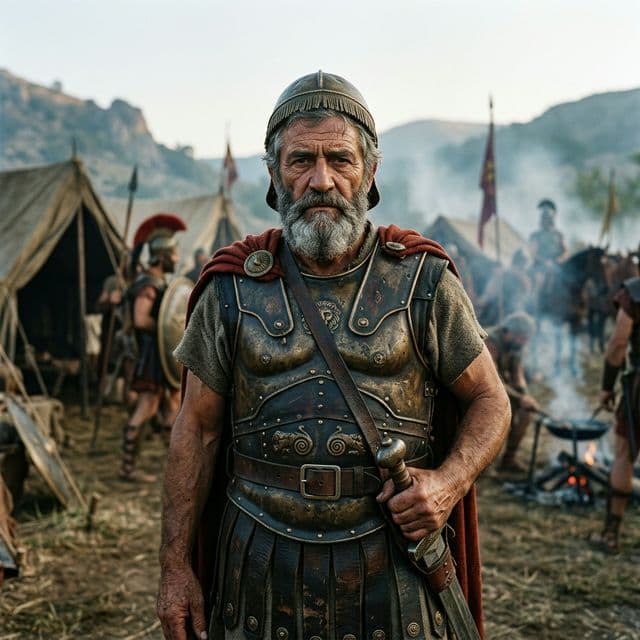
AI-assisted portrait of Parmenion
The Architecture of Tradition
Parmenion did not just fight a war; he enforced a standard. As the veteran general of Philip II, his life was defined by a profound, unwavering commitment to the proven methods and structural integrity of the Macedonian military machine. While his young king Alexander was driven by a mercurial, visionary expansion (Ni), Parmenion’s genius was profoundly rooted in the tangible, reliable reality of the phalanx (Si). He was the anchor of the campaign, the one who valued the known, the structural, and the administrative over the infinite horizons of the visionary.
He was the master of the defensive line and the logistical truth. From the organization of the heavy cavalry to his famous tactical advice at Gaugamela, Parmenion’s cognitive mode was focused on the internal comparison of the present situation to the established benchmarks of success. For Parmenion, the world was a set of known quantities that required a disciplined, objective command to manage.
Historical Context
Parmenion was a Macedonian general in the service of Philip II and Alexander the Great. He was the primary military architect of Philip's reforms and served as the second-in-command during the first half of Alexander's Persian campaign. Known for his tactical caution and logistical brilliance, he often clashed with Alexander's more aggressive and visionary style. His life ended in tragedy in 330 BCE when, following the alleged conspiracy of his son Philotas, Alexander ordered his execution in Ecbatana to prevent a revolt. His death marked the definitive shift from the "Macedonian" campaign of Philip to the "Imperial" campaign of Alexander.
The Psychological Verdict
Parmenion is a definitive ISTJ. He was a figure of deep, internal loyalty to tradition and proven experience (Si), supported by a pragmatic, logical approach to his external environment (Te) and an unwavering sense of duty (Fi).
Si — Dominant
His primary mode was the preservation of established order. Parmenion’s identity was tied to the reforms of Philip II; he was the living embodiment of the Macedonian way of war. His decisions were characterized by a focus on the reliable, the repeatable, and the traditional. He distrusted the "new" and the "unproven," famously advising Alexander to take the safe, established path whenever the young king sought a more visionary risk. He was the guardian of the phalanx as a living tradition.
Te — Auxiliary
Supporting his sense of tradition was an objective, effective application of logic. Parmenion was a master of logistics and tactical organization. His actions were decisive, calculated, and entirely oriented toward the efficient management of the army’s resources. He ran the military machine with the same precision he used to command the left wing of the battle line. He didn't seek glory (Fe); he sought the structural finality of a completed objective.
Fi — Tertiary
Beneath his strategic exterior lay a deeply private and unwavering internal loyalty. His tertiary Fi manifests in his absolute devotion to the service of the Macedonian throne, first under Philip and later under Alexander. This internal standard of duty was quiet and unobserved, but it provided the bedrock for his decades of service. His eventual execution was the ultimate failure of a system he had spent his entire life building.
Ne — Inferior
What stayed in the background was a relative discomfort with the unpredictable and the visionary. Parmenion flourished in the known geography of traditional warfare. His inferior Ne manifested in his skepticism toward Alexander’s more radical and expansive goals. He was the voice of "enough," unable to fully conceptualize or trust the infinite possibilities that the young king saw in the distance.
The Man Who Said "Enough"
Parmenion served Philip II for twenty years before he ever served Alexander. He was in his mid-sixties when the Persian campaign began, commanding the left wing in every major engagement while Alexander led the cavalry charge on the right. His famous line — "If I were Alexander, I would accept these terms" — and Alexander’s retort — "So would I, if I were Parmenion" — captures the entire tension between them. He was the voice of sufficiency in a campaign that was becoming something else. When his son Philotas was accused of conspiracy in 330 BCE, Alexander had them both executed — Parmenion without trial, on the reasoning that a general of his stature couldn’t be left alive once his son had been condemned. He was in Ecbatana at the time, guarding the treasury. He never knew it was coming. The campaign he had helped build continued east without him, and began to fracture shortly afterward.
Connected Figures
Further Reading
- Alexander the Great — Robin Lane FoxThe classic narrative biography; covers Parmenion's role at Granicus, Issus, and Gaugamela in full detail.
- Philip II of Macedon — Ian WorthingtonThe essential study of the king Parmenion served longest — places the general's career in its proper Macedonian context.
- Alexander the Great: The Hunt for a New Past — Paul CartledgeA concise scholarly reassessment of Alexander's campaigns and the officers who made them possible.
