 Historical Figure MBTI
#387 · 4-4-26 · Elizabethan England
Robert Dudley
Earl of Leicester · Elizabeth's Favorite · The Queen's Eyes
1532 — 1588
7 min read
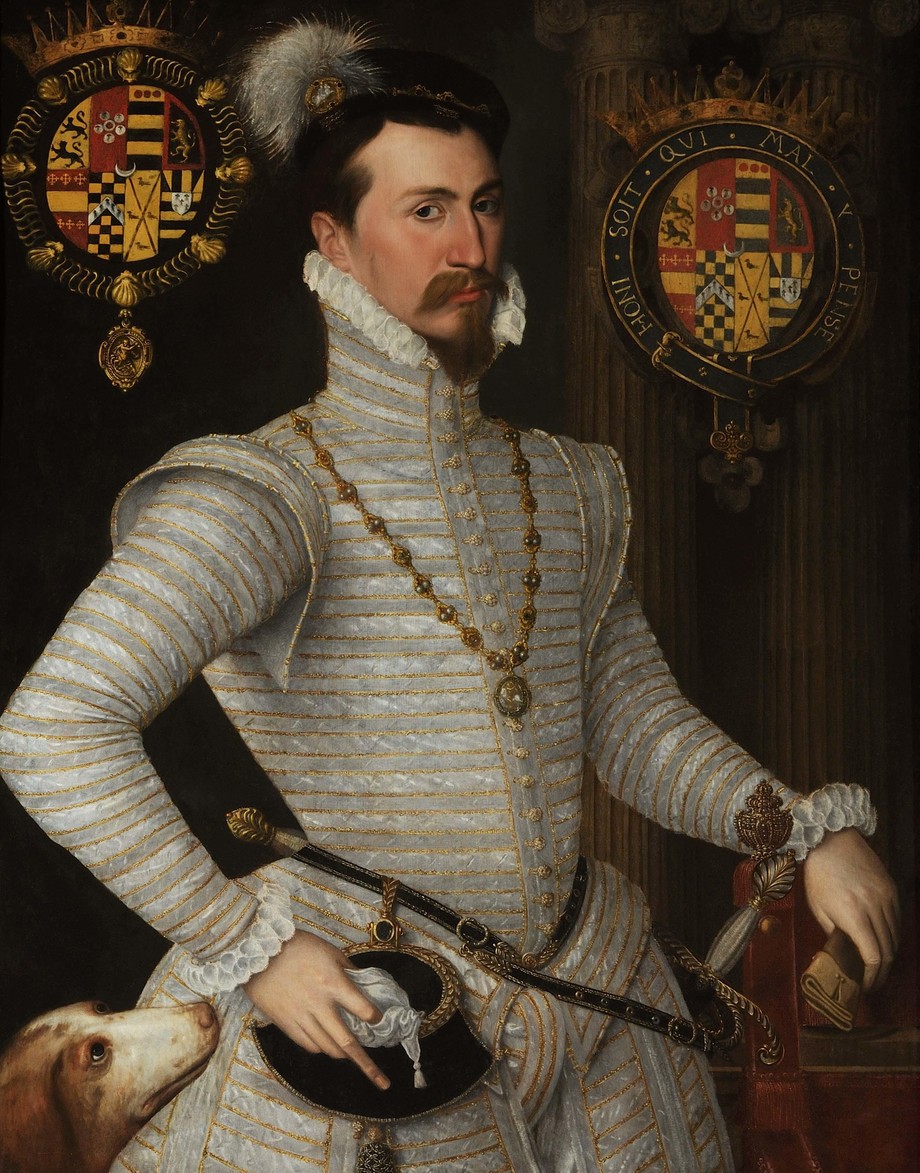
Portrait of Robert Dudley
The Man Who Won a Queen's Heart but Never the Crown
Robert Dudley was born in 1532 into a family that played for the highest stakes: his grandfather executed by Henry VIII, his father hanged for the Lady Jane Grey plot, Robert himself sitting in the Tower under sentence of death as a young man — sharing a prison with the princess who would one day make him the most powerful man in England. When Elizabeth I came to the throne in 1558, almost her first act was to summon him. She named him Master of the Horse—the office that put him at her side whenever she rode, hunted, or processed—and from that day until his death thirty years later he was her favorite and, by every honest reckoning, the love of her life. What he gave her was not Cecil's counsel or Walsingham's intelligence: he gave her spectacle and physical delight, and made the court feel like a bright game played for her amusement.
The scandal that fixed his ceiling came in 1560, when his first wife, Amy Robsart, was found dead at the foot of a staircase on a day she had pointedly sent her servants away. Whether accident, suicide, or murder, the timing was ruinous: Europe assumed Dudley had cleared his way to the throne, and Elizabeth saw at once that marrying him would tar her crown with his rumor forever. He remained the man she loved and could not marry—and when he died in 1588 she shut herself away, keeping his last letter in a casket by her bed, marked in her own hand “his last letter,” until she died. The man under the magnificence is a textbook ESTP: physical dazzle and present-tense charm, a shrewd eye for advantage at close range, and strategically shallow the instant the game required foresight instead of flair.
Dudley was the ESTP in a doublet of gold—dominant Se in the athleticism and the pageantry that dazzled a queen, auxiliary Ti in the courtier's cool eye for advantage, and underneath it the strategic shallowness that won her heart but never the crown.
The Body That Dazzled a Queen
Se — dominant
Contemporaries did not praise Dudley's mind first; they praised his person. He was the finest horseman at court—which is precisely why Elizabeth made him Master of the Horse before giving him anything else—a champion at the tilt, and a dancer of the volta who made the queen keep him near for it. Kenilworth in 1575 is the purest Se set-piece of the reign: nineteen days of fireworks, a floating Lady of the Lake, hunts and acrobats and a clock stopped at two so that time itself seemed to pause for her pleasure. It was courtship in sheer sensory overload, the Se conviction that you win not by argument but by overwhelming the senses. The same impulse made him reckless: he married Lettice Knollys in secret in 1578—the queen's own cousin, a woman Elizabeth detested—grasping at present satisfaction without weighing the cost, earning her lasting fury and Lettice a permanent banishment from court. He was forever doing the vivid thing rather than the prudent one, because the long game was never where his attention lived.
The Courtier's Cool Eye for Advantage
Ti — auxiliary
Dudley was no fool, and the men who underestimated him because he was beautiful learned otherwise. He survived a court where the wrong alliance meant the Tower, and he survived it for thirty years at the very center. He accumulated offices, monopolies, and estates with a careful eye to what each was worth; he read the exact temperature of Elizabeth's favor, knew when to press and when to retreat, and grasped that his value lay in being indispensable to her pleasure rather than to her policy. On the Privy Council he was a sharp advocate for intervention in the Netherlands and held his ground against Cecil's steadier party for decades. But the Ti ceiling is close-range: he could read a room, a rival, or a royal mood with accuracy, and was reliably blindsided by the consequences that lay further out.
The Charm That Bound a Queen for Thirty Years
Fe — tertiary
Charm dies on the page, but its effect is overwhelming in the record. Elizabeth called Dudley her “Eyes,” signed his letters with a pair of dots, and let him closer than she let any other living soul—not because he was handsome, but because he knew instinctively how to make a guarded woman feel seen, amused, and adored. His Fe worked the wider court the same way: players, poets, and Protestant divines clustered to him because he understood the social economy of favor and worked it warmly, making himself the sun that lesser men orbited. But tertiary Fe serves the self before anyone else. He could be cold to the wife kept in the country, ruthless to a rival, and his devotion to Elizabeth was never separable from the fact that her favor was the whole foundation of his greatness. The warmth was sincere and self-interested at once—exactly what tertiary Fe in a hungry ESTP looks like.
The General Who Could Not See the Future
Ni — inferior
For thirty years the court game was tactical and immediate, and Dudley's Se and Ti were superbly equipped for it. Then in 1585 Elizabeth gave him the one thing he had always wanted and was least fitted to hold: a real military command in the Netherlands. The inferior function was exposed at once. He was a mediocre general with no feel for the slow calculus of a campaign—supply, attrition, the long position against the greatest power in Europe. He accepted from the Dutch the title of Governor-General, implying England had taken sovereignty over the Low Countries—precisely what Elizabeth had been at pains to avoid—without seeing the diplomatic catastrophe it set in motion. The queen was incandescent. The campaign limped and failed, and he came home close to disgrace. He overreached because he could not see the shape of the thing he was reaching into: the skills that won a queen's heart were exactly the wrong tools for the task that demanded foresight, and he had nothing else to reach for.
Why ESTP Over ISTP
Why not ISTP?
The ISTP shares Dudley's Se-Ti spine—the physical competence, the cool tactical read, the same allergy to long-range vision—and a hasty diagnosis might stop there. But the ISTP is inward, private, and indifferent to applause. Dudley was the precise opposite: outward, dashing, built to be looked at, a man who staged nineteen-day pageants and danced the volta because he hungered for the spotlight. His tertiary Fe—the gregarious, room-working charm that bound Elizabeth for thirty years—is the extravert's signature; an ISTP would have charmed no one and wanted to charm no one. The man who lived for the queen's eye on him is ESTP, not the detached, self-contained ISTP.
Connected Figures
Further Reading
- Robert Dudley, Earl of Leicester — Derek WilsonThe most thorough modern biography, tracing Dudley from the Tower to Tilbury.
- The Favourite: A Life of Robert Dudley, Earl of Leicester — Clemency Burton-HillA vivid narrative account of the Dudley-Elizabeth relationship and its political stakes.
- Elizabeth: The Struggle for the Throne — David StarkeyPlaces Dudley's rise firmly within the dangerous court politics of Edward VI and Mary's reigns.
- The Virgin Queen: Elizabeth I, Genius of the Golden Age — Christopher HibbertReadable court history that tracks the queen's relationship with Dudley across the full reign.
