 Historical Figure MBTI
#1240 · 9-12-26 · The Mughal Empire
Roshanara Begum
Imperial Princess · Participant in the Succession
1617–1671
5 min read
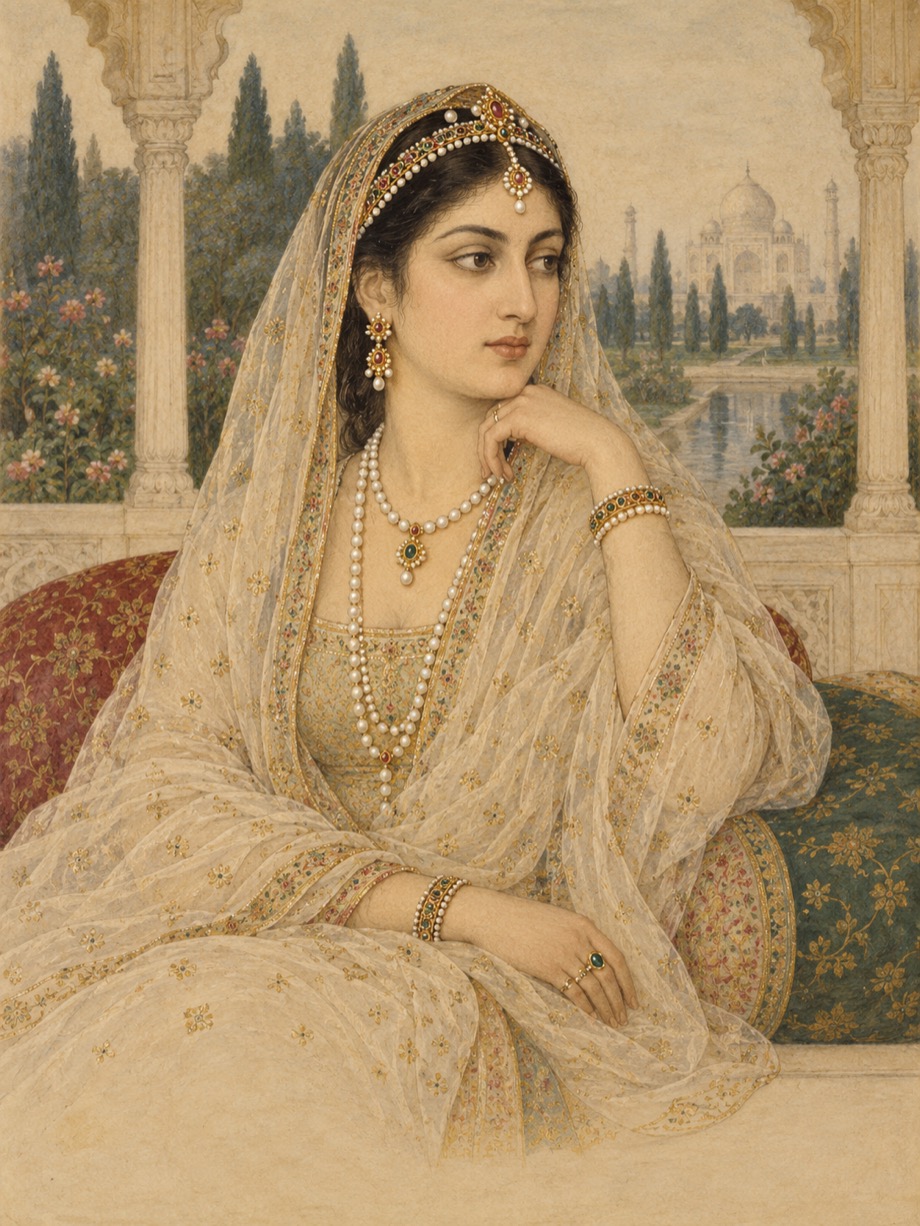
AI-assisted Portrait of Roshanara Begum
The sister who chose another brother
Roshanara Begum refused to let the royal household’s most visible alignment become her own. Her elder sister Jahanara stood close to Shah Jahan and Dara Shikoh; Roshanara supported Aurangzeb during the succession struggle that followed their father’s illness in 1657. The choice mattered because a Mughal princess occupied a political position even when she commanded no field army. Access, information, money, and kinship could affect what men outside the household were able to do.
The record is much less generous about her interior life. European travelers and later narratives often tell the story through rivalry, greed, and sexual scandal. A woman exercising influence becomes especially available for a moral explanation of how power works badly. Such accounts may preserve information, but they cannot be treated as a transparent record of what she wanted or how she reasoned.
The low-confidence ENTJ reading rests on deliberate political alignment and the effort to make that alignment consequential. It is a cautious interpretation of her agency, not a conclusion drawn from being an ambitious princess. The hostile material makes restraint more necessary, not less.
The tentative ENTJ reading emphasizes dominant Extraverted Thinking in Roshanara’s effort to turn a chosen dynastic alliance into effective political influence.
The household has channels of power
Roshanara’s support for Aurangzeb is the secure center of the portrait. He needed allies while operating at a distance from the imperial household and while Dara enjoyed the advantages of proximity to their father. A sister within that household could offer something different from a provincial commander: knowledge of the court’s changing balance and a relationship that did not depend solely on military appointment.
Later accounts describe communication and advice passing between them. The exact content and effect of every reported intervention cannot be established equally well, so she should not become the hidden author of all Aurangzeb’s victories. What matters is that the household was one arena of the contest. To treat her as merely a jealous observer repeats the assumption that power becomes real only when an army appears on a map.
Extraverted Thinking is the proposed dominant function because the surviving pattern points toward influencing outcomes through those channels. That remains a narrow base for typing. We do not possess a comparable record of her ordinary deliberation across many unrelated situations. The interpretation should therefore be carried as a lean, with the historical claim of participation kept separate from the psychological claim about its source.
The result did not make a princess sovereign in her own right. Influence remained attached to relationships, and a victorious brother could redefine the value of a sister’s help. That dependence belongs beside the evidence of agency. Roshanara could act decisively without possessing secure control over what her action would later earn her.
An alliance with a future attached
Her alignment with Aurangzeb also meant choosing one possible future for the dynasty against another. The illness of Shah Jahan did not place a settled rule of succession into automatic motion. Princes had supporters, forces, and competing claims. Roshanara’s decision can be understood as a judgment about where power might go, but hindsight makes that judgment look more inevitable than it was. Before victory, backing Aurangzeb carried risk.
Auxiliary Introverted Intuition offers a possible reading of sustained attention to that political direction. It does not license a fictional scene in which she foresees the entire reign. The central fact is a durable association with one claimant, rather than an endlessly shifting series of allegiances. Whether she chose him for affection, anticipated advantage, conviction about his ability, opposition to Dara, or a mixture of reasons remains less securely documented.
Nor should the contrast with Jahanara become a complete division of character: the spiritual sister against the calculating one. Jahanara also negotiated, held wealth, and exercised political influence. Roshanara’s surviving reputation is narrower in part because narrators made it so. Different alliances do not prove that one woman lacked feeling or that the other stood outside politics.
Why this tentative reading?
Why not ESTJ?
A princess using established household relationships could be interpreted through practical organization supported by inherited precedent. ENTJ is preferred only tentatively because the defining choice appears oriented toward a future concentration of power, rather than preserving the household’s existing alignment. The distinction remains weak, since the evidence records her factional position much more clearly than her process of judgment.
We should resist treating unfavorable adjectives as cognitive evidence. A narrator’s accusation of greed or intrigue may reveal how he judged powerful women, what he heard from rivals, or what made a dramatic story. None identifies a function.
Connected Figures
Further Reading
- Travels in the Mogul Empire, A.D. 1656–1668 — François BernierAn interested contemporary account of the succession war; separate witnessed events from court reports and moral judgments.
- The Mughal Empire — John F. RichardsPlaces princely competition, imperial government, and expansion within their institutional setting.
- The Anecdotes of Aurangzeb — Jadunath Sarkar, translator and editorCollected reports and correspondence to read with attention to transmission, attribution, and the purposes of imperial self-presentation.
