 Historical Figure MBTI
#418 · 4-7-26 · The Age of Travelers
Rustichello of Pisa
Romance Writer · The Ghostwriter of the Travels
fl. c. 1271 — 1300
7 min read
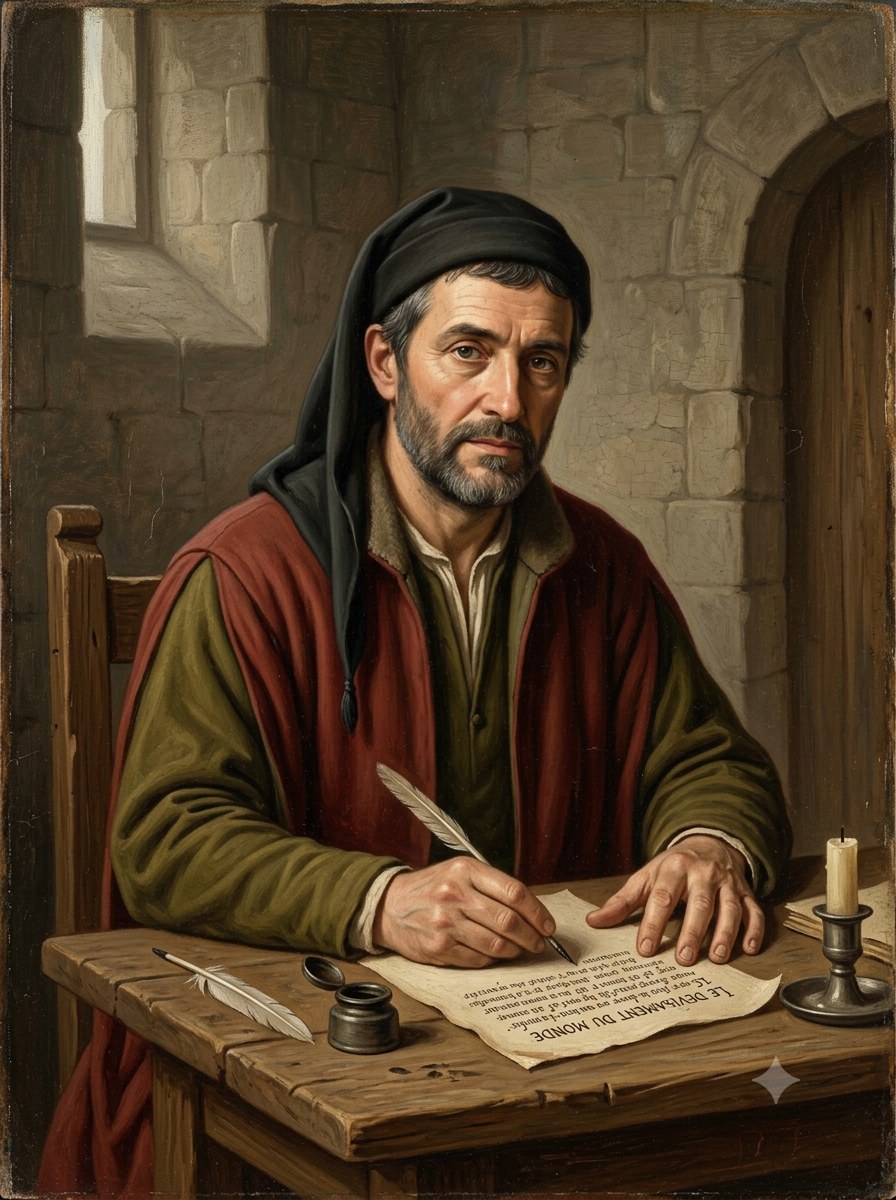
AI-assisted Portrait of Rustichello of Pisa
The Pen Behind the Legend
We know almost nothing about Rustichello of Pisa, and yet without him one of the most influential books of the Middle Ages would not exist. He was a writer of Arthurian and chivalric romance — a professional spinner of knights, quests, and courtly marvels — working in the Franco-Italian literary idiom that educated readers across the Mediterranean prized. Sometime around 1298 he found himself a prisoner of the Genoese, and into his cell, by one of history's luckier accidents, walked a Venetian merchant with twenty-four years of road behind him and a story no European had ever heard.
That merchant was Marco Polo, and what happened next was a collaboration. Marco talked; Rustichello wrote. The merchant supplied the raw memory — the markets and khans and caravan routes of a world that ended somewhere past the edge of the known map — and the romancer supplied the shape. He gave the book an elaborate prologue addressed to “emperors and kings, dukes and marquises,” framed its wonders with the dramatic set-pieces of courtly literature, and colored Kublai Khan's court with the gold leaf of chivalric splendor. A travelogue became a narrative; a report became a romance; and the result became a medieval bestseller. Marco saw the world. Rustichello made it readable.
Rustichello is the ENFP as collaborator and amplifier — the storyteller who hears another man's raw memories and instantly sees the epic latent inside them, then writes it into being.
Seeing the Epic in the Raw
Ne — dominant
Dominant Ne hears a fact and immediately sees the story it could become. Marco Polo was, by all accounts, a plain-spoken man recounting what he had seen — distances, goods, customs, the machinery of an empire. A literal scribe would have produced an inventory. Rustichello produced wonder. He understood instinctively that the value of this material was not in its accuracy but in its possibility — the sense it gave of a vast, shimmering world just beyond reach — and he wrote toward that possibility at every turn.
His whole prior career trained the instinct. A romancer does not transcribe; he heightens. He takes a battle and makes it a single combat between champions, takes a court and makes it a marvel of jewels and ceremony, takes a journey and makes it a quest. Rustichello brought that amplifying eye to Marco's notes, draping the khan's palaces and the Mongol armies in the language of Arthurian splendor. The book is full of set-piece descriptions that read like the great halls of romance because the man writing them had spent a lifetime building exactly those halls in fiction. Ne sees what a thing could be and reaches for the most vivid version.
It is the same imaginative reflex that opens the book with its grand address to emperors and kings — a frame that promises the reader not data but spectacle. Rustichello was not interested in the limits of Marco's account. He was interested in its horizons. That is the romancer's gift and the dominant-Ne signature: the refusal to leave a wondrous thing un-amplified.
The Voice That Loved the Telling
Fi — auxiliary
Auxiliary Fi gives the ENFP's wide-flung imagination a personal center — a felt sense of what is worth caring about, what is beautiful, what deserves to be preserved. In Rustichello it shows up as the storyteller's genuine enthusiasm, the warmth that keeps the book from being a cold catalogue. You can feel a writer who delighted in the marvels he was relaying, who wanted the reader to feel the same astonishment he felt at the size and strangeness of the East. The wonder is not manufactured; it is shared.
That inward conviction also explains the collaboration itself. Rustichello did not merely take down a stranger's words for hire — he attached himself to Marco's story because he believed in it, because something in him responded to the romance of a man who had crossed the world and come back. Fi is selective and loyal; once it commits to a thing, it pours itself in. The personal voice that opens the prologue, claiming the tale for its audience with such evident relish, is the voice of a man who has found a story he loves and means to do it justice.
It is a quieter function than the showman's Ne, but it is the reason the book has heart as well as scope. Rustichello's enthusiasm is contagious precisely because it was real — the auxiliary-Fi conviction that this material mattered, and that telling it well was its own reward.
The Craftsman Who Knew the Machinery
Te — tertiary
Tertiary Te in an ENFP supplies the practical scaffolding that turns inspiration into a finished object. For all his romancer's flair, Rustichello was a working professional who knew how books got made and what made them sell. The choice of Franco-Italian — the prestige literary language of courtly readers across the Mediterranean — was a market decision as much as an artistic one. So was the grand dedicatory frame: a prologue addressed to the highest readers signaled the ambition of the work and positioned it for the widest possible audience.
The structuring instinct runs through the whole project. Rustichello took a sprawling, unordered mass of recollection and gave it the architecture of a narrative — openings, transitions, set-pieces placed for maximum effect. He had done it before: his Arthurian compilations were exercises in assembling existing material into a coherent, readable whole. That editorial competence is the tertiary function quietly at work, the part of him that knew not just how to imagine a scene but how to deliver a manuscript a copyist could multiply and a court could enjoy.
Leaning on the Forms He Knew
Si — inferior
Inferior Si in an ENFP shows up as a reliance on familiar templates — the comforting, well-worn forms a restless mind reaches for when it needs solid ground. Confronted with the genuinely new — an account of a civilization no romance had ever imagined — Rustichello did the characteristic inferior-Si thing: he poured the unprecedented into the molds he already trusted. Kublai's court became a chivalric court; the marvels of Cathay became the marvels of romance. The unfamiliar was made legible by dressing it in the conventions he had used his whole career.
It is a limitation and a gift at once. Some of what gives the Travels its slightly fabulous quality — the borrowed set-pieces, the recycled motifs, even passages lifted from his earlier Arthurian work — comes from this instinct to fall back on the established pattern rather than invent a wholly new form to match a wholly new world. But it is also exactly what made the book accessible. Readers met the most foreign material of their age in a shape they already understood. The inferior function, leaning on the past, was quietly what carried the future to the audience.
Why ENFP Over ENTP
Why not ENTP?
Both types share dominant Ne — the same proliferating, possibility-seeking imagination. The split is in what sits beneath it. The ENTP runs on Ti: it builds arguments, tests logical consistency, and reaches for the world to debate it. The ENFP runs on Fi: it reaches for the world to feel and to tell. Rustichello shows no sign of the debater. There is no dialectic in the Travels, no system being defended, no opponent being dismantled — only a story being amplified and adorned with evident love. His amplifying impulse is the romancer's, driven by wonder and a personal delight in the telling, not the logician's drive to win a point.
What distinguishes Rustichello is that his Ne served enchantment rather than argument. An ENTP handed Marco's account might have interrogated it, weighed its claims, turned it into a case. Rustichello did the ENFP thing instead: he saw the marvel, fell for it, and wrote it bigger and brighter so others would fall for it too. The Travels endures not as a proof but as a spell — and that is an Ne-Fi achievement, the romancer's wonder amplified by a voice that genuinely loved its subject.
Connected Figures
Further Reading
- The Travels of Marco Polo — Marco Polo & Rustichello of Pisa (trans. Ronald Latham)The book itself — the collaboration in full; Rustichello's romance frame and amplifying hand are visible on every page.
- Marco Polo and the Discovery of the World — John LarnerThe standard scholarly account of how the book was made, transmitted, and read — clear-eyed on Rustichello's role as co-author.
- Marco Polo: From Venice to Xanadu — Laurence BergreenA vivid narrative biography that brings the Genoese prison and the dictation of the Travels to life.
