 Historical Figure MBTI
6 min read
#282 · 3-25-26 · Catherinian Russia
Samuel Greig the Younger
Admiral · Son of a Legend · Commander of the Black Sea Fleet
1775 — 1845
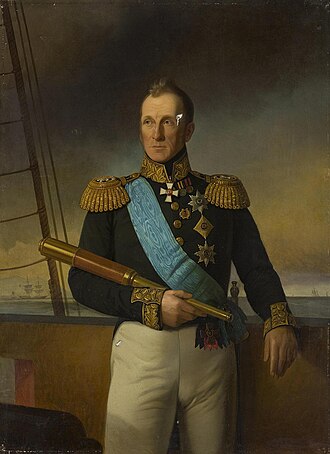
Portrait of Samuel Greig the Younger (Admiral Aleksey Greig)
The Admiral Who Consolidated What His Father Built
He was born Aleksey Samuilovich Greig — son of the legendary Admiral Samuel Greig and Sarah Cook of Scotland, born in Kronstadt in 1775 inside the naval fortress his father was busy modernizing. Scotland was his ancestry; Russia was his only real country.
He rose to become Commander of the Black Sea Fleet from 1816 to 1833. He reorganized its administration, rebuilt Sevastopol's infrastructure, and drilled the fleet into a force capable of serious operations. That preparation paid off in October 1827 at the Battle of Navarino — the last major fleet action fought entirely under sail — where he commanded the Russian contingent in a combined Allied squadron that destroyed the Ottoman-Egyptian fleet and secured the conditions for Greek independence. Aleksey Greig was at the center of that moment.
The ESTJ is not the visionary who builds institutions from nothing — that was his father. The ESTJ is the capable administrator who inherits those institutions, understands them thoroughly, and makes them function at their best. Aleksey Greig was exactly that: the consolidator of a naval legacy his father had created.
Where his father arrived in Russia and had to invent a modern fleet from near-nothing, Aleksey inherited a functioning institution and made it better. The father was a builder; the son was an administrator — and in the long run, empires need both.
The Systematic Commander
Aleksey Greig's dominant function was Te — extraverted thinking — and it expressed itself in how he approached the Black Sea Fleet: not as a political prize but as an institution that needed to be organized correctly. When he took command in 1816, the fleet was functional but inconsistent. Greig spent two decades systematizing it — rebuilding Sevastopol's infrastructure, establishing clearer administrative procedures, and holding officers to standards of accountability that had previously been enforced unevenly. His approach was procedural in the deepest sense: get the systems right, and the outcomes follow.
Sevastopol as a functioning naval base — capable of sustaining the Crimean War a decade after Greig left — owed much of its infrastructure to his tenure. Te dominant leadership of this kind is rarely celebrated in the popular imagination, but it is what actually sustains institutions across generations. At Navarino, commanding within a coalition operation — the most demanding administrative context a naval officer can face — he executed his part of the engagement with the disciplined precision that defined his career. He did not improvise brilliantly like a Nelson. He performed excellently what he had prepared his fleet to do.
The Weight of His Father's Name
The Si auxiliary of an ESTJ provides the anchor of precedent and accumulated knowledge that gives their Te its depth. For Aleksey Greig, that Si had a very specific content: his father's legacy. Admiral Samuel Greig was already a legend in the Russian Navy by the time Aleksey came of age — the Scottish officer who built the Baltic Fleet into a serious fighting force, won the Battle of Chesme, and whom Catherine the Great mourned when he died in 1788. Aleksey grew up inside that shadow and chose, consciously, to inhabit it rather than escape it.
This is Si at work: not clinging to the past neurotically but taking it seriously as a source of standards. His career was, in a meaningful sense, a continuation of his father's project — extending Russian naval power, building on the infrastructure his father had started, professionalizing the fleet his father had helped create. The elder Greig had understood that a navy functions through systems and traditions. Aleksey absorbed that understanding and applied it to the Black Sea Fleet with the same thoroughness. The Si auxiliary shows in ESTJs not through sentiment but through the depth of their institutional knowledge — the way they can recall why procedures exist and why deviation from them is dangerous.
A Russian Who Was Never Really Scottish
Aleksey Greig's Fi tertiary — the function of personal values and private loyalty — expressed itself in a choice that was, for someone of his background, not obvious: he was genuinely Russian. Not performatively, not strategically, but in the way that actually matters. His mother Sarah Cook was Scottish; his father had been Scottish; but Aleksey was Kronstadt-born and Russian-formed, and he committed his entire professional life to the Russian state without expressed nostalgia for a Scotland he had never really known.
The Fi tertiary in an ESTJ is the wellspring of their deeper loyalties — the ones that don't need to be performed because they simply are. For Aleksey Greig, that loyalty was to the Russian Navy. It also shaped how he navigated court politics — carefully, protecting the institutional interests of the Navy rather than attaching himself to any particular faction. ESTJs with developed Fi have a clear sense of what they stand for that is separate from what is convenient; Aleksey Greig maintained his professional integrity across a career that spanned several reigns and several shifts in the political winds of St. Petersburg.
Why ESTJ Over ENTJ or ISTJ
Why not ENTJ?
An ENTJ commander would have been a strategic visionary — reshaping the geopolitical role of the fleet, seeking new missions, inventing new doctrines. Greig was not this. His father was closer to the ENTJ archetype — the builder who arrived with a vision. Aleksey took that vision and systematized it, which is the ESTJ mode rather than the ENTJ one.
Why not ISTJ?
An ISTJ would have maintained systems quietly rather than demanding institutional compliance from others. Aleksey Greig was clearly extraverted in his command style: he imposed standards, confronted dysfunction, and drove change through authority. The Te dominant axis places him as ESTJ over ISTJ.
Connected Figures
Further Reading
- By the Banks of the Neva: Chapters from the Lives and Careers of the British in Eighteenth-Century Russia — Anthony CrossCovers the Greig household — Aleksey Greig, son of Samuel and Sarah Cook, born into Britons in Russian service.
- Russia in the Age of Catherine the Great — Isabel de MadariagaSets the imperial framework in which a second-generation admiral like Aleksey Greig built his career.
- The Romanovs: Autocrats of All the Russias — W. Bruce LincolnTraces the Black Sea Fleet's command structure that Aleksey Greig rose through and led.
- Catherine the Great and Potemkin: The Imperial Love Affair — Simon Sebag MontefioreCovers the naval patronage networks his father built and that Aleksey Greig inherited and consolidated.
