 Historical Figure MBTI
#1000 · 7-23-26 · The Second World War
Sophie Scholl
The White Rose · Student Resistance · Leaflets Against the Reich
1921 — 1943
8 min read
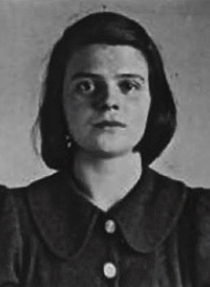
Portrait of Sophie Scholl
A Suitcase of Paper
She was twenty-one, a first-year student of biology and philosophy at the University of Munich, and by the morning of 18 February 1943 she had been at it for months — stencils, a hand-cranked duplicator, night trains to Stuttgart and Vienna with a case full of paper that could get her killed. The White Rose printed six leaflets in eight months. The last of them she and her brother Hans carried into the university’s main building between lectures, laying them along the corridors, and then, with the halls about to fill, she pushed the remaining stack off the atrium balustrade so that the pages fell through the light well onto the floor below.
A caretaker saw her do it and locked the doors. The Gestapo had her by noon. She was interrogated for four days, tried before the People’s Court under Roland Freisler, and beheaded on 22 February alongside Hans and their friend Christoph Probst, hours after sentence. Everyone who saw her in those last days described the same thing, which was composure.
What is easy to miss in the martyrdom is the deliberateness. She had been an enthusiastic member of the League of German Girls at fourteen, and spent the years since taking apart, slowly and in writing, the thing she had once belonged to. By the time she joined her brother’s circle she was not expressing a feeling. She was executing a campaign.
Scholl reads as an INFJ: a dominant Introverted Intuition that resolved, in private and years ahead of the act, into a single moral certainty — and an auxiliary Extraverted Feeling that insisted on printing it and putting it in other people’s hands.
Ni — The Certainty Arrived at Early
Her diaries and letters, kept from her teens, show the characteristic Ni pattern: not argument accumulating toward a conclusion, but a conclusion forming somewhere below the surface and then simply being there. She read Augustine and Newman, worried at questions of conscience and God in language with nothing adolescent about it, and kept returning to the same problem — how a person is supposed to live inside a lie everyone around them has agreed to. Her father had been arrested for calling Hitler a scourge of God in front of an employee; the family knew what the state was. Sophie had worked out what that obliged her to do long before there was anything to do about it.
The leaflets themselves are the clearest evidence. They do not read as pamphlets of grievance; they read as an appeal to an order the writers regard as more real than the government — Goethe and Schiller and scripture quoted at a nation being told it has forfeited itself. The second leaflet stated flatly that three hundred thousand Jews had been murdered in Poland and called it the most terrible crime against human dignity in history, at a time when most Germans preferred not to know it and the statement was a capital offence. That is an intuitive’s move: state the thing whole, from inside a moral picture, without hedging toward what the reader is ready to hear.
Ni also accounts for the steadiness at the end. Told she would die that afternoon, she reportedly said that so many were dying on the front, and that what mattered was that this would start people thinking — not a consolation but a picture she had held for a long time and did not revise under pressure.
Fe — Conviction That Insisted on an Audience
An inward conviction can be kept. Hers was not. The whole point of the White Rose was other people: the leaflets were addressed to fellow Germans, demanded passive resistance and sabotage rather than private disgust, and were physically put into the hands of strangers. Sophie handled the logistics with a practicality the circle badly needed — buying paper, envelopes and stamps in small quantities from different shops so no purchase would be conspicuous, working the duplicator, travelling by train to post batches from distant cities so the postmarks would not point back to Munich. By the fifth leaflet they were producing thousands of copies.
Fe is also visible in how she reasoned about the risk to others. Under interrogation she made a sustained attempt to take the whole thing onto herself and Hans in order to keep the rest of the circle out of it, and stopped only when the evidence made denial pointless. In court she said openly that many thought as she and her brother did but did not dare say it — a person still arguing, in her last week, for a shared judgment.
The final drop was itself an Fe gesture rather than a tactical one. Leaving the stack in the corridors was already done and already lethal; scattering the surplus over the balustrade into an atrium about to fill with students added nothing to the distribution and everything to the visibility. She wanted it seen falling.
Ti — Four Days of Argument in a Gestapo Room
The surviving transcripts from her four days with the interrogator Robert Mohr are the best record of how her mind worked under pressure. She began with a fully constructed alibi — the empty suitcase was for laundry from home, she and Hans had come to meet a friend, she knew nothing about leaflets — and held it through hours of questioning until the evidence found in the flat made it untenable. It was a coherent story, defended on its internal logic, by a twenty-one-year-old with no time to rehearse it.
What followed the collapse of the alibi is more striking. She stopped defending and started reasoning: conceding the acts, denying that they were crimes, telling Mohr she would do the same again because it was he and not she who had the wrong worldview. Tertiary Introverted Thinking shows here as an unwillingness to let a proposition go unexamined even when examination has no possible upside — she was still auditing the premises of the state that was about to kill her.
Se — The Balustrade
Inferior Extraverted Sensing is a poor conspirator, and it is what caught her. The White Rose had survived eight months on postal distribution precisely because it never had to be in the room; the Munich drop was the one operation that put its members physically at the scene, in daylight, in a building where they were known by name. With the corridors already seeded and the lecture halls about to empty, Sophie pushed the last pages over the atrium rail. The caretaker, Jakob Schmid, was standing where he could see it, and the doors were locked within minutes.
In operational terms it was an error, and it is the moment the story turns on. But an inferior function is not simply a defect; under enough pressure it erupts and commits. Two weeks earlier the circle had gone out at night to paint “Freedom” and “Down with Hitler” on walls along the Ludwigstrasse — again a visible, wildly dangerous escalation from anonymous mail. Paper posted from other cities had stopped feeling like enough.
What she did not do is panic. The passage from campaign to cell to scaffold took four days, and the reports from Stadelheim describe a young woman who slept the night before her trial and walked to the end without needing to be held up.
Why INFJ Over INFP
Why not INFP?
The INFP reading is tempting and mostly biographical: a young, bookish, religiously searching woman with a diary full of private moral reckoning. But Introverted Feeling guards the integrity of a value; it does not require the value to be adopted by strangers. Scholl’s conviction went straight into an organized public campaign aimed at changing what other Germans did — thousands of leaflets, a distribution network across several cities, slogans painted on the street. The whole apparatus exists to move an audience, and her final defence was not that she had to be true to herself but that many people already agreed and lacked the courage to say so.
The difference is easiest to see in what she chose to do with her certainty. A private values-holder can refuse — decline to join, decline to salute, keep her conscience intact — and that alone was dangerous enough in 1943. Scholl treated refusal as insufficient. Her leaflets did not merely condemn; they instructed, calling for sabotage of the war effort and the passive resistance of a whole population. The vision came from somewhere interior and unshakable, but every action she took with it was addressed outward, to a country she had not given up on.
Connected Figures
Further Reading
- The White Rose: Munich 1942–1943 — Inge SchollHer sister's memoir — the founding account of the circle, and the source of much of what is known about the family.
- Sophie Scholl: The Real Story of the Woman Who Defied Hitler — Frank McDonoughA careful modern biography that works from the Gestapo interrogation files rather than the legend.
- Sophie Scholl and the White Rose — Annette Dumbach & Jud NewbornThe best English narrative of the group as a group, with the full text of the six leaflets.
- At the Heart of the White Rose: Letters and Diaries of Hans and Sophie Scholl — Inge Jens (ed.)The primary documents, and the clearest window onto how her convictions formed years before the leaflets.
