 Historical Figure MBTI
#1001 · 7-23-26 · The Second World War
Hans Oster
The Spy Inside the Abwehr · Military Intelligence · Betrayer of Berlin
1887 — 1945
4 min read
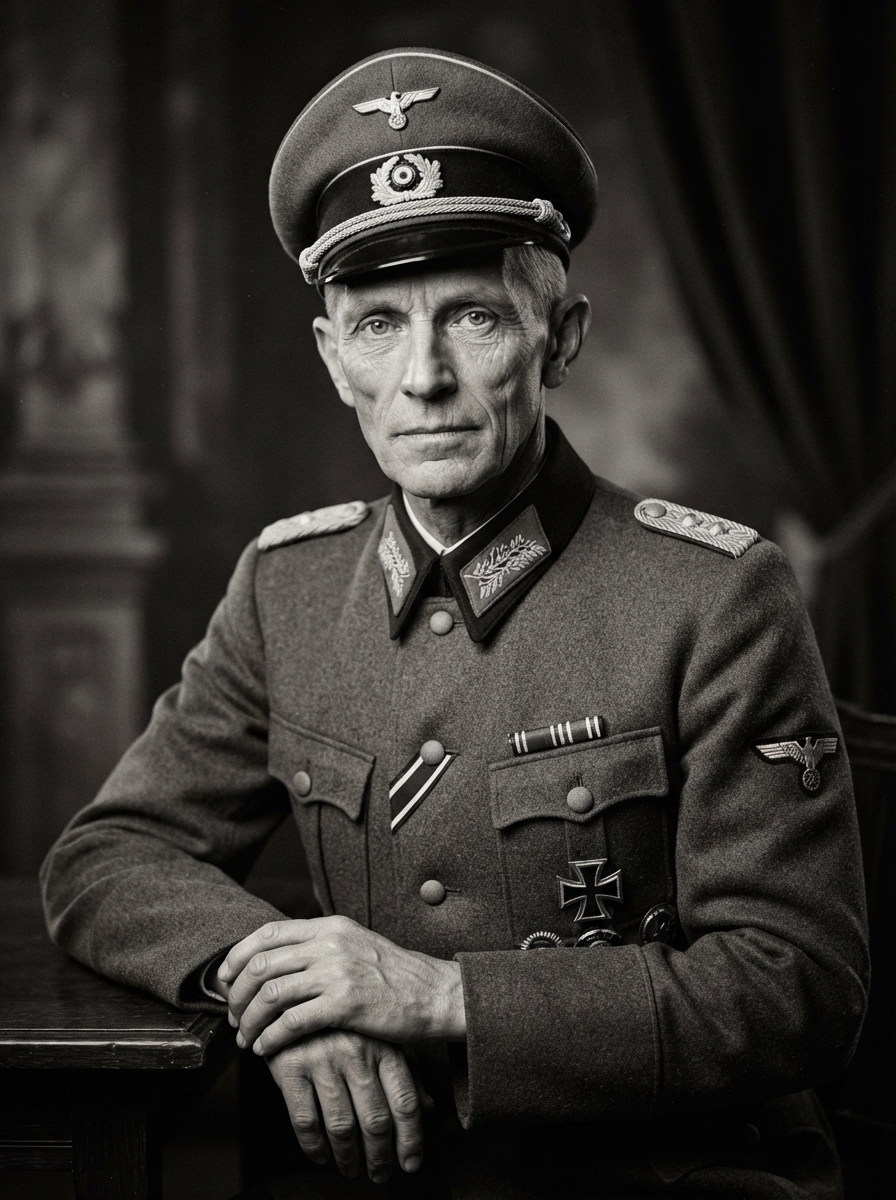
AI-assisted Portrait of Hans Oster
The Loyal Officer Who Warned the Enemy
Hans Oster's treason looked nothing like drama. As deputy head of the Abwehr — German military intelligence, under the careful patronage of Admiral Wilhelm Canaris — he sat inside one of the regime's most sensitive institutions, trusted with its secrets, and used that trust to leak them to the people they were meant to destroy. In the months before the German invasions of the Netherlands, Belgium, and Norway, Oster personally passed warnings to those governments through intermediaries — acts that, had they been traced to him, would have meant certain death for treason of the highest order.
What is striking about Oster is how undramatic the man himself seems against the scale of what he did. He was not a firebrand or an ideologue. He was a career officer who built, patiently and over years, a shelter inside the Abwehr for a whole underground of fellow resisters — supplying cover identities, diverting investigations, and quietly protecting a growing circle of conspirators who might otherwise have been arrested long before 1944. His resistance was the resistance of protection, not proclamation.
Oster's ISFJ instincts turned inward-facing loyalty outward — a dominant Si sense of what he owed his country redirected, through auxiliary Fe, into warning and shielding the people that country was about to harm.
A Standard the Regime Had No Right to Overwrite
Dominant Si anchors identity in an internalized, remembered sense of how things ought to be — a private code built from experience and precedent rather than improvised in the moment. Oster's lifetime as a Prussian officer had given him exactly that kind of code: a settled understanding of what the army was for, what honor obligated, and what a state owed the neighbors it had not attacked. When the Nazi leadership violated that inherited standard — invading neutral countries without provocation, subordinating the army to a criminal program — Oster did not need a new philosophy to know it was wrong. He measured the present against a standard he already held, and the present failed.
That same Si groundedness explains the method of his resistance: methodical, procedural, built on the same administrative competence that made him valuable to the Abwehr in the first place. He didn't reinvent his role; he inverted its use, applying the same careful, detail-oriented habits of a trusted staff officer toward undermining the institution he served.
Warnings Sent to Save Strangers
Auxiliary Fe is what turned Oster's private conviction into action on behalf of people he would never meet. His warnings to the Dutch, Belgian, and Norwegian governments were not calculated to advance any personal or ideological project — they were an attempt, at enormous personal risk, to spare foreign civilians and soldiers a slaughter he knew was coming. That is Fe's characteristic move: taking an internal sense of right and projecting it outward as concern for the welfare of a wider group, including people entirely outside one's own national or institutional loyalty.
The same instinct shaped his role inside the resistance itself. Oster functioned as a kind of protector-in-chief for the Abwehr's conspirators — smoothing over suspicious travel, shielding colleagues from investigation, holding the network together through care and cover rather than strategic vision. Where a Tresckow supplied cold analysis, Oster supplied the human infrastructure that let the analysis survive contact with the Gestapo.
Why ISFJ Over ISTJ
Why not ISTJ?
An ISTJ reading would cast Oster's resistance as pure procedural duty — an officer enforcing the rules even against his own government. But his actions were fundamentally relational, not procedural: he warned foreign governments to save lives he had no institutional obligation to protect, and he spent years personally shielding colleagues rather than simply refusing unlawful orders himself. That pattern — care for the wellbeing of a wide circle, expressed through quiet, sustained protection — is Fe's fingerprint, not Ti's detached logic operating underneath an ISTJ's Si.
Oster's resistance reads less like a man defending a rulebook and more like a man defending people — the Dutch families who never learned his name, the fellow conspirators he kept out of Gestapo hands for years. That is a Fe-driven ISFJ's signature, not an ISTJ's.
Connected Figures
Further Reading
- The History of the German Resistance 1933–1945 — Peter HoffmannThe standard scholarly account of the Abwehr resistance network
- The Plots Against Hitler — Danny OrbachDetails Oster's role and the internal politics of the Abwehr conspiracy
- Berlin Diaries, 1940–1945 — Marie VassiltchikovFirsthand glimpses of the Abwehr resistance circle Oster protected
- Hitler's Traitor: Admiral Canaris and the German Resistance — Ian ColvinCovers the Abwehr's leadership and Oster's warnings to invaded neutral states
