 Historical Figure MBTI
4 min read
#192 · 3-20-26 · Ancient Athens
Theophrastus
The Observer of Types and Tendencies
c. 371 – 287 BCE
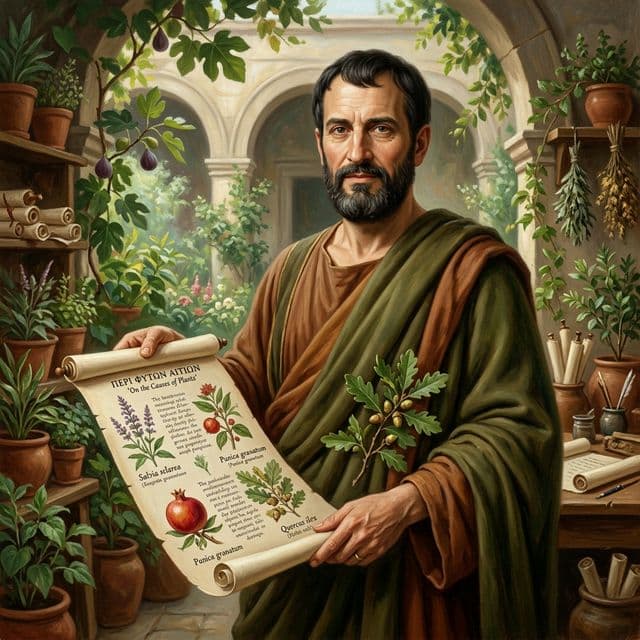
AI-assisted portrait of Theophrastus
The Architecture of Classification
Theophrastus did not just inherit Aristotle's school; he expanded its social and psychological reach. As a pioneer of both botany and psychology, he sought to map the internal and external world through a lens of collective understanding. His "Characters" was one of the earliest attempts to categorize human temperament through recognizable social patterns.
His journey was one of harmonizing the abstract principles of Peripatetic thought with the visceral realities of human behavior. He lived in the space between the lecture hall and the agora, using his insights to create a bridge between philosophical elite and the common experience of life.
Historical Context
Successor to Aristotle at the Lyceum, Theophrastus presided over the school during a period of immense growth, reportedly attracting over 2,000 students. He was a master of organization, ensuring the survival of the Lyceum's library and research during the early Hellenistic period. His scientific works remained authoritative for over a millennium, and his psychological profiles influenced moral philosophy and theater for centuries.
The Psychological Verdict
Theophrastus reads most clearly as ENFJ. He was a leader driven by a desire to categorize and understand the collective human experience (Fe), guided by an intuitive sense of the underlying structures that define character and growth (Ni).
Fe — Dominant
Theophrastus was a master of social observation. His hallmark work, "Characters," is an exercise in Fe: identifying the shared behaviors, social dynamics, and interpersonal friction points that define human interaction. He didn't just study people; he recognized the patterns of the community, seeking to harmonize philosophical standards with the reality of the social group.
Ni — Auxiliary
Beneath his observations lay a drive for deeper synthesis. He didn't just collect traits; he looked for the "type" behind the action. This auxiliary Ni provided the predictive power and the structural vision that allowed him to organize the Lyceum into a massive, functioning research engine that could sustain its mission long after his death.
Se — Tertiary
His commitment to field observation—especially in his botanical studies—shows a strong engagement with the sensory world. Tertiary Se grounded his Fe-Ni vision, ensuring that his psychological and biological categories were based on the visceral reality of the physical specimen, not just abstract theory.
Ti — Inferior
His focus was always on the "type" and the "collective" rather than the detached, purely internal consistency of logic. His inferior Ti manifested in his reliance on Aristotelian frameworks; he was more comfortable expanding and socialy applying an existing system than dismantling it to build a purely personal, logical edifice.
The Garden After the Storm
Aristotle left Athens in 323 BCE under political pressure after Alexander’s death; Theophrastus stayed, took over the Lyceum, and ran it for thirty-five years. Where Aristotle was the architect, Theophrastus was the gardener — less interested in building the system than in keeping it alive and growing. He expanded the botanical work, produced the first systematic study of plants in the Western tradition, and wrote the Characters, a set of thirty personality sketches so precise that they read almost like DSM-adjacent case studies. Epicurus was teaching nearby in his Garden during these same years; the two schools were in productive tension, one focused on social participation, the other on withdrawal. Aristotle’s biological curiosity found perhaps its most devoted executor in Theophrastus, who pushed the empirical project further than his teacher ever did — just with considerably less fanfare.
Not the one who found the rule. But the one who recognized the pattern in the face of the crowd.
Connected Figures
Further Reading
- Theophrastus of Eresus: Sources for His Life, Writings, Thought and Influence — William W. Fortenbaugh et al.The definitive scholarly collection of ancient sources; essential for serious study of Theophrastus.
- Characters — Theophrastus (trans. James Diggle, Cambridge, 2004)The primary text — thirty personality sketches that remain the clearest window into his psychological method.
- Theophrastus: His Psychological, Doxographical, and Scientific Writings — William W. Fortenbaugh & Dimitri Gutas (eds.)A volume from the Rutgers University Studies series covering the full range of his intellectual output.
- Aristotle and His School — Felix GrayeffPlaces Theophrastus within the Peripatetic tradition and reconstructs the functioning of the Lyceum under his leadership.
