 Historical Figure MBTI
#520 · 4-21-26 · The Wars of the Roses
William Hastings
Edward IV's Loyal Chamberlain, Ambushed in the Tower
c. 1431 — 1483
7 min read
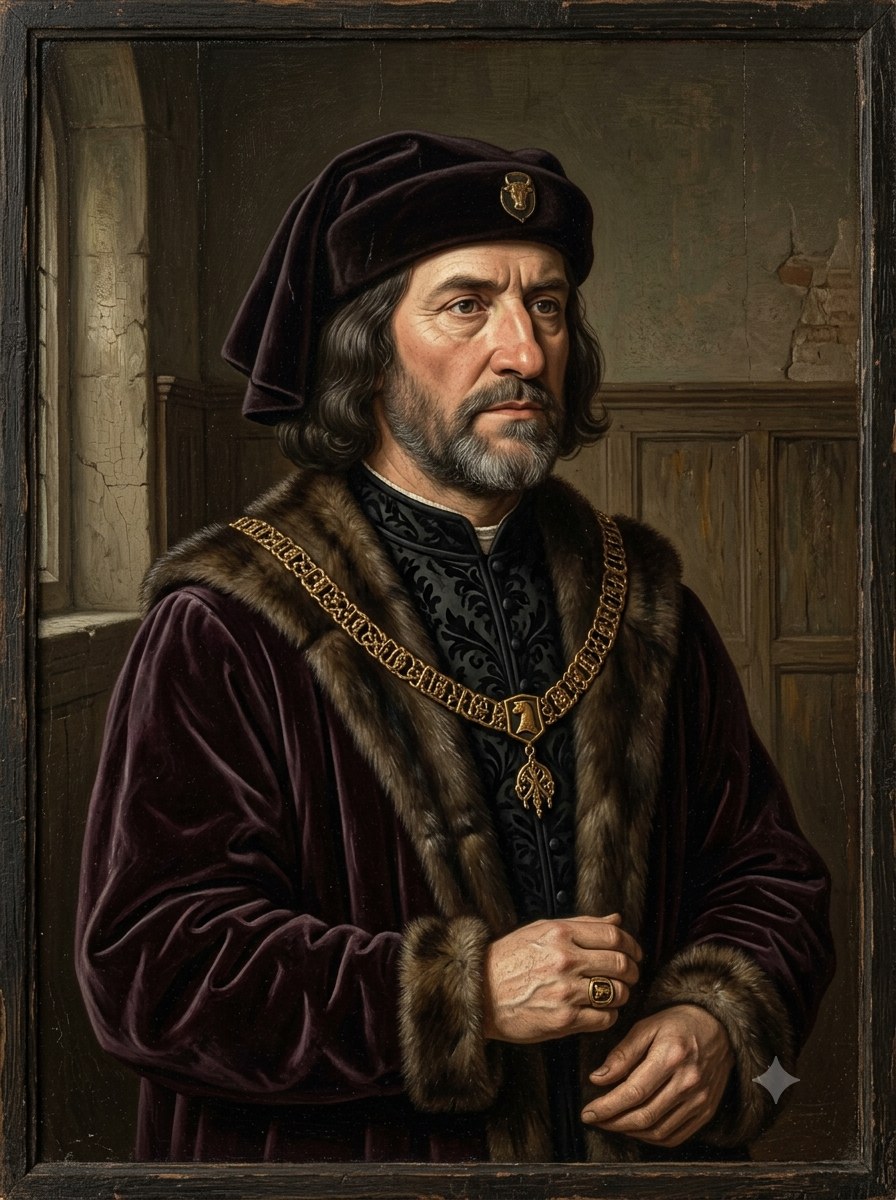
AI-assisted Portrait of William Hastings
The King's Right Hand
William Hastings was the friend a king actually wants—not a courtier angling for advantage, but a bluff, hard-living soldier who shared Edward IV's campaigns, his table, his appetites, and even his women. He rose with Edward through the bloody years of the Wars of the Roses, fought beside him at Towton and Tewkesbury, and was rewarded with the office that put him at the king's side every day: Lord Chamberlain of the household. From there he governed Calais—England's last toehold on the Continent—with real competence, and stood, for two decades, as the most trusted man in Edward's orbit.
He was not a schemer. His loyalty was personal, instinctive, and total: to Edward, and then to Edward's sons. That loyalty made him, and in the end it killed him. When the king died suddenly in 1483, Hastings threw himself into the scramble that followed—and discovered too late that the danger he had backed was deadlier than the one he had feared. He is a textbook ESTP: a man of action, presence, and appetite, brilliant in the moment and blind to the long game.
Hastings lived by friendship and the moment, not by a system—the ESTP's gift and his doom. He read the room masterfully and the future not at all.
The Man in the Saddle and the Hall
Se — dominant
Everything contemporaries said about Hastings points to dominant Se: he was at home in the physical world—on campaign, at the feast, in the bedchamber. Chroniclers describe a convivial, open-handed, hard-living man, brave in the field and easy in company, the kind of companion a restless warrior-king could not do without. He matched Edward IV pleasure for pleasure and danger for danger, and the bond between them was built not on policy but on shared experience—battles fought together, nights spent together, the same tastes pursued at the same time.
The most telling detail is that he and Edward loved the same woman: Jane Shore, the king's favorite mistress, who after Edward's death became Hastings' own. That is Se living: appetite and presence, the immediate and the tangible, with little interest in the moral architecture an intuitive judge might build around it. Hastings did not theorize about loyalty or power. He acted, he enjoyed, he fought—and he trusted his read of the people in front of him, because that read had carried him safely through twenty years of the deadliest court in Europe.
Competence Under the Bonhomie
Ti — auxiliary
Bluffness can disguise real skill, and it did with Hastings. Beneath the soldier's geniality ran a practical, problem-solving intelligence—auxiliary Ti—that made him genuinely useful rather than merely agreeable. As Lord Chamberlain he ran the machinery of the royal household, controlling access to the king and the daily rhythm of the court. As Captain of Calais he held England's most sensitive military outpost—a fortified port that was also a hub of trade and intrigue—and he held it well, balancing the garrison, the wool merchants, and the king's strategic needs.
This is Ti in the service of Se: not abstract system-building, but the cool, on-the-spot analysis that lets a man of action figure out exactly how a thing works and how to make it work for him. Hastings understood the mechanics of power—who held what office, where the leverage lay, how a household or a garrison actually functioned. What he never developed was the deeper strategic vision that would have let him see how those mechanics might be turned against him.
Loyalty as a Personal Bond
Fe — tertiary
Tertiary Fe gave Hastings his warmth and his fatal devotion. His politics were never ideological; they were relational. He loved Edward IV the man, and that love extended, without calculation, to Edward's children. He detested the Woodvilles—the queen's grasping, upstart relatives—not from any considered theory of governance but because they were rivals for the king's favor and a clan he found personally insufferable. His feelings about people drove his choices more than any cold assessment of advantage would have.
So when Edward died and the Woodvilles moved to control the young heir, Hastings naturally sided with Richard, Duke of Gloucester, against them. It felt like loyalty: protect the late king's memory, keep the upstarts from seizing the boy. Tertiary Fe reads the immediate social field well—Hastings knew exactly whom he liked and whom he loathed—but it is not the same as the strategic foresight to see where an alliance of convenience will end. He picked his side by the warmth or coldness of his feeling, and the warmth of his feeling for Edward's sons would soon override everything else.
The Future He Could Not See
Ni — inferior
Here is where Hastings died. Inferior Ni is the ESTP's blind spot—the inability to project a situation forward, to sense the trajectory of events before they arrive. Hastings saw the danger directly in front of him, the Woodville threat to the realm, with perfect clarity. What he could not see was the larger arc: that in helping Richard sideline the Woodvilles, he was clearing the path for Richard to take the crown itself—and that he, the loyalist who would defend Edward V, was the last obstacle in that path.
He trusted too long. By every account Hastings believed Richard meant only to secure the young king's government, not to seize it; he could not imagine the betrayal until it was on top of him. Richard struck without warning: at a council meeting in the Tower of London in June 1483, he abruptly accused Hastings of treason and had him dragged out and beheaded on the spot, with no trial—the brutal removal of the last great loyalist standing between Richard and the throne. The man who read every room he ever entered walked into that one without sensing what was coming.
Hastings saw Richard's threat to the Woodvilles but never his threat to Edward's sons—or to himself. Inferior Ni: sharp in the present, blind to the trajectory.
Why ESTP Over ESTJ
Why not ESTJ?
The ESTJ reading is tempting—Hastings was capable, held high office, and ran Calais well. But the ESTJ is an institution-minded administrator whose loyalty flows through structures, duties, and the chain of command. Hastings was nothing of the kind. His loyalty was personal and instinctive—to Edward the man, then to Edward's boys—and his enmities, like his hatred of the Woodvilles, were equally personal. He lived by friendship, appetite, and the moment, not by a system; he was a companion and a fighter first, an administrator only because the king he loved had use for one.
The distinction is what doomed him. An ESTJ in Hastings' position might have thought institutionally—weighed the structures of succession, the precedents, the long-term balance of power, and seen the protectorate hardening into a usurpation before it closed around him. Hastings reasoned through people and the present instead. He backed the man he trusted against the faction he despised, and that instinct—Se-driven, relationally loyal, blind to the trajectory—both ennobled him and killed him. It is the ESTP's signature, not the ESTJ's.
Connected Figures
Further Reading
- Edward IV — Charles RossThe standard modern biography of the king Hastings served — essential for understanding the household and the friendship that defined his career.
- Richard III — Charles RossThe authoritative life of the usurper, with a clear-eyed account of the 1483 council coup and the summary execution of Hastings.
- The Wars of the Roses — Anthony GoodmanA clear narrative of the dynastic conflict that made and unmade men like Hastings.
- Richard III and the Princes in the Tower — A. J. PollardStudies the usurpation crisis in detail, including the political logic behind Hastings' sudden destruction.
