 Historical Figure MBTI
5 min read
#134 · 3-16-26 · The Founding Generation of USA
William Stephens Smith
Soldier · Schemer · Son-in-Law
1755 — 1816
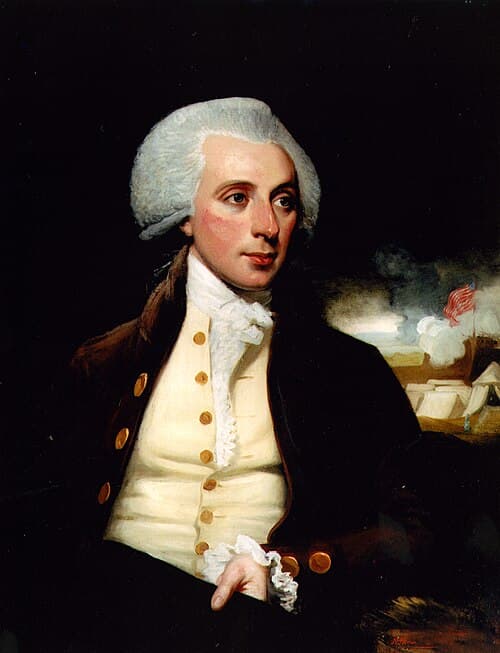
Portrait of William Stephens Smith
The Man Who Could Only Shine at War
William Stephens Smith spent seven years being extraordinary. Washington's aide-de-camp. Lafayette's adjutant through the 1780 light infantry campaigns. One of three commissioners who supervised the British withdrawal from New York in November 1783. His gravestone claimed twenty-two battles. The testimonial Washington wrote him in 1782 is unambiguous: "great fidelity, bravery & Good Conduct."
Then the war ended. What followed — the diplomatic posting in London, the New York land speculation, the Miranda expedition, the debts that outlasted him by decades — reads not as the continuation of a life but as its systematic undoing. He died in 1816 owing more than $200,000. His father-in-law, John Adams, wrote: "All the Actions of my Life and all the Conduct of my Children have not disgraced me so much as this Man."
William Stephens Smith was an ESTP — a man built for immediate reality, for tactical brilliance in the field, for the magnetic pull of the next bold action. The same traits that made him exceptional in war made him ungovernable in peace.
The Soldier Who Lived in the Moment
Dominant Se is the function of immediate sensory engagement — reading the present situation and responding faster than deliberation allows. Smith didn't lose the bridge at Throgs Neck in 1776. He destroyed it himself, with a corporal's guard, preventing the British from encircling Washington's army on Manhattan. He was wounded at Harlem Heights carrying orders under fire. Washington selected him for the Yorktown campaign — the most operationally complex moment of the war.
The problem with Se dominance is its relationship to time. Long-range planning demands the willingness to subordinate present action to future consequence. Smith could not sustain this. He resigned the U.S. Marshalship after a year. He resigned the Revenue Supervisorship after a year. He started a Manhattan estate he sold unfinished. Every time an institutional role required him to wait, he left. The present was always more compelling than the plan.
The Tactician's Logic
Auxiliary Ti gave Smith the internal analytical framework to assess situations quickly and independently — not a soldier who waited for instructions, but one who derived the correct response from first principles. In the field, this was invaluable. In peacetime, detached from institutional constraint, it was dangerous. Smith appears to have genuinely believed that Miranda's White House dinner provided sufficient authorization to arm a ship and sail against a Spanish colonial power. His Ti had found a justification that satisfied his own internal logic, if not the Neutrality Act. Ten Americans captured by Spanish ships were executed for piracy. Jefferson's verdict: "a man of integrity and honor, led astray by distress."
The Charmer Who Was Never Truly Present
Tertiary Fe in an ESTP produces social magnetism without depth — warmth without sustained commitment. Smith was personally selected for staff work by Washington, Sullivan, and Lafayette in succession. He moved through the London elite with ease, formed a genuine intellectual friendship with Jefferson, knew Francisco de Miranda for twenty years. But the trust he inspired eventually curdled. His wife Nabby managed the household through his repeated absences, raised their children through his financial collapses, and returned to her parents' house to die — her husband present in the room while surgeons cut into her breast for twenty-five minutes. He was charming, and he was absent. These were not in contradiction.
The Future He Could Never See
Inferior Ni is the ESTP's blind spot: the capacity to see where a trajectory leads before it arrives. Smith's biography is a series of such trajectories. The land speculation bubble of the 1790s was broadly visible; Smith entered it at scale, with borrowed money. The Miranda expedition carried obvious legal risk — the Neutrality Act had been law for twelve years. He sent his nineteen-year-old son on the expedition as a recruit. What he couldn't do was project forward — couldn't internalize that the world in 1806 was not the world of 1776, that organizing a military expedition to liberate a colonial people had been heroic in one era and criminal in another. He died in 1816 still owing the debts from the 1790s collapse. His gravestone listed twenty-two battles — the count that made sense of a life that, in every other respect, had refused to cohere.
Why ESTP Over ISTP
Why not ISTP?
The ISTP is also Se-Ti dominant, also drawn to immediate physical reality. But Smith's entire career depended on social magnetism — on being chosen for staff work, trusted with diplomatic missions, liked enough to win appointment after appointment despite a record that should have disqualified him. He recruited 200 men for Miranda through personal networks and charm. An ISTP's charm is typically not the instrument. For Smith, charm was the instrument — which points to extraverted Se as the lead function, with Fe providing the social antenna.
Connected Figures
Further Reading
- John Adams — David McCulloughThe fullest narrative account of the Adams family; Smith appears throughout as the son-in-law whose spectacular failures shadowed Adams's final decades.
- The Letters of John and Abigail Adams — Ed. Frank ShuffeltonPrimary source — the Adamses' private correspondence contains some of the most pointed contemporary verdicts on Smith's character and conduct.
- Abigail Adams — Woody HoltonCenters Abigail rather than John; illuminates the domestic cost of Smith's schemes as experienced by the women of the Adams household.
