 Historical Figure MBTI
#832 · 6-16-26 · The American Civil War
Winfield Scott
The Old General Who Planned the War He Wouldn't Fight
1786–1866
6 min read
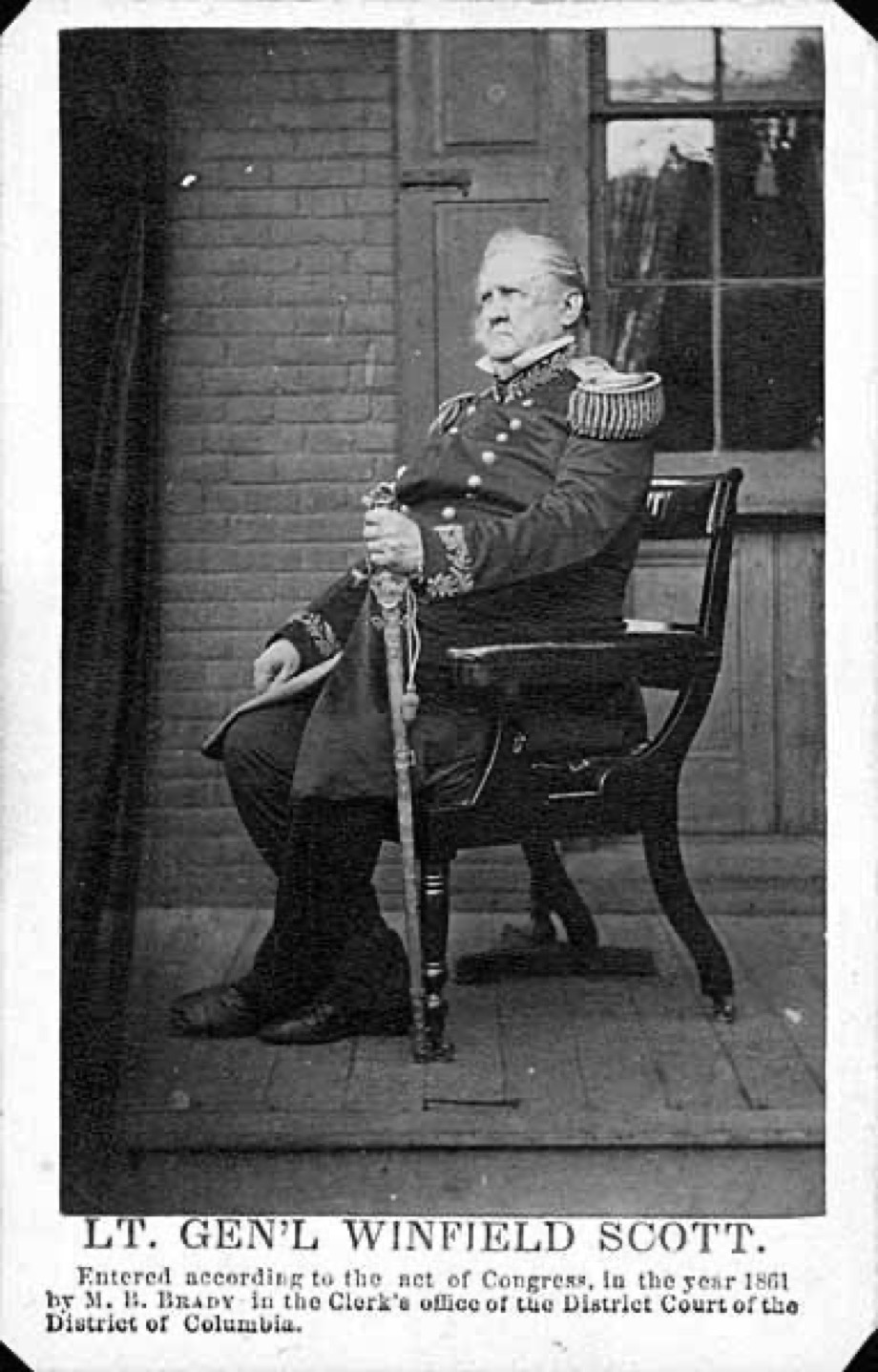
Portrait of Winfield Scott
The Architect of a War He Was Too Old to Fight
By 1861, Winfield Scott had been the most important soldier in America for a generation, and he looked it — six foot five, past three hundred pounds, too gout-ridden and dropsical to mount a horse, kept in his chair by aides who called him, not always fondly, “Old Fuss and Feathers.” He had earned the nickname honestly: four decades of parade-ground correctness, of insisting the army be drilled, provisioned, and organized exactly right before it fired a shot. He had done that in the War of 1812 and again in Mexico, where a young engineer named Robert E. Lee watched him plan the Veracruz landing and the march on Mexico City and decided this was what soldiering, done properly, looked like.
Scott's mind never slowed even as his body failed him. In the spring of 1861, unable to take the field himself, he handed Lincoln's cabinet a plan that the newspapers mocked as the “Anaconda” — blockade the Southern coast, split the Confederacy along the Mississippi, and let time, logistics, and economic strangulation do what a single dramatic battle could not. It asked for patience nobody in Washington wanted to hear about in 1861. It was also, more or less, the war the Union actually fought and won.
Scott is an ESTJ down to the bone — a man who trusted proven method over improvisation, organization over inspiration, and who kept building the machine long after his own body had disqualified him from operating it.
He could no longer sit a horse, so he built a war that didn't need him to.
A War Reduced to Logistics
The Anaconda Plan is Te in its purest form: strip a problem of its emotional and political noise and solve it as a resource-allocation question. Scott did not ask how to inspire the Union or humiliate the Confederacy. He asked what the South actually needed to keep fighting — cotton exports, river transport, imported matériel — and designed a strategy to cut off each in turn. It was unglamorous by intention. Te does not need the win to look heroic; it needs the win to be structurally guaranteed.
That same instinct shaped his whole career. Scott professionalized an American army that had been, before him, a loose collection of militias and political appointees — standardizing drill manuals, discipline, and supply chains until competence stopped depending on which general happened to be talented that year. He built systems that would outlast him, which is exactly what the Anaconda Plan was: a system designed to win a war its author would not live to finish directing.
The press hated it precisely because Te's logic runs against the grain of public appetite. Newspapers wanted Bull Run tomorrow. Scott wanted the Mississippi in eighteen months. He was right, and being right on a timeline nobody wanted to accept is the loneliest kind of correct.
Forty Years of Precedent
Si is memory turned into method, and Scott had more institutional memory than any other man in American uniform. He had watched what worked at Lundy's Lane, at Veracruz, at Chapultepec, and he distrusted any plan that hadn't been tested against that record. His nickname mocked the habit — the buttons, the etiquette, the insistence on doing things the correct, established way — but the same rigidity that made him a martinet on parade also made him the one man in 1861 who had actually planned and executed a campaign at national scale before.
It showed in how he handled his own obsolescence. Rather than cling to field command out of pride, Scott took stock of what forty years of experience told him he could and couldn't still do, and retired that November to a subordinate, McClellan, while remaining the plan's quiet author. That is Si's dignity: knowing precisely what the record says about your present capacity, and acting on it rather than on ego.
Seeing the War Behind the Battle
Tertiary Ne is what let Scott see past the battle everyone else was staring at. In the spring of 1861, the entire country — press, Congress, even much of the cabinet — was fixated on the single dramatic clash they assumed would decide everything. Scott's Ne pulled the frame back: what if the war wasn't one battle at all, but a slow-motion economic siege playing out over years and geography? That is a genuinely imaginative leap for a man otherwise defined by procedure, and it is why the Anaconda Plan reads less like a drill manual and more like a prophecy.
It surfaced elsewhere too — in his willingness, late in life, to reach across the coming rupture and personally offer his old protégé Lee command of the Union army, betting that loyalty and mentorship might outweigh the gravitational pull of Virginia. The bet failed. But making it at all took a capacity to imagine outcomes the record didn't yet support, a flicker of possibility thinking underneath all that Si-built certainty.
Why ESTJ Over ISTJ
Why not ISTJ?
ISTJ would explain the discipline, the precedent-worship, the buttoned formality — but not the scale of Scott's ambition. An ISTJ commander tends toward careful custodianship of what already exists; Scott spent his career building institutions and doctrines that hadn't existed before he arrived, and at seventy-four he was still willing to author the strategic concept for a war of unprecedented size. That outward-facing drive to impose a large, decisive structure on a chaotic situation, rather than simply maintain one, is Te leading, not supporting.
The distinction matters because the Anaconda Plan itself is the tell. An introverted, precedent-bound officer content to follow established doctrine would have proposed the conventional decisive battle everyone expected. Scott instead used decades of internalized experience as raw material for an extroverted act of large-scale organization — reshaping an entire theater of war around a single, patiently executed idea. That is Te wielding Si, not Si wielding a subordinate assistant.
Connected Figures
Further Reading
- Agent of Destiny: The Life and Times of General Winfield Scott — John S. D. EisenhowerThe standard modern biography, covering the full arc from 1812 to the Anaconda Plan
- Team of Rivals: The Political Genius of Abraham Lincoln — Doris Kearns GoodwinSituates Scott's 1861 strategic role within Lincoln's cabinet and command decisions
- Scott: The Soldier and the Man — Marcus J. WrightAn older but detailed account of Scott's military career, including the Mexican War
- This Republic of Suffering — Drew Gilpin FaustContext on the human cost the Anaconda strategy was ultimately weighed against
