 Historical Figure MBTI
#1087 · 8-13-26 · Spring and Autumn China
Xi Shi
The Beauty Sent to Break a Kingdom
c. 506 BCE – ?
5 min read
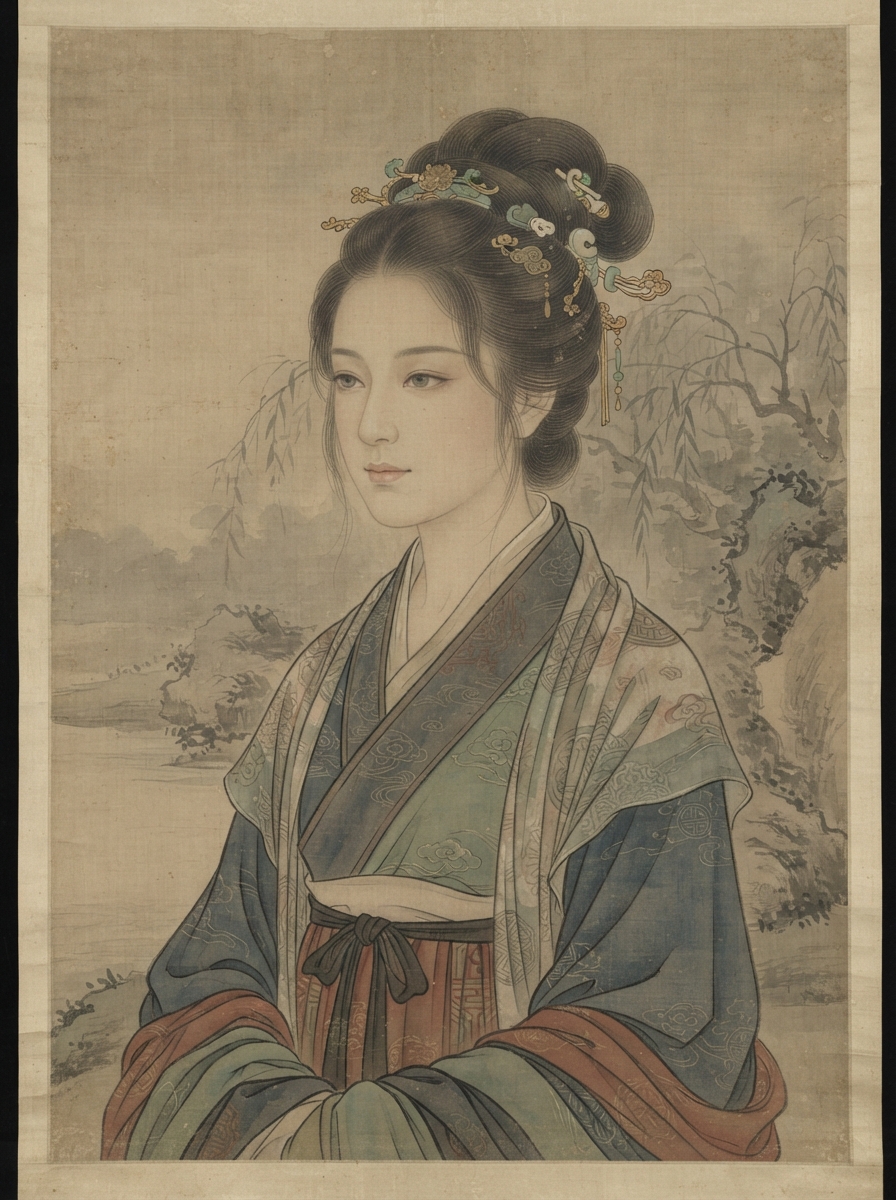
AI-assisted Portrait of Xi Shi
A Face Recruited for a War
What survives of Xi Shi is less a biography than a legend with a diplomatic function. Tradition places her as a washerwoman's daughter from the hill country of Yue, discovered by the minister Fan Li for a beauty reportedly so complete that fish, seeing her reflection, forgot to swim and sank. She was, the story goes, groomed for years in music, deportment, and court manners before being sent — along with another chosen beauty — as a gift to King Fuchai of Wu, the rival power that had humiliated Yue and its king, Goujian, in defeat. Wu's minister Wu Zixu warned Fuchai against accepting her, correctly guessing the trap; he was ignored, and later forced to suicide for his trouble.
Whatever the factual kernel beneath the later embroidery — the story reaches us largely through literary and dramatic elaboration centuries after the events it describes — the shape of the tale is consistent: Xi Shi is acted upon. She is selected, trained, deployed, and later disposed of (accounts disagree on how) by men pursuing a state's revenge. That very passivity in the record, paradoxically, is what makes a psychological reading of her possible at all — not through what she did, but through the persistent, unresolved questions the tradition keeps asking about what she privately felt.
Every version of Xi Shi's story insists on asking whether she loved anyone in it — Fuchai, Fan Li, no one — which is another way of saying that everyone since has sensed an ISFP interior behind a life otherwise recorded only as instrument.
The Unrecorded Interior
No source claims to know what Xi Shi felt about the mission she was given, and that silence is itself the most telling thing about her legend. Later poets and playwrights — most famously the Ming dramatist behind The Girdle of Silk — rushed to fill the gap, imagining her torn between duty to Yue and a dawning attachment to the enemy king she was sent to seduce, or between that attachment and an older, quieter loyalty to Fan Li himself. The fact that so many competing versions could take root suggests a woman whose inner life was assumed to be rich, private, and essentially unknowable to the statesmen managing her — the classic signature of a dominant Fi figure moving through a world built entirely by Te and Ni operators.
Where Fan Li and Goujian thought in terms of strategy, timelines, and the humiliation to be avenged, the tradition keeps returning Xi Shi to a register of feeling: does she love him, does she grieve, is she loyal out of conviction or resignation. Nothing in the sources lets us answer with confidence — but the shape of the question is Fi's shape, a values-led interior that the surrounding political machinery never quite manages to narrate, only to use.
Beauty as the Only Recorded Fact
If Xi Shi possesses one indisputable trait in every retelling, it is physical presence — the immediate, sensory fact of her beauty, vivid enough to survive two and a half millennia of retelling in a single fixed image: the fish sinking beneath the water's surface at the sight of her. Whatever she did at Fuchai's court, tradition remembers it as an act of live, embodied performance — dance, music, presence in the room — rather than intrigue conducted at a distance. That is an auxiliary Se orientation as the tradition imagines it: an aesthetic and physical fluency that operates directly on the moment, not a mind occupied with schemes of its own.
It is worth stressing how much of this is legend rather than verifiable history — the earliest strata of the record, including Sima Qian's fragmentary references, are far sparer than the vivid figure later literature supplies. But legend, too, is evidence of a kind: of what qualities observers over centuries found most plausible and most compelling to attach to her.
An Ending With No Fixed Shape
Xi Shi's fate after Wu's fall is the single most contested detail in her legend, and the disagreement is itself instructive. In one strand she is drowned — by Yue's own court, some versions imply, uneasy at the living reminder of what had been done in the state's name; in another, gentler tradition, she slips away with Fan Li, the two of them trading the intrigue of two courts for a quiet second life as merchants on the lakes. A tertiary Ni glimpsed dimly through the legend would not need either ending confirmed to sense which one it was heading toward; the stories themselves seem to reach for a symbolic resolution — reunion, escape, disappearance from history's bookkeeping — more than a factual one.
That the tradition could not settle on an ending, and instead offered two mutually exclusive ones centuries apart, says less about Xi Shi than about what later ages needed her story to mean: either a warning about the price exacted from those used as instruments of statecraft, or a wish that such a person might, improbably, get to choose her own life after all.
No Head for the Scheme Itself
Nothing in Xi Shi's legend credits her with authorship of the plot that used her. The scheming — the calculation of exactly how a distracted king, a neglected treasury, and a resentful minister would combine to bring down Wu — belongs entirely to Fan Li and Wen Zhong. Xi Shi is the instrument of a Te strategy she did not design and, in most versions, barely seems to track; her inferior Te shows up as an absence rather than a struggle, a figure simply outside the register in which the men around her are operating.
That asymmetry is precisely what has made her useful to storytellers ever since — a still, feeling center around which a hard-edged political plot revolves, and against which the plot's costs can be measured.
Connected Figures
Further Reading
- Shiji (Records of the Grand Historian) — Sima QianThe earliest and sparest surviving references to the Wu–Yue conflict; Xi Shi herself appears only glancingly.
- Huansha Ji (The Girdle of Silk) — Liang ChenyuThe Ming-dynasty chuanqi play most responsible for the fuller, romanticized Xi Shi of later tradition.
- Exemplary Women of Early China: The Lienü zhuan of Liu Xiang — Anne Behnke Kinney (ed. and trans.)Translated biographies of early Chinese women that shaped how figures like Xi Shi were later read and moralized.
- Wu Yue Chunqiu (Spring and Autumn Annals of Wu and Yue) — Zhao Ye (attrib.)A later Han-dynasty semi-historical narrative that elaborates the Wu–Yue rivalry and Xi Shi's role within it.
