 Historical Figure MBTI
#524 · 4-22-26 · The Wars of the Roses
Anne Neville
Queen of England · Warwick's Daughter, Twice a Pawn-Bride
1456 — 1485
8 min read
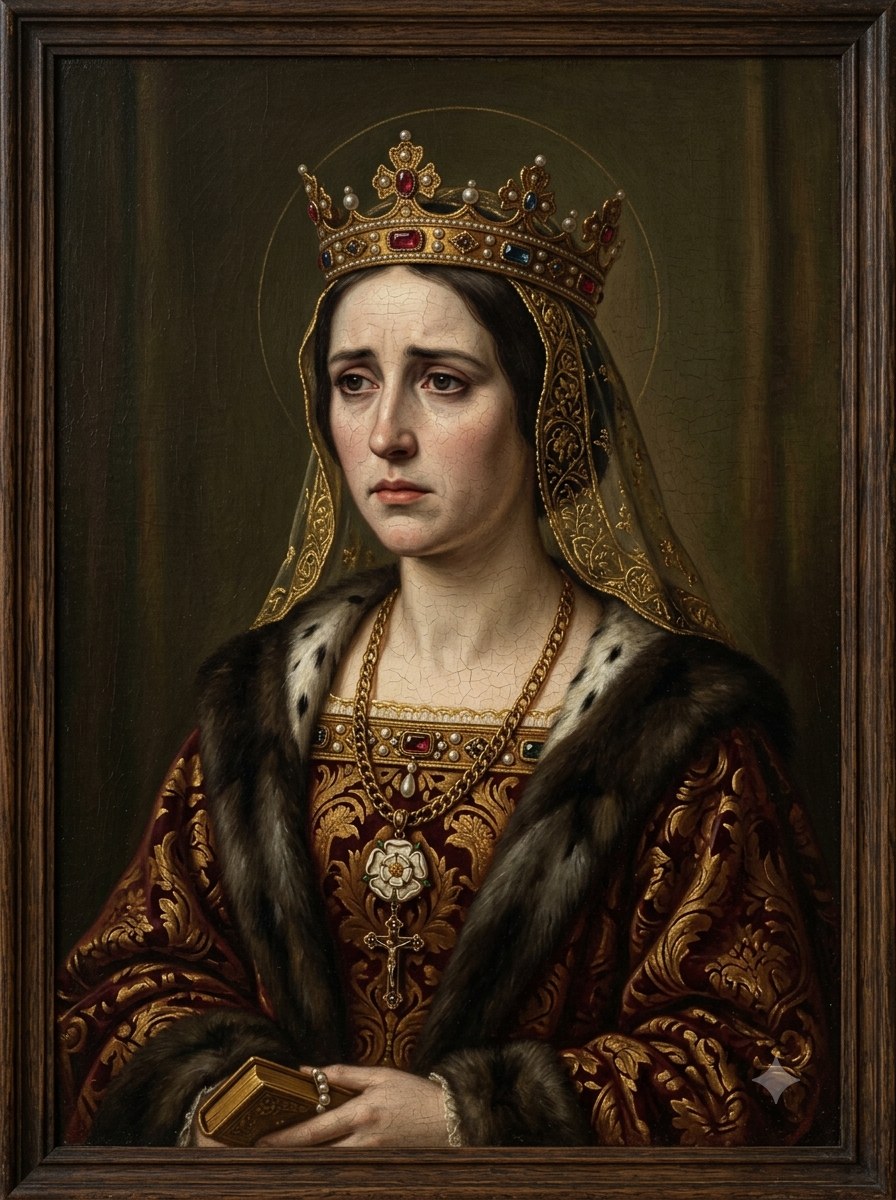
AI-assisted Portrait of Anne Neville
The Most Used, Least Heard Woman of the Wars
Anne Neville was twice a queen-in-waiting and twice a pawn, and in neither role did anyone trouble to record what she wanted. Born in 1456, she was the younger daughter of Richard Neville, Earl of Warwick — “the Kingmaker,” the richest and most dangerous magnate of fifteenth-century England, the man who made and unmade kings and then bartered his daughters to seal the bargains. Anne was the chip he played last, and she paid for it longest.
At fourteen her father married her to Edward of Westminster, the Lancastrian prince, to bind Warwick's sudden alliance with the exiled queen Margaret of Anjou. Within months she was a widow: Edward was killed at the Battle of Tewkesbury in 1471, and her father had already fallen at Barnet the same spring. Orphaned of her protector and stripped of her cause, she became the prize in a different fight — a bitter quarrel over the vast Warwick inheritance — and married Richard, Duke of Gloucester, the future Richard III. She was crowned queen of England in 1483. By 1485 she was dead, probably of tuberculosis, after her only son had died the year before, amid whispers that her husband had poisoned her to free himself to marry his niece, Elizabeth of York. She was not yet thirty.
History records Anne's movements but almost never her voice — and what little survives sketches an ISFJ: the dutiful, enduring consort who quietly fulfilled the roles other men assigned her, and was moved across the board until there were no moves left.
The Role Quietly Kept
Si — dominant
A caution must come first. So little of Anne's inner life survives that any type reading is a careful sketch drawn from the shape of her conduct rather than from her words. But the shape is consistent, and it is a dominant-Si shape: the figure who absorbs the role she is given and fulfills it steadily, without visible rebellion, marriage after marriage. Married off to a Lancastrian prince at fourteen, then to a Yorkist duke a year later — to the son of the very house her first marriage had been meant to destroy — Anne stepped from one inherited duty into its mirror image and kept each faithfully.
Si is the function of continuity and obligation, of doing what the position requires because the position requires it. As Duchess of Gloucester through the 1470s, Anne settled into the northern world of Middleham, the Neville stronghold of her childhood, and ran a household that drew on the loyalties her family name still commanded in Yorkshire. There is no record of her grasping for influence, no faction built around her, no intrigue traced to her hand. When the crown came in 1483 she wore it as she had worn everything else: as a duty discharged, not a prize seized. The dutiful, uncomplaining consort is the dominant-Si woman in her purest medieval form — defined by the steady keeping of what others had placed upon her.
The Faithful Wife, Not the Player
Fe — auxiliary
Where dominant Si keeps the role, auxiliary Fe makes it gentle. The fragments that survive of Anne describe an accommodating, warm-tempered woman — loyal rather than ambitious, a wife and queen rather than a power in her own right. Fe orients toward harmony and the bonds that hold a household together, and Anne's entire visible existence ran along those lines: she was the steadying presence beside Richard at Middleham, the consort who shared in his northern affinity, the mother who bound her life to the single fragile son who would carry the line forward.
Compare her to almost anyone else on the board in those years — her ferociously scheming father, the relentless Margaret of Anjou, the calculating men who turned the inheritance dispute into open feud — and Anne's Fe registers as an absence of all that. She is the one figure in the story who does not maneuver. When her son died in 1484, the chroniclers note that both parents were stricken nearly to madness with grief; it is one of the few moments her feeling breaks the surface of the record at all, and it is feeling poured into family, the natural channel of Fe. She made herself a faithful wife in an age that gave her no other safe shape, and she kept that faith to the end.
A Survivor's Quiet Calculation
Ti — tertiary
Tertiary Ti in an ISFJ is the private, practical reasoning that runs beneath the dutiful surface — not a system-builder's logic but a quiet weighing of what is actually possible. With Anne the evidence is almost all circumstantial, because almost everything about her is. But consider the position she navigated after Tewkesbury: a teenage widow of the losing side, her father attainted and dead, her inheritance the object of a struggle between two royal brothers. Marrying Gloucester was, among other things, the one move that converted her from a liability into a duchess — and securing the Warwick lands meant resolving the rivalry with the Duke of Clarence, who had married her elder sister and wanted the whole estate for himself.
Whether Anne reasoned her way toward Richard or was simply steered there, we cannot know — the famous later legend that Clarence hid her, disguised as a kitchen maid, to keep the inheritance whole says more about Tudor storytelling than about her. What the tertiary function offers here is a reading rather than a proof: beneath the compliant consort there was likely a clear-eyed grasp of where safety lay in a lethal game, the modest, self-protective intelligence of a woman who had watched everyone around her be destroyed and meant to keep her footing.
In the Shadow of What Might Come
Ne — inferior
Inferior Ne is the ISFJ's blind side: the dread of unknown futures, the sense that catastrophe waits just past the edge of the familiar. Few lives have vindicated that dread as completely as Anne's. The world she knew kept dissolving — her father's sudden treason, her first husband's death at Tewkesbury, her son's death, her own failing health, and at the last the rumor swirling around her deathbed that the man she had married meant to replace her with Elizabeth of York. Where a strong-Ne figure might have read the chaos for opportunity, Anne's temperament could only have braced against it, holding to the small kept world of household and family as the storms came.
The poisoning rumor is itself a kind of inferior-Ne nightmare made historical fact. There is no real evidence Richard poisoned her; tuberculosis is the far likelier killer, and the timing of her death amid talk of his designs on his niece was enough to brand him in the gossip of a frightened court. But that is precisely the shadow such a temperament lives under — the suspicion that the people closest to you may already be calculating past you, that your steady fidelity counts for nothing against the next turn of the wheel. Anne died inside that shadow, the future she could not master closing over her at last.
Why ISFJ Over ISFP
Why not ISFP?
The ISFP shares the quiet, gentle surface, but is led by Fi — an inner compass that, pushed far enough, follows its own heart against the current. Nothing in Anne's record suggests a woman acting on private conviction in defiance of her circumstances; she did not flee her marriages, resist her uses, or chart a course of her own. Her life was defined by what was done to her and the roles she steadily kept — the Si-Fe pattern of fulfilling the part assigned, not the Fi pattern of living by an inner law.
The distinction is the whole of her tragedy. An Fi-led woman leaves some trace of a self pressing back against the world — a refusal, a flight, a choice made against advantage. Anne leaves the trace of a self being moved: married for her father's politics, married again for her inheritance, crowned, widowed of her child, and gossiped into the grave, accommodating each turn because accommodation was the role. That steady, role-fulfilling endurance — warmth and loyalty offered to whatever position she was placed in — is dominant Si served by Fe, and it is the signature of the ISFJ, not the ISFP.
Connected Figures
Further Reading
- Anne Neville: Queen to Richard III — Michael HicksThe standard modern biography — reconstructs a life the sources barely record and weighs the poisoning rumor against the evidence.
- The Wars of the Roses — Dan JonesA vivid narrative of the dynastic bloodletting that made and unmade Anne's father, husbands, and crown.
- Medieval Queenship — John Carmi Parsons (ed.)Essays on the constrained role of the late-medieval consort — the part Anne was twice married into and quietly kept.
