 Historical Figure MBTI
#666 · 5-16-26 · The Five Good Emperors
Avidius Cassius
The General Who Declared Himself Emperor
c. 130 — 175 CE
5 min read
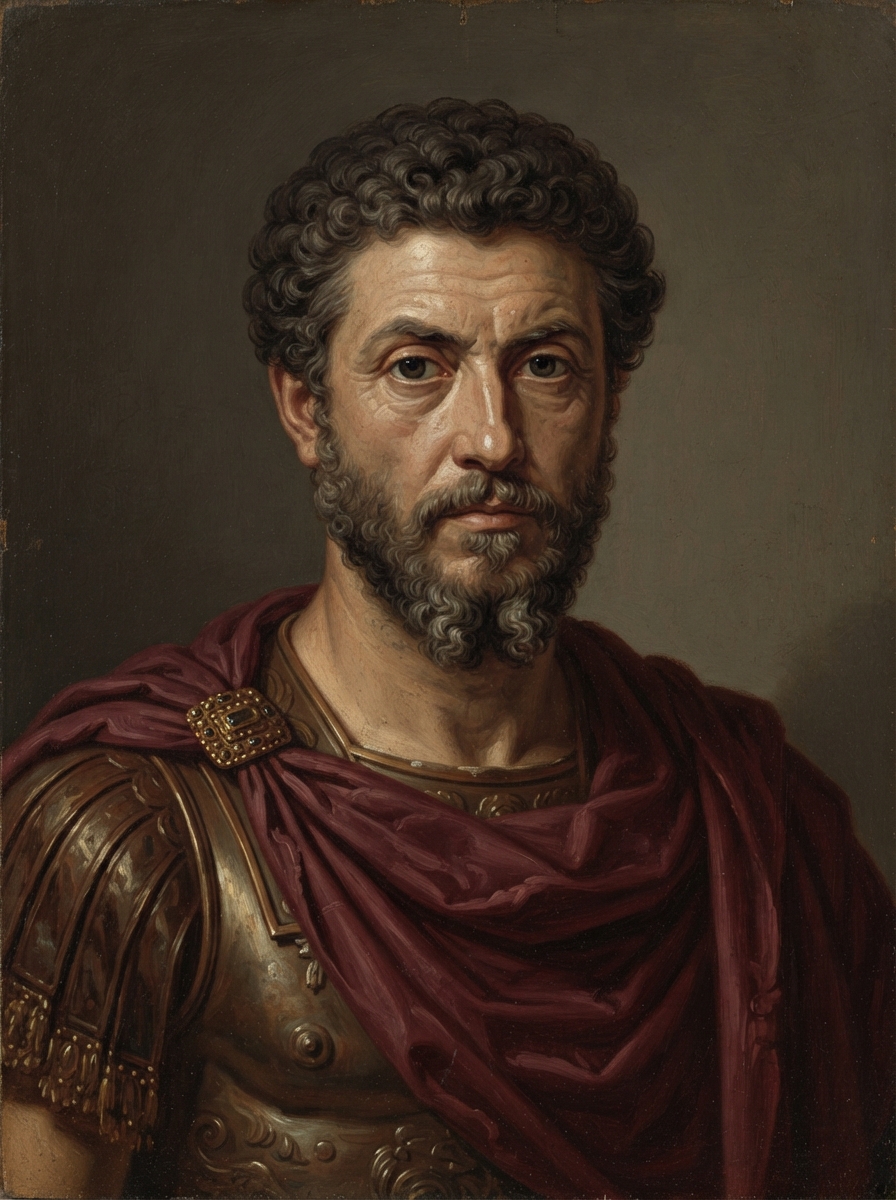
AI-assisted Portrait of Avidius Cassius
The Second Man Who Did the First Man's Work
For six years Gaius Avidius Cassius did the actual fighting that made someone else's war a triumph. Born around 130 CE in Cyrrhus, Syria, to a distinguished provincial family, he rose through the eastern legions until, when the Parthian War broke out in 161, he found himself doing the field generalship for a campaign nominally led by the co-emperor Lucius Verus — a man more interested in Antioch's theaters and its women than its maps. It was Cassius's columns that pushed east, and Cassius's forces that took and burned Ctesiphon, the Parthian capital, in 165. Verus took the triumph. Cassius took, from Marcus Aurelius, something arguably better: extraordinary, quasi-regal authority over the entire Roman East.
It is that reward, and what he did with it a decade later, that makes Cassius legible as an ENTJ. In 175, a rumor reached the East that Marcus had died fighting the Marcomanni on the Danube. Cassius did not wait for confirmation, did not consult, did not hedge. Within days he had himself proclaimed emperor. Within months Egypt and Syria had fallen in behind him. It was the same trait that had won Ctesiphon — a mind that sees the shape of an opportunity and moves on it before anyone else has finished reading the situation — now aimed at the throne itself. When the rumor turned out to be false, the same speed that built his revolt in weeks unmade it in about three months: his own centurions cut him down and sent his head to Marcus, who is said to have refused even to look at it.
Cassius was not a plotter waiting for his moment — he was a commander who, the instant he judged the throne empty, treated seizing it as the next logical order to execute. That is dominant Te: authority is a function to be exercised the moment competence and opportunity align.
The General Who Actually Won the War
Lucius Verus held the title of commander in the Parthian War; Cassius held the war. Through the campaigns of 163–166, it was Cassius who drove the eastern advance to its conclusion, and Cassius whose legions marched into and burned Ctesiphon — the kind of decisive, externally-verifiable result that dominant Te exists to produce. He was not interested in the war as an occasion for glory or sentiment; he was interested in it as a problem with a solution, and he applied troops, logistics, and timing to that problem until it was solved.
Marcus's response tells you how rare that competence was judged to be: rather than reabsorb Cassius into the ordinary chain of command afterward, he handed him something close to a standing viceroyalty over the Roman East — command authority no other legate held. That is a Te figure being rewarded in the currency Te values most: not honors, but jurisdiction. And it is the same faculty, unromantically, that let him move on Marcus's rumored death with such speed in 175 — an emperor was needed, the office was (he believed) vacant, and he was, by every operational measure he trusted, the man for it.
Reading a Throne He Could Not See
What separates Cassius's revolt from mere opportunism is the confidence with which he read a political landscape he had no way to confirm firsthand. He was in Syria; Marcus was somewhere on the Danube, hundreds of miles and weeks of travel away. Cassius did not have proof of Marcus's death — he had a rumor, and a bet that the eastern provinces, which he had governed for years, would back him immediately if he moved before anyone could check. That bet was, in fact, correct: Egypt and Syria came over to him within a season. That is auxiliary Ni — a long-incubated, largely unconscious model of how the eastern half of the empire would break, cashed in at the single moment it mattered.
It is also what makes the episode tragic rather than merely rash. Cassius wasn't guessing blindly; he had spent a decade as the de facto ruler of the East and had internalized, correctly, that its loyalty to him personally rivaled its loyalty to a distant, ailing emperor. His model of the situation was sound. The one variable he could not model — because no one could, at that distance and speed — was whether Marcus was actually dead. When the answer came back no, the vision collapsed as suddenly as it had crystallized, and his own officers, recalculating the same landscape in reverse, killed him for it.
Why ENTJ Over ESTJ
Why not ESTJ?
An ESTJ reading casts Cassius as a loyal administrator-executor, a man who simply carried out orders efficiently within an established hierarchy. But nothing about the 175 revolt is careful or precedent-respecting: Cassius acted on an unverified rumor, within days, to seize an office rather than defend a post. That is a strategic leap made on an internal read of the situation — Ni feeding Te — not the cautious, procedure-bound execution of Si-Te. An ESTJ general waits for confirmation and works the chain of command; Cassius treated the vacancy itself, real or not, as the order.
The distinction matters because it is exactly what makes Cassius's story a tragedy of character rather than a cautionary tale about discipline. He was not undisciplined — his Parthian campaigns show meticulous operational control. What he had, in addition, was the ENTJ willingness to bet everything on a single strategic reading the moment he believed the board had changed. It made him indispensable to Marcus for a decade. It made him a corpse within a season.
Connected Figures
Further Reading
- Life of Avidius Cassius — Historia Augusta, trans. David MagieThe fullest ancient narrative of the revolt, though its reliability is contested by modern historians.
- Roman History, Book 71 — Cassius Dio, trans. Earnest CaryA more sober near-contemporary account of Cassius's career and Marcus's response to his death.
- Marcus Aurelius: A Biography — Anthony Birley (1966, rev. 1987)The standard modern account; covers the Parthian War command dynamics and the revolt in careful detail.
- Meditations — Marcus Aurelius, trans. Gregory Hays (2002)For the emperor's own reflections on clemency and forgiveness toward those who wrong him.
