 Historical Figure MBTI
#665 · 5-15-26 · The Five Good Emperors
Lucius Verus
The Co-Emperor Who Delegated
130 — 169 CE
6 min read
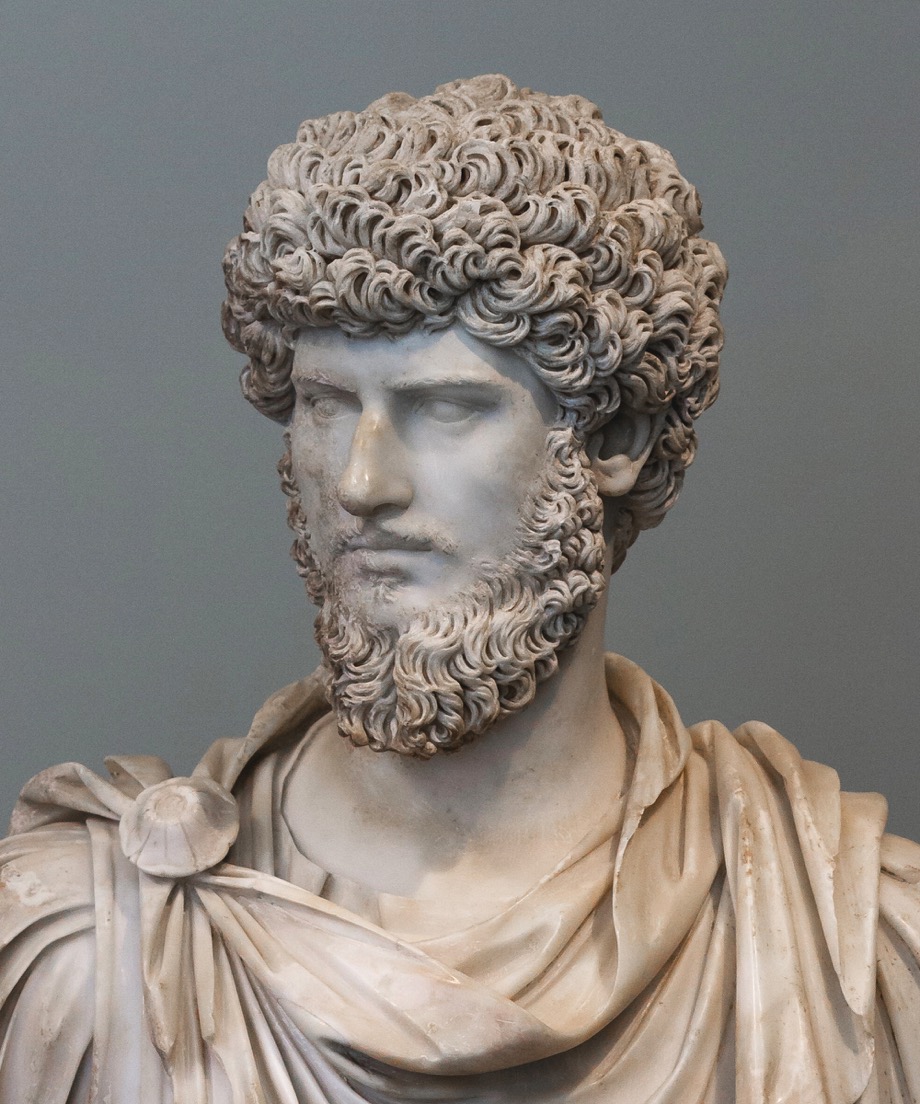
Portrait of Lucius Verus
A Throne Given Away
Marcus Aurelius did not have to share the purple. When Antoninus Pius died in 161 CE, the succession passed to Marcus alone, cleanly and without dispute — Hadrian had arranged it that way decades earlier. Yet Marcus's first act as emperor was to insist that his adoptive brother, Lucius Verus, be raised to the same rank: not junior colleague, not designated heir, but co-emperor in full legal standing, the first time Rome had ever recognized two rulers as genuine equals. It is one of the strangest gestures of restraint in Roman history, and it says more about Verus's temperament than any of his own recorded acts, because it only makes sense if Marcus judged, correctly, that Verus wanted the honor without wanting the burden.
That judgment held. When Parthia invaded Armenia and Rome needed a general in the field, Verus took the command — and then, on arriving in the eastern provinces, largely handed the war to his officers, chiefly the sharp and ambitious Avidius Cassius, and settled into Antioch for the duration. There he watched theater, backed chariot teams, threw dinners, and kept a long companion named Panthea, while Cassius fought and eventually sacked the Parthian capital at Ctesiphon. Verus came home to Rome and celebrated a triumph for a war he had scarcely touched. He felt no need to have done it himself, and he felt no shame in that. He is an ISFP: a man organized around private, authentic enjoyment rather than command, status, or display.
Verus wanted the throne beside his brother, not the war in front of him — an ISFP's dominant Fi choosing contentment over conquest, and trusting others to handle the rest.
Contentment Without Conquest
Dominant Fi does not need to be seen enjoying itself; it only needs to actually enjoy itself. That distinction defines Verus. He did not stage his pleasures in Antioch as propaganda or provocation — he simply lived them, privately, for years, while a war that bore his name was decided by other men's tactics. An ESFP in the same position would have needed the campaign narrated around him, his exploits reported to Rome; Verus let Cassius's victories speak for the war and asked for none of the credit for himself beyond the triumph that came with the title.
The same quiet self-sufficiency explains the arrangement with Marcus in the first place. A man hungry for status contests a throne; a man governed by internal values accepts an equal share of one without apparent friction. For eight years the two emperors ruled jointly, and no meaningful account survives of Verus resenting Marcus's evident seniority in temperament and industry, or of Marcus resenting Verus's evident preference for leisure. Each got what he actually wanted. That is Fi doing exactly what it does best — knowing, without needing outside validation, what genuinely matters to you, and holding to it even while wearing an emperor's title.
Antioch, Fully Lived In
Auxiliary Se is what turned Verus's contentment into a specific, sensory life rather than an abstract preference. Ancient writers, hostile as many of them were, agree on the texture of his years in the east: theater seats, chariot races he wagered on and attended in person, long dinners, a household built around present pleasure rather than administrative ambition. This was not idleness in the sense of doing nothing — it was an intense, physical engagement with whatever the moment in front of him offered, exactly the register an auxiliary Se runs in.
It also explains why he went east at all rather than directing the Parthian War by letter from Rome, as a more cerebral type might have preferred. Verus wanted to be there, in the actual place, near the actual army and the actual city of Antioch, even if he had no intention of personally commanding a battle line. Presence, not control, was the point. When the war ended and the legions marched home carrying the plague that would ravage the empire for a decade, Verus's own war had already been the sensory one he chose for himself — a life of immediate pleasures pursued in real time, at the edge of an empire he governed but did not particularly need to run.
Why ISFP Over ESFP
Why not ESFP?
ESFP is the obvious foil in this era, since Commodus later supplies exactly that type on the same throne — a ruler who needed the arena's applause the way Verus never needed Antioch's. Verus's pleasures were private and low-key: a companion, a dinner table, a theater box, not a staged spectacle demanding an audience. He let Cassius take the field and the glory of Ctesiphon without apparent resentment, something an attention-seeking ESFP would find intolerable. There is no record of him performing his enjoyment for Rome to witness — only of him having it, quietly, for himself.
What separates Verus from an ESFP is precisely what he never needed: an audience. Commodus fought in the arena because he required Rome's eyes on him. Verus fought no arena at all and seemed entirely satisfied to let his name attach to a victory he had not personally won. That is introversion showing up not as shyness but as a simple absence of hunger for applause — pleasure as a private good, not a public performance.
Connected Figures
Further Reading
- Life of Lucius Verus — Historia Augusta, trans. David MagieThe fullest ancient biography, gossipy and hostile but the primary source for the Antioch years.
- Roman History, Book 71 — Cassius Dio, trans. Earnest CaryA contemporary-adjacent senatorial account of the joint reign and the Parthian campaign.
- Marcus Aurelius: A Biography — Anthony Birley (1966, rev. 1987)The standard modern biography of Marcus; covers the co-rule with Verus in careful detail.
- Correspondence — Fronto, trans. C.R. Haines (Loeb Classical Library)Personal letters touching on Verus's character and the conduct of the Parthian War.
