 Historical Figure MBTI
#663 · 5-15-26 · The Five Good Emperors
Marcus Aurelius
The Philosopher Emperor
121 — 180 CE
9 min read
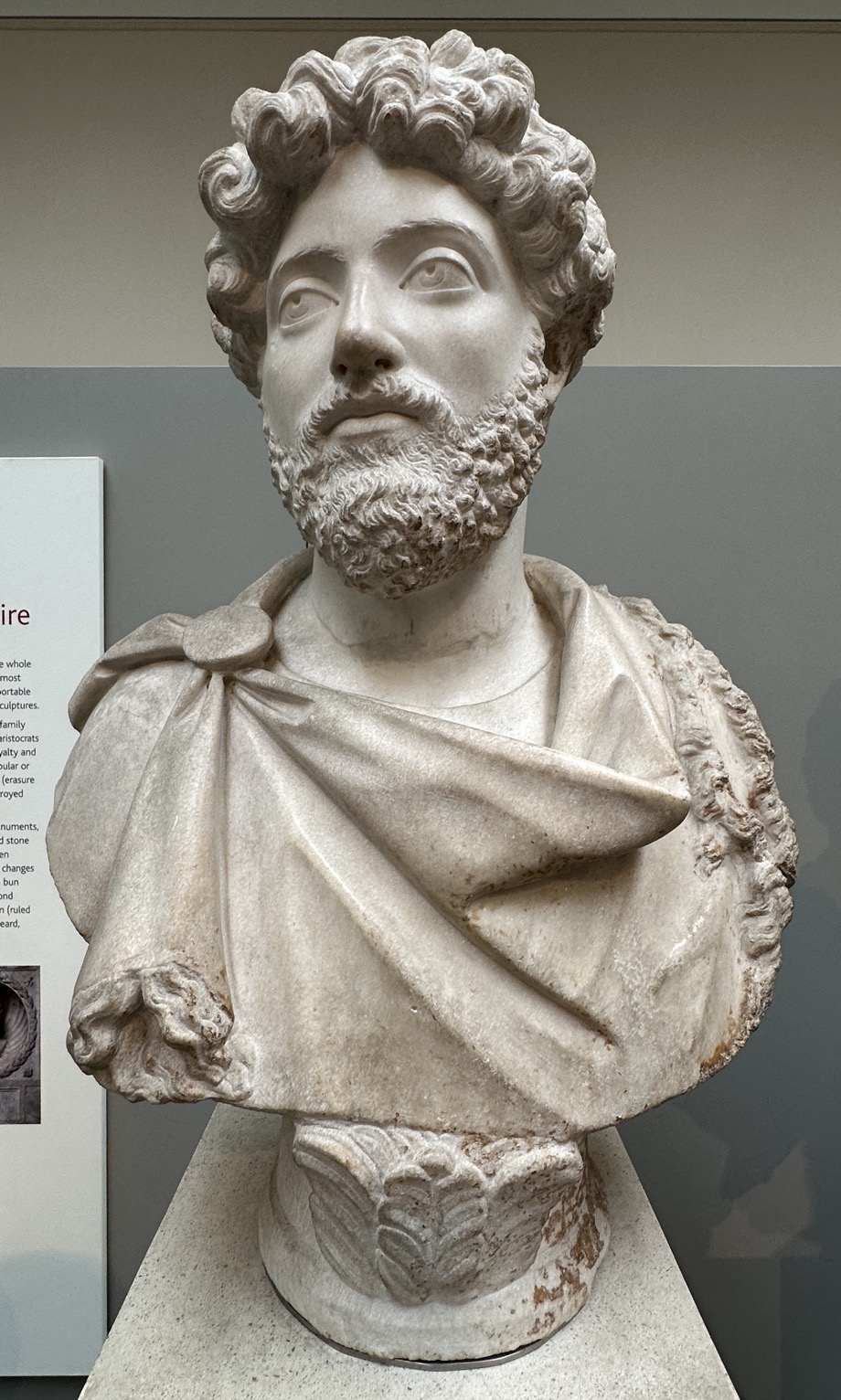
Portrait of Marcus Aurelius
The Notebook He Never Meant You to Read
Sometime in the 170s, in a tent on the Danube, the most powerful man alive wrote himself a note about death. It was in Greek, not Latin — the language of philosophy rather than of government — and it was addressed to nobody. There is no dedication, no reader implied, no arrangement into books that he authorized. The manuscript we call the Meditations survives by accident, and its first readers were people Marcus Aurelius never imagined. That accident is the single most important fact about him. We possess, uniquely among rulers of the ancient world, the interior of an emperor: not his propaganda, not his apologia, but the private argument he was having with himself while the empire waited outside.
What that argument reveals is a man almost entirely uninterested in the things power is normally wanted for. Hadrian had spotted him as a boy and nicknamed him Verissimus — the truest — then wrote him into a succession plan that ran through Antoninus Pius and arrived, twenty-three years later, at the throne. Marcus took it in 161 and immediately gave half of it away, elevating his adoptive brother Lucius Verus to full co-emperor when nothing in Roman law or Hadrian’s design required it. He then spent the better part of fifteen years in frontier camps he loathed, fighting wars he had not chosen, presiding over a plague he could not stop, and writing — night after night — reminders to himself that none of it was about him.
Read as a career, this is the life of a dutiful administrator. Read as a mind, it is a single unifying vision of the cosmos as one living body and every human being a limb of it — held with the quiet, faintly melancholy conviction of a man who reached his conclusions early and spent the rest of his life checking them for cracks.
Marcus Aurelius was an INFJ — a dominant-Ni moralist who governed an empire from inside a private cosmology he never once tried to publish.
Ni — The One Vision, Rehearsed Ten Thousand Times
The Meditations are not a diary. Almost nothing happens in them. There are no dates, few names, no account of battles won or provinces reorganized; a reader coming to them for history finds a book that seems to be about the same four or five ideas, restated in slightly different words, for a hundred pages. That repetition is the tell. Dominant introverted intuition does not accumulate insights the way sensing accumulates facts — it arrives at one organizing image and then spends a lifetime turning it, testing it against each new day, wearing it smooth. Marcus’s image was the cosmos as a single rational body in continuous change: everything that happens is the whole doing what wholes do, every person is a part of it, and the only real question ever available to you is whether you will act like a part or like an amputation.
Once you see that vision, the strange flatness of his reign starts to look like policy. He built no new Rome, restructured nothing, left no signature reform. The Meditations explain why: from inside a Ni cosmology, structures are provisional and the emperor’s achievements are already dust in advance. He tells himself repeatedly how soon he will be forgotten, how quickly the whole court of Augustus vanished, how the names that filled the Forum became ancient history, then myth, then nothing. This is not depression and not humility for show. It is the characteristic Ni move of standing outside the present and looking back from a point where it has already ended — then asking what, from there, still matters. His answer never changes: only the quality of the will behind the act.
The privacy is the proof. An extravert with the same convictions writes a treatise, delivers it, teaches it, converts. Marcus was emperor; every copyist in the Mediterranean would have reproduced anything he cared to release, and he released nothing. The vision was complete inside his own head and needed no audience to be true. The book that has done more moral work than any other document of the Roman Empire was written by a man who would have been faintly embarrassed to learn you were reading it.
Fe — Hands, Eyelids, and the Two Rows of Teeth
“We were born to work together,” he wrote, “like feet, like hands, like eyelids, like the rows of upper and lower teeth. To obstruct each other is unnatural.” The line is quoted so often that its oddity has worn off. It is not a statement about kindness or political order; it is anatomy. Marcus’s intuition of the cosmos as one body descends directly into an ethics in which harming another person is a category error, like a hand injuring the other hand. That is Ni supplying the picture and Fe supplying the obligation, fused so tightly you cannot pull them apart.
It shows in the one act of his accession that nobody made him perform. Hadrian’s plan and Antoninus’s long reign had left Marcus the obvious sole heir, and the Senate offered him the principate alone. He refused it alone, insisting that Verus be raised beside him with equal imperial powers — the first genuine joint emperorship in Roman history, invented on the spot by a man halving his own authority because his adoptive brother had been named in the same succession and it would have been, in some obscure way, indecent not to. Verus was not his equal in ability and Marcus surely knew it. The gesture was a refusal to be a limb that obstructs.
The clearest case, though, is Avidius Cassius. In 175, Marcus’s most trusted eastern general — on a false rumor that the emperor had died — had himself proclaimed emperor, and held half the east for three months before his own officers murdered him. Marcus’s recorded reaction to the news was grief: not that he had been betrayed, but that Cassius’s death had robbed him of the chance to pardon the man in person. Then he had the usurper’s private correspondence brought to him and burned it unread, so that no name in it could be used to hunt down anyone else. Set that beside Nero, whose response to a conspiracy was to work outward through the letters until the confessions ran out. Burning the evidence is not clemency as policy; it is a man protecting his own conscience from what he might feel obliged to do with the truth.
Ti — The Borrowed Scaffolding
A vision that large needs a frame or it becomes mysticism, and Marcus went looking for one early. He took the Stoic system — physics, logic, ethics locked together — largely through Epictetus, whose discourses his teacher Junius Rusticus put into his hands and whose vocabulary saturates the Meditations. The discipline of assent, the division of everything into what is up to us and what is not, the dismantling of an alarming impression into its parts: these are analytic tools, and Marcus uses them on himself the way a mechanic uses a wrench. Roast meat is a dead animal; the purple robe is sheep’s wool dyed with shellfish blood. Take the thing apart and the impression loses its authority.
That is tertiary introverted thinking doing exactly what tertiary functions do — serving the dominant rather than leading. Marcus never advanced Stoic theory. He contributed no doctrine, resolved no school dispute, and shows almost no interest in the technical logic that had occupied Chrysippus; he even admits, with visible relief, that he was spared becoming a professional philosopher. What he wanted from the system was structural: a set of proofs he could run whenever the vision faltered, so that duty rested on argument rather than on mood. His rhetoric tutor Fronto spent years trying to pull him back toward eloquence and lost, because eloquence has an audience and Marcus wanted a machine for private conviction.
Se — Fifteen Winters on the Danube
He was a frail, studious boy who trained himself to sleep on boards and gave it up only when his mother complained. He had never commanded an army, and had spent his twenties and thirties doing legal and administrative work in Rome under Antoninus, who in twenty-three years of rule barely left Italy. Then the Marcomanni and Quadi crossed the Danube, the Antonine Plague came back with the eastern legions, and Marcus spent most of his remaining life in camps at Carnuntum and Sirmium — mud, cold, dispatches, sick men, a war that would not end.
He performed it. That is the whole of the inferior-Se story, and it is worth lingering on how unusual it is. He did not delegate the frontier to a general and stay in the capital; he went, and stayed, and kept going back. But nothing in the Meditations suggests he ever found the physical world absorbing on its own terms — no relish for the march, no eye for terrain, no appetite for the games (he was famously criticized for reading dispatches in the imperial box at the arena). The sensory world reaches him almost entirely as something to be reframed. Where Augustus or Tiberius had physical instincts about armies and geography, Marcus had a rule about obligation and applied it, year after year, in weather he hated.
He died at Vindobona in 180, on campaign, in his late fifties — worn out on a frontier he had never wanted, in a war he had inherited, doing the part of the body that had fallen to him.
Why INFJ Over ISTJ
The strongest case against this typing is the reign itself, and it is serious. Marcus changed almost nothing structurally. He deferred to the Senate with a punctiliousness that had been theatre under his predecessors and seems to have been sincere in him. He fought only defensive wars, chosen for him by the tribes across the river. And Book 1 of the Meditations — the only part that reads like a finished composition — is a gratitude ledger, itemizing what he owed to his grandfather, his mother, his tutors, his adoptive father. It is hard to imagine a more ISTJ document.
Why not ISTJ?
The reign was ISTJ; the man was not. An Si-dominant steward preserves the institution because it is the institution — precedent has authority in itself. Marcus preserved it because it happened to be his assigned part in a cosmic order he had reasoned out privately, and he says so in a notebook no ISTJ emperor would have produced: a hundred pages of interior metaphysics with no ledger, no record, no practical use. The unprompted elevation of Verus is not a precedent-following act — there was no precedent — it is an intuitive-ethical one. And the Cassius response is its opposite: duty and prudence both said read the letters and identify the conspirators; Marcus burned them unread. Even Book 1’s gratitude is not Si recall of facts but Fe accounting of obligations, sorted by what each person taught him to be.
The contrast is available in the archive itself, one entry back. Antoninus Pius is the pure ISTJ steward: a man who ruled twenty-three years, never left Italy, kept the treasury full, changed nothing, and left no interior record because there was no second layer to record. His son by adoption did much the same job and was a completely different animal underneath — restless, self-interrogating, convinced that the administration of an empire was a minor consequence of a much larger fact about the universe. Pius left a functioning state. Marcus left a functioning state and a book, and it is the book that has outlived the state by eighteen hundred years.
Connected Figures
Further Reading
- Meditations — Marcus Aurelius, trans. Gregory Hays (2002)The primary evidence for everything argued here, in the translation that strips away the Victorian solemnity and lets the private voice sound private.
- The Inner Citadel: The Meditations of Marcus Aurelius — Pierre Hadot (1998)Reconstructs the book as a set of repeated spiritual exercises rather than a treatise — indispensable for why it circles the same ideas.
- Marcus Aurelius: A Biography — Anthony Birley (1966, rev. 1987)The standard scholarly life; careful on the Hadrianic succession plan, the elevation of Verus, and the Fronto correspondence.
- Marcus Aurelius: A Life — Frank McLynn (2009)A more skeptical modern narrative, hard on the Commodus decision and useful as a corrective to the saintly reading.
- Roman History, Books 71–72 — Cassius Dio, trans. Earnest CaryThe nearest ancient narrative source for the Marcomannic wars and the Avidius Cassius revolt, including the burned correspondence.
- Historia Augusta, "Life of Marcus Aurelius" — trans. David MagieLate, gossipy, and partly invented — but the origin of much of the received anecdote, including Hadrian's 'Verissimus'.
