 Historical Figure MBTI
#647 · 5-12-26 · The Julio-Claudians
Nero
The Performer Emperor · Golden House · Last of the Julio-Claudians
37 — 68 CE
8 min read
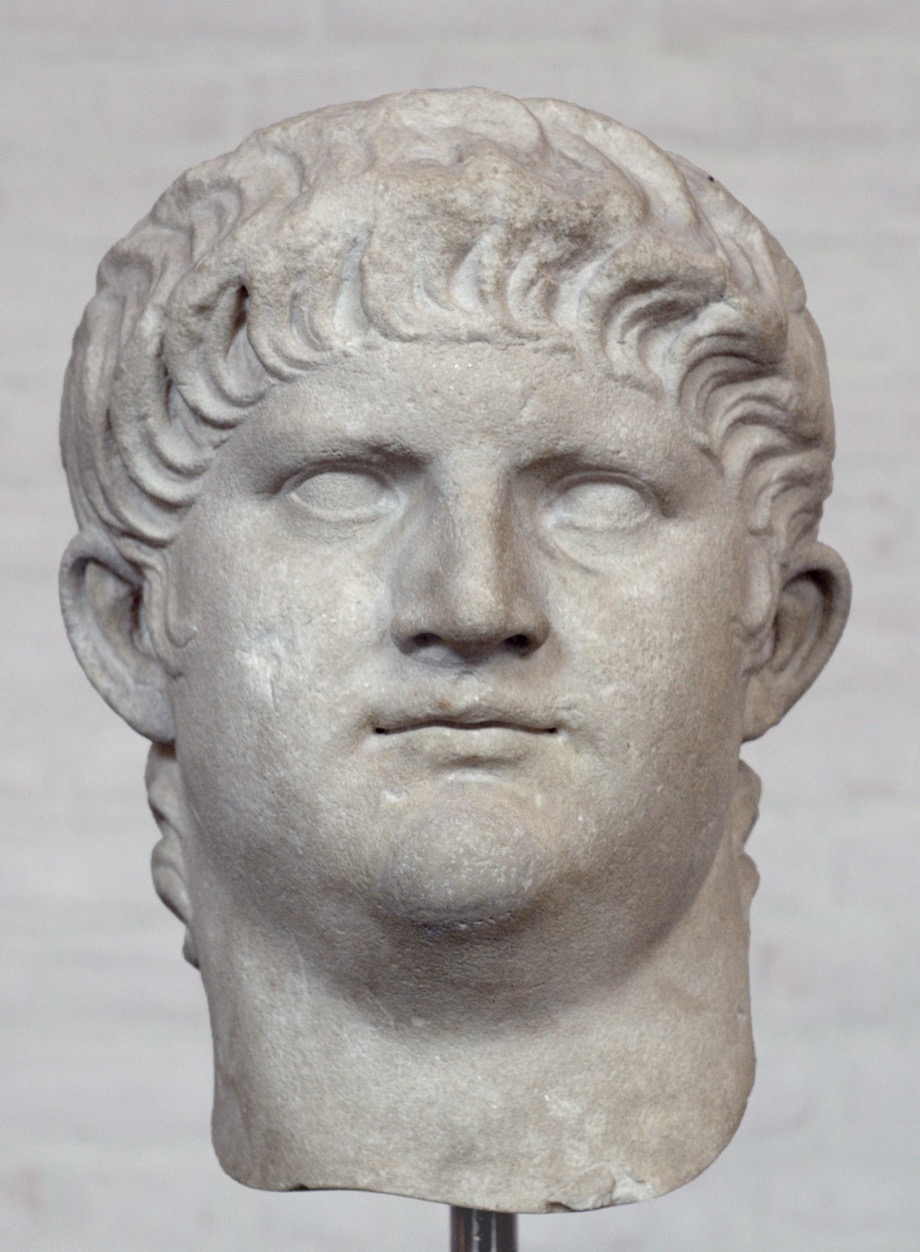
Portrait of Nero
What an Artist Dies in Me
Nero came to the throne at sixteen, the last blood heir of a house that had spent a century learning how power actually worked. He never learned it, and never much cared to. What he wanted — consistently, nakedly, from his first public performance to his last — was to be watched, applauded, and felt. He wanted the lyre, the chariot, the stage, the roar of a full theater, and he wanted it more than he wanted the empire that made those things possible. That is not the profile of a tyrant with a plan. It is the profile of an ESFP, a sensation-seeking performer who happened to be born holding the keys to the Roman world.
Everything that reads as monstrous in Nero's reign — the murdered mother, the murdered wife, the five-hour concerts elite Romans were barricaded into attending, the palace built on the ashes of a burned city — reads differently once you stop looking for strategy behind it. There isn't any. Nero killed people who threatened his freedom to feel and perform exactly as he wished, in the moment the threat became intolerable to him, and then he moved on to the next spectacle. He never built an ideology. He never articulated a vision of Rome beyond "Rome, watching me." That absence of design, sustained across fourteen years of absolute power, is itself the clearest evidence of his type.
Nero was an ESFP, and dominant Se explains him better than any theory of tyranny: he did not rule so much as perform, chasing the next vivid sensation with no thought for the next year.
His death completed the pattern rather than contradicting it. Facing revolt, abandonment, and certain execution, Nero did not scheme his way out or rally an army. He composed himself, quite literally, for the moment — dictating his own epitaph on the spot, mourning not his empire but his artistry, and dying with the line "Qualis artifex pereo": what an artist dies in me. Even at the very end, the only tragedy he could register was the loss of an audience.
The Stage That Ate an Empire
Se, in Nero, was not a talent for reading a room or seizing an opening — it was a hunger for raw, immediate sensation, indulged at a scale only an emperor could afford. He trained his voice for years, performed publicly as a singer, actor, and lyre player, and entered chariot races himself, all activities considered beneath the dignity of even an ordinary senator, let alone an emperor. He did not do this once, as a stunt. He did it compulsively, again and again, because the act of performing and being watched was the point of being alive.
The clearest evidence is what he was willing to do to other people's bodies to get more of it. Suetonius and Tacitus both describe audiences locked into his performances for hours at a time, guards posted at the exits, no one permitted to leave regardless of illness, exhaustion, or labor — women reportedly gave birth in the stands, and men faked their own deaths to be carried out on stretchers. That is Se with no governor on it at all: the emperor's appetite for a captive audience simply overriding every other consideration, including basic physical decency.
The Great Fire of 64 CE and the Domus Aurea that followed tell the same story on an architectural scale. Whatever the truth of his role in the fire, Nero's response to a devastated Rome was to seize the cleared ground for an extravagant pleasure palace — landscaped grounds, a colossal statue of himself, reportedly a mechanical dining room ceiling that rained flowers on guests. It is the instinctive move of a man who experiences the world through spectacle and never stopped to ask what the ashes around him meant to anyone else.
Whatever Wounds Him, Dies
Nero's auxiliary Fi shows up not as a code of ethics but as an intensely personal, entirely unphilosophical sense of what he could and could not tolerate feeling. He did not weigh his mother Agrippina the Younger's growing political interference against the good of the state; he experienced it as an intolerable violation of his own autonomy and, in 59 CE, had her killed. There was no doctrine behind it, no argument he offered the Senate about necessity. It was personal, visceral, and final — the hallmark of Fi unmoored from any larger framework.
The killing of Poppaea Sabina, his second wife, follows the same shape according to the hostile tradition: not a calculated murder but a fit of feeling, reportedly a kick delivered to a pregnant woman in a moment of rage that then could not be undone. Whether or not every detail is accurate, the story survived because it fit what Romans already understood about him — that his interior emotional weather, not any external principle, governed what happened to the people closest to him.
Fi also explains the tenderness the Se-driven excess so easily obscures: his genuine grief at Poppaea's funeral, his real attachment to his art, his fury at anyone who mocked his singing. He felt everything intensely and privately, judged the world entirely by how it made him feel, and never developed the outward ethical architecture — the Fe concern for how his feelings affected others, or the Te concern for outcomes — that might have restrained him.
Borrowed Competence
Whatever functional government Nero's reign produced came almost entirely from delegation, not from any Te of his own. The famous "good Quinquennium" — the first five years of stable, comparatively humane administration — was the achievement of Seneca and Burrus, the tutor and the Praetorian prefect who ran the actual machinery of empire while their teenage emperor was still content to let them. Tertiary Te here looks like borrowed competence: Nero could recognize, at least early on, that Seneca's arrangements kept the provinces and the treasury functioning, and he let them run.
That borrowed competence collapsed the moment Nero's own impulses outgrew his advisers' patience. He drove Seneca into retirement and eventual forced suicide, sidelined Burrus's successors, and left the empire's actual administration to freedmen and favorites while he toured Greece competing in rigged festival contests. Te that isn't truly one's own erodes exactly like this — present only as long as someone with real judgment is standing close enough to lend it, gone the moment that person is pushed away.
By the final years, the gap was unmistakable. Provincial governors revolted, the treasury strained under the cost of his spectacles and building projects, and Nero's response to mounting crises was not administrative but performative — more contests, more praise extracted from terrified courtiers, no coherent plan to hold the empire together. When Galba's revolt finally came in 68 CE, there was no operational core left to mount a real response.
No Horizon Beyond the Next Act
Inferior Ni in Nero appears mainly as an absence — the thing he never developed rather than a force that occasionally surfaced. He showed almost no capacity to imagine the long-term trajectory of his own reign, no ability to weigh how a murdered mother, a devastated aristocracy, or a starved provincial army might eventually converge against him. Each crisis was handled as its own isolated, present- tense problem, resolved by whatever removed the immediate discomfort, with no model of consequence extending past that.
The rare glimpses of something like foresight were brief and superstitious rather than genuinely visionary — reported anxieties about omens, prophecies, and his own eventual downfall that surface in the later sources as a kind of dread rather than planning. That is characteristic of an underdeveloped inferior function: intuitions about the future arrive as vague foreboding he cannot act on constructively, not as a coherent picture he can use to change course.
When the revolt finally arrived in 68 CE, Nero had no contingency whatsoever — no loyal legions cultivated in advance, no fallback plan, nothing but flight and, at the end, a borrowed dagger and a line for posterity. A ruler with any real Ni would have seen the convergence of an alienated Senate, a mutinous military, and an exhausted treasury coming years earlier. Nero saw none of it until it was standing at his door.
Why ESFP Over ENFP
Why not ENFP?
An ENFP driven by dominant Ne would have generated ideas — theories about art, religion, government, some pattern he wanted to build or explore beyond the immediate moment. Nero generated none of that. He had no ideology behind the persecution of Christians beyond convenient scapegoating, no vision for the Golden House beyond his own comfort and display, no larger project for his singing beyond the applause of the specific room he was standing in. What Nero wanted was concrete sensation and personal expression, repeated and escalated, never abstracted into a pattern or a plan. That is Se and Fi, not Ne.
The distinction matters because it is easy to mistake Nero's theatricality for imagination. It wasn't. An ENFP tyrant would have left behind manifestos, grand reinterpretations of Rome's destiny, strange visionary building schemes justified by some idea. Nero left behind performances, a palace built for his own pleasure, and a trail of people killed for standing between him and the next one. He was a creature of the present tense from beginning to end, and ESFP is the type that actually describes that.
Connected Figures
Further Reading
- The Annals of Imperial Rome — TacitusThe essential hostile-but-detailed account of Nero's reign, court, and fall.
- The Twelve Caesars — SuetoniusVivid, gossip-rich biography — the source for the captive-audience performances and the death scene.
- Nero — Edward ChamplinA revisionist study reading Nero's spectacles as coherent self-presentation rather than mere depravity.
- Roman History — Cassius DioA later, still hostile, Greek-language perspective that fills gaps in Tacitus and Suetonius.
