 Historical Figure MBTI
#653 · 5-12-26 · The Julio-Claudians
Claudia Octavia
The Discarded Wife · Loyalty That Bought Nothing
39/40 — 62 CE
6 min read
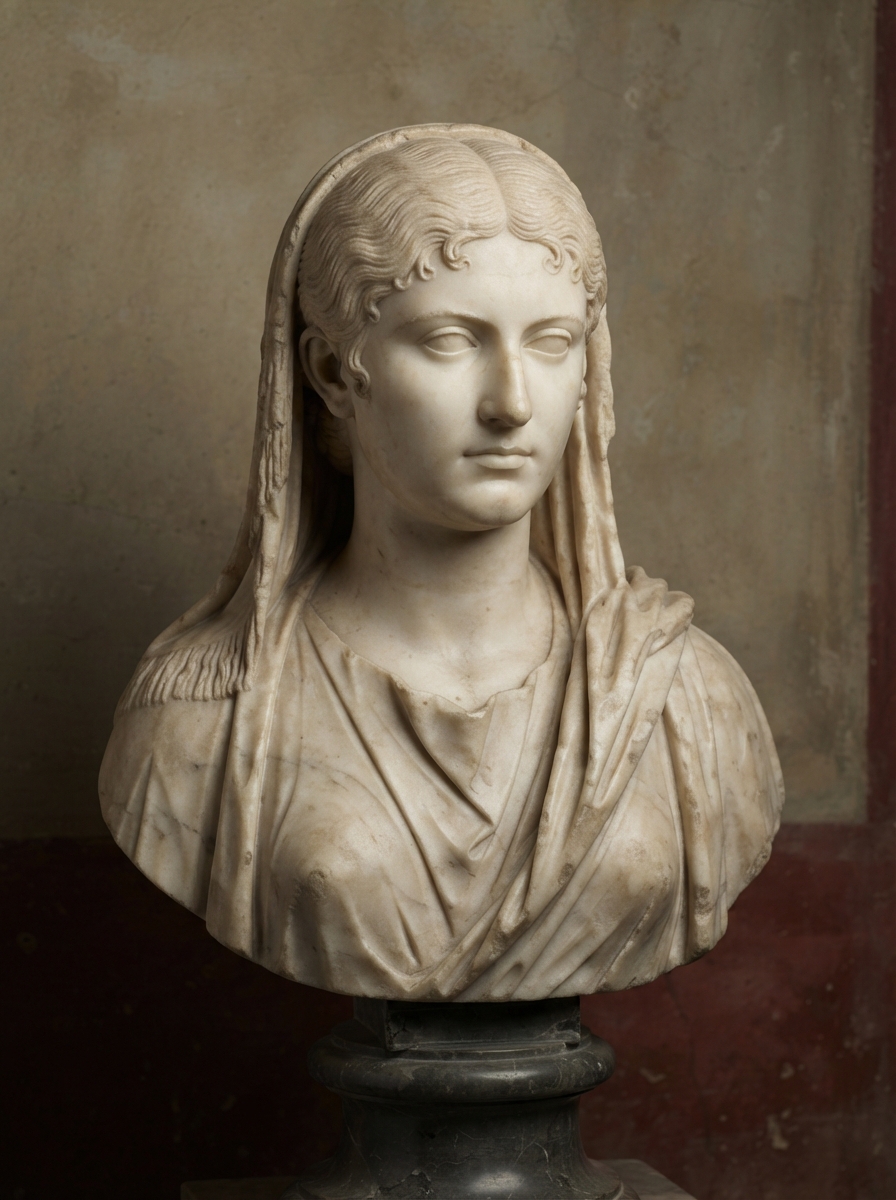
AI-assisted Portrait of Claudia Octavia
The Wife Who Was Never Meant to Matter
Claudia Octavia was arranged into her own life before she was old enough to object to it. Daughter of Claudius and Messalina, she was betrothed and then married to Nero in 53 CE at Agrippina the Younger's engineering — a stamp of legitimacy laid over an ambitious stepson's claim to the throne. She was perhaps thirteen. Nothing about the marriage was hers: not the timing, not the partner, not the purpose. What survives of her in the sources is not ambition or defiance but a kind of grinding constancy — she stayed where she was placed, did what a Roman wife of her station was supposed to do, and never once tried to bend the marriage toward anything of her own.
That constancy is the whole story. Nero paraded his mistresses, most conspicuously Poppaea Sabina, while Octavia held her ceremonial place beside him with no apparent recourse and, so far as the record shows, no apparent plot. When he finally discarded her in 62 CE — divorcing her on a fabricated charge of infertility and adultery so he could marry Poppaea — she did not flee, did not rally a faction, did not appeal to some larger vision of what she deserved. She endured the divorce, then the exile to Campania, then a still more contrived charge of conspiracy, then execution at about twenty-two. Through all of it she is described doing exactly what was expected of a discarded wife: nothing more, nothing less. That is ISFJ under maximum pressure — a personality built around loyalty to role and tradition, tested by a husband and a court that offered her no other role to play.
Octavia never rebelled, never schemed, and never sought power of her own — she simply kept faith with the role she had been given, long after everyone around her had stopped honoring the bargain. That is the quiet architecture of dominant Si serving auxiliary Fe.
Fidelity to a Role Nobody Else Honored
Dominant Si anchors itself to precedent — to the way things are supposed to be done, the role one has been given, the standing obligations of family and station — rather than to some inner vision of what could be different. Octavia never seems to have imagined an alternative script for her own life. She was the emperor's daughter, then the emperor's wife; both were fixed facts, not positions to be renegotiated. When the marriage curdled into public humiliation, she did not reach for a new identity or a new alliance. She held the one she had.
That fidelity persisted past the point of any conceivable benefit to her. After the divorce and the fabricated adultery charge, after exile to Campania, Octavia is not recorded pleading a case, seeking foreign refuge, or courting a faction that might restore her — the kinds of moves a more forward-looking or theory-driven type might attempt. She simply occupied the diminished, humiliating position assigned to her, the way she had occupied the honored one before it. It is Si's particular tragedy: the same steadiness that makes a role sustainable in good times keeps a person locked to it in catastrophic ones, because the alternative — inventing a new self on the fly — was never part of her repertoire.
Even the final conspiracy charge fit this pattern by exploiting it. Nero's regime did not need to prove Octavia dangerous, only accuse her of it, because her entire public identity was built on passive constancy rather than active maneuvering — there was no history of scheming to weigh against the charge, and also no instinct in her to organize a defense beyond enduring what came.
Grief the City Could Recognize
Auxiliary Fe orients outward toward the emotional expectations of a group — what a wife, a daughter, a public figure owes to the people watching her. Octavia's public bearing through years of humiliation reads as textbook Fe discipline: whatever she felt in private, she performed the correct, dignified role of Caesar's wife in public, giving the Roman audience nothing to seize on and nothing to pity prematurely.
That discipline is precisely what made her death land as it did. Her execution on a manufactured conspiracy charge produced something rare in Nero's reign: visible public sympathy, even quiet unrest, one of the few moments before the final revolt when the city turned against him openly. That reaction was possible only because Octavia had spent years being legible to the public as blameless and dutiful — an Fe performance so consistent that when it ended in murder, the audience she had always played to recognized the injustice immediately and reacted as a wronged community, not as spectators of a private grudge.
Why ISFJ Over INFJ
Why not INFJ?
INFJ would carry an internal vision or ideal driving her endurance — a private conviction about what her suffering meant, or what better outcome she was working toward. Nothing in the sources supports that. Octavia's constancy reads as role-fidelity, not insight: she held her place because it was hers to hold, not because dominant Ni had shown her some larger pattern or purpose worth suffering for. Pseudo-Seneca's Octavia gives her grief and dread, but never a vision of a different world — only dread that the present one will not spare her.
The distinction matters because it is easy to romanticize silent suffering as depth. Octavia's case argues against that reflex. Her steadiness was traditional, not visionary — Si's fidelity to precedent and role, not Ni's reach toward an unrealized future. She endured because enduring was what a Roman wife did, full stop, and the record gives no hint she imagined herself doing anything else.
Connected Figures
Further Reading
- The Annals of Imperial Rome — TacitusThe primary account of Octavia's marriage, divorce, exile, and execution, and of the public sympathy that followed.
- The Twelve Caesars — SuetoniusNero's biography, situating the divorce within his broader pattern of discarding inconvenient family ties.
- Octavia — Pseudo-SenecaA tragedy dramatizing Octavia's final days; the closest surviving text to her interior voice, however fictionalized.
