 Historical Figure MBTI
#654 · 5-12-26 · The Julio-Claudians
Thrasea Paetus
The Senator Who Walked Out · Stoic Conscience Under Nero
died 66 CE
7 min read
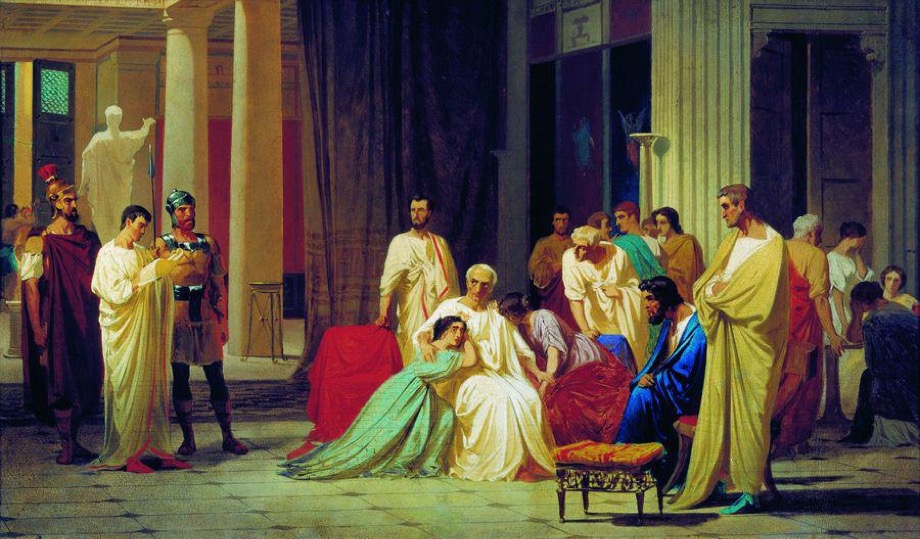
Portrait of Thrasea Paetus
The Empty Seat in the Curia
In the year 59, the Senate of Rome gathered to vote honors and thanksgivings for the murder of Agrippina the Younger, mother of the emperor who had ordered it. The chamber was full of men who understood exactly what they were doing and did it anyway. One senator did not. Thrasea Paetus rose and walked out, saying nothing, offering no denunciation, staging no scene — he simply would not be present for the lie. No one arrested him. No one even quite knew what to charge him with. That was the problem he posed to Nero's Rome for the next seven years: how do you punish a man whose only crime is refusing to clap?
Thrasea was a Stoic, an admirer of the elder Cato, and by every account a man of unremarkable public ambition — he did not seek the consulship of conscience, did not organize a faction, did not write pamphlets. What he did was quieter and, in its way, more unnerving: he withdrew, steadily and on principle, from the rituals of complicity that held the Julio-Claudian court together. He stopped attending Senate sessions where flattery was the day's business. He stayed home on Nero's birthday, when every other senator dutifully appeared. The withdrawal was not sulking. It was a position, held for years, communicated entirely through absence.
That pattern — an inward, uncompromising sense of what integrity required, sustained silently over time rather than argued or performed — is the signature of an INFJ. Thrasea did not need an audience to know he was right, and he did not need confrontation to act on it. He needed only to not participate.
He never organized a rebellion. He simply stopped attending the theater of loyalty, and let his absence do the arguing.
The Standard That Didn't Move
What makes Thrasea legible as Ni-dominant is not any single act of defiance but its consistency across years and circumstances that kept changing around him. Agrippina's murder, Poppaea's rise, the slow strangling of what remained of senatorial independence — each event was different, but his response was the same response, arrived at once and never revisited: he would not lend his presence to what he judged false. He did not need to relitigate the question each time a new outrage came along. The internal picture of what Rome had become, and what his own participation in it would mean, was fixed early and held without wavering.
This is also why his resistance so unsettled Nero's court more than open rebellion would have. A conspirator can be caught, a rival can be flattered or crushed. A man who has simply concluded, privately and permanently, that the honors are lies and the birthdays are theater cannot be argued out of it, because the conclusion was never reached through argument. Tacitus records the years of small refusals — absences from the Senate, avoidance of overt displays of allegiance — as a pattern too consistent to be accident and too quiet to be treason, until the regime decided it had to be treason anyway.
In the end, his accusers charged him not with any act but with the pattern itself: years of not showing up. That the state could find nothing to prosecute except a man's steady, self-generated sense of what he owed his own conscience is itself evidence of how completely Ni had authored his conduct.
A Conscience Meant to Be Read
Thrasea's dissent was private in origin but public in form — which is the signature of Fe serving an Ni core. He did not vanish from Rome or retreat into a philosopher's silence; he walked out of the Senate in full view of his colleagues, on the specific day the vote mattered, so that his absence would be noticed and understood. A man indifferent to the social fabric would have simply stayed home from the start. Thrasea instead staged his non-participation precisely where it would register as a rebuke without ever being spoken as one.
The same instinct shaped his final hours. Facing a forced suicide, he did not rage or plead; he gathered friends around him and discussed philosophy as his veins were opened, converting his own death into a lesson delivered to the people he cared about keeping steady. It was composure offered outward, a last act of care for the community of the like-minded he was leaving behind — Fe's concern for the collective mood and its example, right to the end.
A Stoic's Private Ledger
Beneath the symbolic gestures sat a Stoic's habit of internal accounting — Thrasea's admiration for the elder Cato was not sentimental costume but an intellectual reference point, a private standard against which he tested his own conduct before he ever acted. When he was finally brought before the Senate on the charge of treason, he did not beg for his life or bargain; he argued his case on principle, on the logical coherence of a life lived according to Stoic precept, as though the verdict mattered less than the correctness of the reasoning behind his choices.
That tertiary Ti gave his Fe-expressed defiance its backbone. It was not enough for Thrasea to feel that the honors for Agrippina's murder were wrong; he needed the position to hold up as a consistent framework, applicable the same way in 59 as in 66, regardless of the personal cost accruing against it. The composure of his death scene, philosophical discussion continuing as the blood drained from his veins, was the final demonstration that the internal logic had never broken down.
Why INFJ Over ISFP
Why not ISFP?
An ISFP resists through immediate personal feeling — a refusal in the moment, driven by what feels intolerable right then, and not necessarily repeated the same way twice. Thrasea's dissent was the opposite: patterned, anticipated, and sustained across years without variation. He did not merely flinch at Agrippina's murder and walk out; he then declined the Senate again, and again, and stayed home on the same anniversary every year that followed, applying one fixed internal standard consistently rather than reacting fresh to each provocation. That is Ni holding a conclusion steady over time, not Se-Fi responding to the moment as it comes.
The years-long shape of his withdrawal is the tell. Nero's Rome could have absorbed a single outburst, however dramatic — courts absorb outbursts constantly. What it could not absorb, and eventually had to prosecute as treason, was a senator who had reached a settled verdict on the regime's legitimacy and simply never revisited it, letting his conduct express that fixed inner judgment for the rest of his life.
Connected Figures
Further Reading
- The Annals of Imperial Rome — TacitusThe primary account of Thrasea's dissent, trial, and death.
- Nero: The End of a Dynasty — Miriam GriffinSituates Thrasea's Stoic opposition within the broader collapse of the Julio-Claudian court.
- Roman History — Cassius DioA later narrative source on the Neronian Senate and its purges.
