 Historical Figure MBTI
#671 · 5-17-26 · The Five Good Emperors
Commodus
The Gladiator Emperor
161 — 192 CE
11 min read
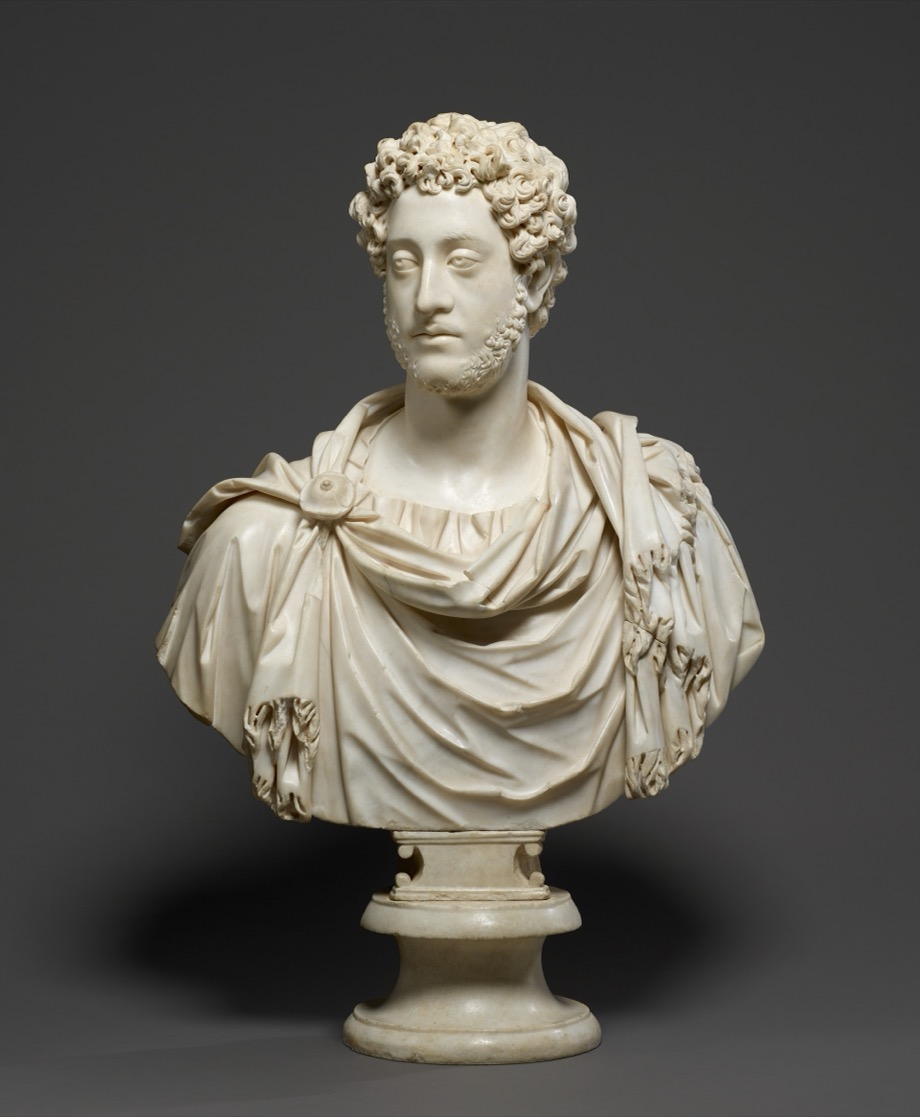
Portrait of Commodus
The Son Who Would Not Read
His father spent the last decade of his life on the Danube frontier, writing private notes to himself in Greek about duty, decay, and the shortness of a man's attention. His son spent the last decade of his own life in a sand pit in the middle of Rome, killing crippled men in front of a crowd and counting the shouts. Nothing in the ancient record is quite as vertiginous as the gap between Marcus Aurelius and Commodus, and nothing has done more to flatten Commodus into a punchline. He is remembered as the emperor who ruined everything — the golden thread snapped, the decline made flesh.
That reading is comfortable and slightly wrong. Commodus was not stupid, and he was not, in any sense the sources support, mad. He was something more ordinary and more dangerous: a man of enormous physical talent and total present-tense appetite, handed absolute power at eighteen, who never found a reason to look past the end of the week. Born in 161 CE to Marcus and Faustina the Younger, he was made co-emperor in 177 — Marcus breaking, for his own son, the adoptive succession that had produced four consecutive competent rulers. On his father's death in 180 he inherited an unfinished war on the Danube, bought peace with the tribes within months, and went home. Rome was where the crowds were.
For twelve years he ran the empire as a venue. He fought in the arena as Hercules Romanus in a lion skin; he renamed the city “Colonia Commodiana” and the twelve months of the year after his own titles; he handed the administration to prefects and freedmen and then killed them when the street turned. He survived a plot led by his own sister, and died on the last night of 192 with a wrestler's forearm across his throat. Every one of those acts is the same psychology, applied without brakes.
Commodus is the archive's clearest case of an ESFP with an empire for a stage — extraverted sensing in the dominant seat, tuned to blood, muscle, and the noise of a crowd, with no counterweight anywhere in the stack.
Se — The Emperor in the Sand
No Roman emperor before him had done what Commodus did in the amphitheatre, because the thing was structurally unthinkable. Gladiators were slaves, convicts, and the socially dead. An emperor could fund the games, preside over them, gesture with a thumb; he could not step into the sand without becoming, in the eyes of every senator watching, the same category of object as the men on it. Commodus did it hundreds of times. He fought as a secutor, took an appearance fee from the gladiatorial fund like a hired professional, and did it in front of the class whose good opinion was the only currency that could have protected him.
The tell is that the appetite was for the sensation, not the risk. His opponents were wounded soldiers, condemned men, and amputees armed with sponges; the beast hunts were staged with netted animals and elevated platforms. Cassius Dio, who sat in the stands as a senator and had to compose his face while doing it, describes Commodus decapitating an ostrich and carrying the head across to the senatorial benches, holding it up with a smile and his sword in the other hand — a gesture whose meaning was unmistakable and which reduced Dio to chewing laurel leaves to keep from laughing out loud. What Commodus wanted was the moment: the weight of the blade, the animal going down, the roar arriving a half-second after the kill. Rigging the fights did not spoil it, because the physical experience was the point and the danger never had been.
Everything else ran on the same channel. He trained obsessively and was, by all accounts, genuinely magnificent — a left-handed archer who could put a shaft through a running leopard. He dressed for effect and kept a household organised around appetite. Dominant Se is no moral failing on its own; in a soldier or an athlete it is a gift. Placed atop the Roman state with nothing above it, it simply converted the empire into a supply of sensation, and the supply was inexhaustible.
Fi — A Private Religion With One Believer
The Hercules business is usually filed under megalomania, which is a description rather than an explanation. What distinguishes Commodus from an ordinary flatterer of himself is that the identity was sincerely, inwardly held — a self-image assembled in private and then pressed outward until the world agreed. He did not merely accept the title Hercules Romanus; he had himself sculpted in the lion's pelt with the club and the apples of the Hesperides, put the guise on his coinage, and by the end styled himself the god's reincarnation rather than his favourite. The famous Capitoline bust shows a soft-featured man in his thirties peering out from under a lion's jaws, and the striking thing about it is how unironic it is.
That is auxiliary Fi doing what Fi does — building a value-identity from the inside out, answerable to nobody, and treating it as the deepest fact about the self. In a healthier life it produces the person who cannot be talked out of what they know they are. In Commodus it produced a demigod with legions. He renamed the legions Commodianae and the Senate the Commodian Fortunate Senate not as policy but as devotional act: the internal picture had to be true everywhere. His plan for the last night of 192 was to process to his consulship from the gladiators' barracks, in arms, because that was to him the accurate presentation of who he was.
Fi also explains the cruelty's texture: personal rather than systematic. He did not build a machinery of terror; he took offence. Senators who smirked, favourites who had become embarrassing — the sources are full of individuals removed for scratching the self-image at close range. An emperor with a sovereign internal value and dominant Se to enforce it in the moment is a man whose private feelings are a public hazard.
Te — Renaming the Calendar
Tertiary Te is administration as gesture: real levers pulled for the shape of the act rather than any downstream result. Commodus renamed the city of Rome Colonia Commodiana and renamed the twelve months after his own titles — Lucius, Aelius, Aurelius, Commodus, Augustus, Herculeus, Romanus, Exsuperatorius, Amazonius, Invictus, Felix, Pius. This is not indifference to the machinery of state; the calendar and the city's name are load-bearing instruments, and changing them took decrees, mints, and clerks. It is a man reaching for the most powerful administrative lever available and using it to write his name twelve times.
Everything requiring sustained attention he handed off. Perennis ran the empire as Praetorian prefect until a delegation of soldiers came to Rome to complain, at which point Commodus gave him to them. Cleander, a freedman who had been a slave, took over and sold offices at scale — in one year Rome had twenty-five consuls — until a grain shortage put a mob at the gates, and Commodus had Cleander's head carried out on a pole to meet it. The pattern is efficient in the crudest possible sense: delegate everything, and when the external result goes bad, delete the person attached to it. There is no inquiry, no correction of the system, no interest in why the grain ran short.
It is worth being precise about the damage. The frontier settlements he bought in 180 held; the empire did not collapse under him. What collapsed was the trust that made the office workable — the Senate learned that competence bought nothing and proximity killed, and the Praetorians learned that emperors could be disposed of and replaced. When he died, the mechanism for choosing a successor had rotted through, and the men who had watched it rot were the ones holding the swords.
Ni — The Blade at the Mouth of the Theatre
In 182 his sister Lucilla organised a conspiracy and sent a young relative to do the work. The man met Commodus at the entrance to the amphitheatre, drew a dagger, and — the detail everyone remembers — announced “this is what the Senate sends you” before he stabbed. He was seized mid-sentence. Commodus was twenty-one, and he took the sentence more seriously than the knife. Everything afterward reads as the aftershock.
Inferior Ni does not produce foresight; it produces dread without shape. What followed was not a purge with a logic to it but a decade of pattern-free suspicion — executions of consulars and cousins in clusters, then long calm stretches, then another cluster. He read conspiracy into sarcasm and missed the real plot forming in his own bedroom. He could not model the future well enough to see that killing the men he installed taught everyone around him that installation was a death sentence — precisely the lesson Laetus and Eclectus had learned by 192.
So the end was almost a formality. On 31 December 192, with a list of names for execution allegedly discovered by his mistress Marcia, the three people closest to him — Marcia, the Praetorian prefect Laetus, and the chamberlain Eclectus — moved first. She gave him poisoned wine; he vomited it up. So they sent in Narcissus, his own wrestling coach, who found him in the bath and strangled him. An emperor who had spent twelve years insisting that reality was a contest between bodies was settled by a stronger man's hands, in the middle of the sensory pleasure he had organised his life around.
The Same ESFP as Nero — Different Engine
The archive types Nero ESFP too, and the parallels are almost embarrassing: two young emperors handed the world before they were twenty, both converting the imperial office into a personal stage, both scandalising the senatorial class by performing in public in a role reserved for the lowborn, both killed by the people who slept nearest them. The real question about Commodus is not whether he is ESFP. It is whether he is anything other than Nero run again.
Why not simply read him as Nero's psychological twin?
Because the two men wanted different things from the same crowd. Nero performed as an artist — lyre, verse, tragic roles, competing in Greek festivals and agonising over the judges' verdicts — and what he was chasing was aesthetic approval, the audience's agreement that he was good. Commodus never once sought to be judged. He performed as a body: gladiator, archer, beast-slayer, strongman in a lion skin, and what he wanted from the stands was awe and submission, which is why rigging every fight cost him nothing. Nero would have been humiliated by a rigged contest; it would have invalidated the applause. And Commodus went a step past anything Nero attempted — Nero built a golden house and put his face on a colossus, but he did not rename Rome, the Senate, the legions, and all twelve months of the year after himself. That is Fi self-mythology administered through Te levers, at a scale Nero's more socially calibrated Fi never reached for.
The distinction tells you what each man was ultimately vulnerable to. Nero could be wounded by a bad review; his last recorded thought was about the artist dying in him. Commodus could only be wounded by a stronger body, and he was — by a wrestler he had hired to be strong. Same dominant function, same appetite for the immediate, same fatal absence of anyone able to say no. But one wanted to be loved for something he made, and the other wanted to be feared for something he was — which is why ESFP explains far less about a man than what he does with it.
Connected Figures
Further Reading
- Roman History, Books 72–73 — Cassius Dio (trans. Earnest Cary)A serving senator's eyewitness account of the arena performances, including the ostrich head and the laurel leaves — the single most valuable source on the reign.
- History of the Roman Empire Since Marcus Aurelius, Book 1 — Herodian (trans. C. R. Whittaker)Near-contemporary narrative of the accession, the Lucilla plot, the fall of Cleander, and the assassination.
- Historia Augusta, "Life of Commodus" — trans. David MagieLate, gossipy, and often unreliable — but the origin of most of the lurid detail, and where the renamed months are listed.
- Commodus: An Emperor at the Crossroads — Olivier HeksterThe standard modern study, reading the Hercules imagery and arena appearances as deliberate self-representation rather than madness.
- Gladiators and Caesars: The Power of Spectacle in Ancient Rome — Eckart Köhne & Cornelia Ewigleben (eds.)Essential context on why an emperor in the sand was a scandal rather than a stunt.
