 Historical Figure MBTI
#669 · 5-17-26 · The Five Good Emperors
Galen
The Gladiator's Surgeon Who Ruled Medicine
c. 129 — c. 216 CE
8 min read
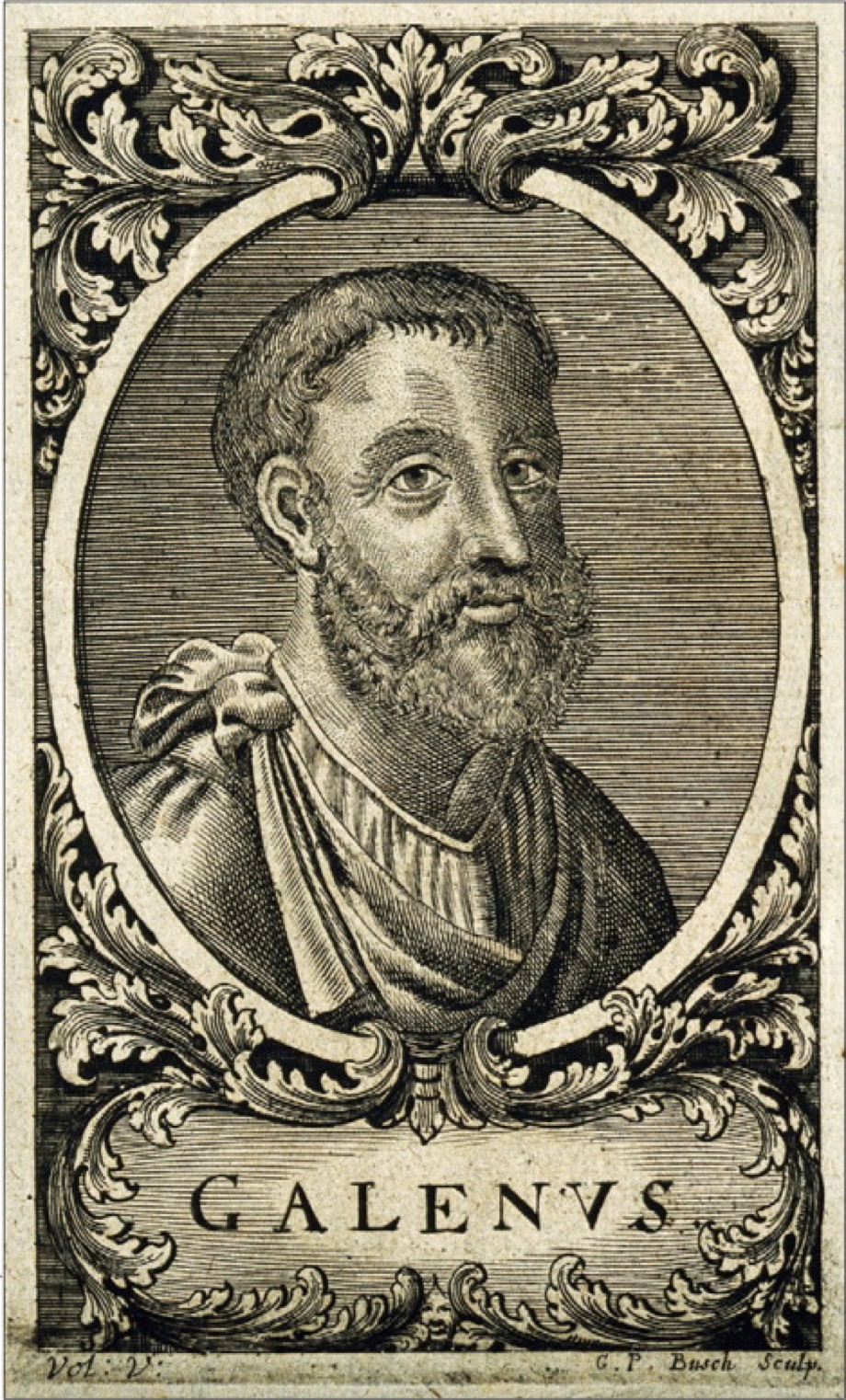
Portrait of Galen
The Man Who Argued Medicine Into Submission
He learned the body by cleaning up after the arena. Before he was the most quoted physician in human history, Galen was a young man in Pergamon with a knife, appointed surgeon to the gladiators of the city's high priest, opening and closing the wounds that professional violence produced — punctures, crush injuries, slashes that laid a torso open like a specimen tray. Roman law and Greek squeamishness forbade the dissection of human corpses. The arena obligingly performed the dissections for him and then paid him to reverse them. He would call wounds "windows into the body," and he meant it literally.
From that apprenticeship in blood he built a career of astonishing noise. He arrived in Rome around 162 CE and made his name in public: staged anatomical demonstrations before crowds of senators and philosophers, in which he opened living pigs and Barbary macaques, severed nerves one by one to silence a squealing animal mid-cry, and dared his competitors to explain the result. These were not lectures. They were duels, and the audience knew it. He wrote at the same tempo — a corpus so vast that what survives is estimated at something like a tenth of all surviving ancient Greek literature, much of it aimed like a spear at the Empiricists and Methodists he regarded as frauds.
He was also, on a great many points, wrong. He read ape anatomy onto human bodies and invented pores in the septum of the heart because his physiology required them. None of it mattered. The confidence carried, and Galen's errors governed Western and Islamic medicine for roughly thirteen centuries, until Vesalius stood over an actual human cadaver in the 1540s and started counting.
Galen is the archetypal ENTP: a dominant Ne that generated theory faster than any century could test it, sharpened live against opponents rather than perfected in private.
A Mind That Could Not Stop Branching
The most obvious fact about Galen is the sheer spread of him. He wrote on anatomy and physiology, on pharmacology, on pulse and fever and prognosis, on dietetics, on dreams, on the passions of the soul — and then, not content, on Aristotelian logic and on whether the good physician must also be a philosopher. His father, an architect in Pergamon, had given him a broad education and a taste for structure; Alexandria gave him bones. Galen treated every subject he touched as a doorway into three more.
Ne shows most clearly in how fast he moved from an observation to a theory. Watching a gladiator's exposed chest, he reasoned about the mechanics of breathing. Cutting the recurrent laryngeal nerve in a living pig and hearing the animal fall silent, he leapt at once to a general account of nerves as the messengers of voluntary motion — a genuinely brilliant inference, and one he had extracted from a single dramatic cut. He generalized from analogy constantly: the body as a workshop, organs as tools designed for purposes, faculties that attract and retain and expel the way a magnet draws iron. Some of these leaps were centuries ahead of anyone. Some were castles built on one animal.
And he never closed. There is no final, sealed Galenic treatise; there is an ever-widening delta of them, revisiting, extending, arguing back at objections raised since the last book. He kept opening inquiries he would never finish, because the opening was the pleasure.
The Demand That Everything Cohere
What kept the sprawl from dissolving was an auxiliary Ti of real severity. Galen inherited a Hippocratic tradition that was a loose bundle of aphorisms and a humoral scheme with soft edges, and he could not tolerate it. He forced it into a system: four humors mapped onto four qualities, temperaments derived from their mixtures, organs assigned functions, functions assigned causes, causes chained back to a nature that never made anything in vain. Everything had to connect, and where the connection was missing he supplied it.
His methodological writing is Ti at full volume. He insisted medicine be built on demonstration in the logician's sense — premises, inference, proof — and attacked the Empiricists for refusing to reason past what they had seen and the Methodists for reasoning from a scheme so thin it explained nothing. His experiments are causal-chain hunting: sever the nerve, lose the voice, therefore the nerve carries the motion; tie the ureter, watch it swell above the ligature, therefore urine descends from the kidney and does not, as rivals claimed, collect in the bladder itself. That last demonstration is pure Ti — an argument built so the internal logic leaves the opponent no exit.
Blood on the Hands, Crowd in the Room
Galen was not a theorist who happened to touch bodies; he needed the body in front of him, alive and resisting. Four years of gladiator surgery — during which, he boasted, his charges died at a fraction of the rate his predecessors' had — gave him a tertiary Se education no library could match: the pressure and time-limit of real trauma, decisions made in the seconds before a man bled out.
He carried that appetite into his fame. The Roman demonstrations were physical theatre and he was the performer: the animal secured, the incision made in view, the prediction announced before the cut so the crowd could verify it, the rival invited to object and then dismantled on the spot. When challengers proposed a different animal or a different test, he took it, because he was quicker with a blade and quicker on his feet than they were. The showmanship was not incidental to the science — it was how he validated the science, in real time, before witnesses who could not be argued into agreement afterward.
The Wound of Being Contradicted
Then there is the temper. Galen could not be wrong, and could not be told he was. His polemics do not read as scholarly disagreement; they read as injury. Rivals are not merely mistaken but lazy, venal, contemptuous of truth — errors in physiology become defects of character. When Rome's medical establishment closed against him he did not negotiate; he left the city abruptly around 166 CE, a departure he explained variously and never convincingly, and only an imperial summons brought him back.
This is inferior Fi doing what inferior Fi does: converting an intellectual position into an identity, so its defense becomes a matter of personal honor. He wrote a treatise on diagnosing and curing the errors of the soul, and the man giving that advice is audibly the same man who could not let a slight go. It also explains why his mistakes lasted. Galen never built the habit of doubting Galen, and the certainty he bequeathed to thirteen hundred years of physicians was, at root, a personal one.
Why ENTP Over INTJ
Why not INTJ?
The system is real — Galen genuinely welded Hippocratic humoralism and his own findings into one comprehensive, internally consistent edifice, and that architectural instinct looks INTJ at a distance. But Ni-Te builds in private and arrives finished; Galen's method was to generate wildly, publicly, and adapt to whatever objection was standing in front of him. His conclusions were argued into existence live, in front of crowds, against named opponents — not engineered in isolation and then unveiled. An INTJ perfects one closed model and defends its edges; Galen opened a dozen fronts and needed a fight in each of them to think well. Compare Hadrian in this same cluster: a mind that withdrew to design, where Galen required an audience to perform.
The distinction explains both his reach and his failure mode. The Ne-Ti engine let him range across anatomy, pharmacology, and logic with equal appetite and build a coherent frame around all of it. But it also meant his confidence was calibrated to whether he had won the argument in the room, not to whether the evidence would survive a second look. He beat every opponent he ever faced. He simply never faced a human cadaver, and so nobody corrected him until Vesalius did — thirteen centuries too late for the correction to be a conversation.
Connected Figures
Further Reading
- The Prince of Medicine: Galen in the Roman Empire — Susan P. Mattern (2013)The standard modern biography — strongest on the gladiator years and the theatre of the Roman demonstrations.
- Ancient Medicine — Vivian Nutton (2nd ed., 2012)Places Galen inside the rival schools he spent his life attacking; the best single overview of the field.
- Selected Works — Galen, trans. P. N. Singer (Oxford World's Classics, 1997)The most accessible way into his own voice, polemics and self-regard intact.
- On the Natural Faculties — Galen, trans. Arthur John Brock (Loeb Classical Library)His physiological system laid out in full, including the ureter experiment.
- The Cambridge Companion to Galen — R. J. Hankinson, ed. (2008)Essays on his logic, philosophy of demonstration, and long afterlife in Arabic and Latin medicine.
