 Historical Figure MBTI
#659 · 5-13-26 · The Five Good Emperors
Hadrian
Wall-Builder · Wandering Architect of Empire
76 — 138 CE
7 min read
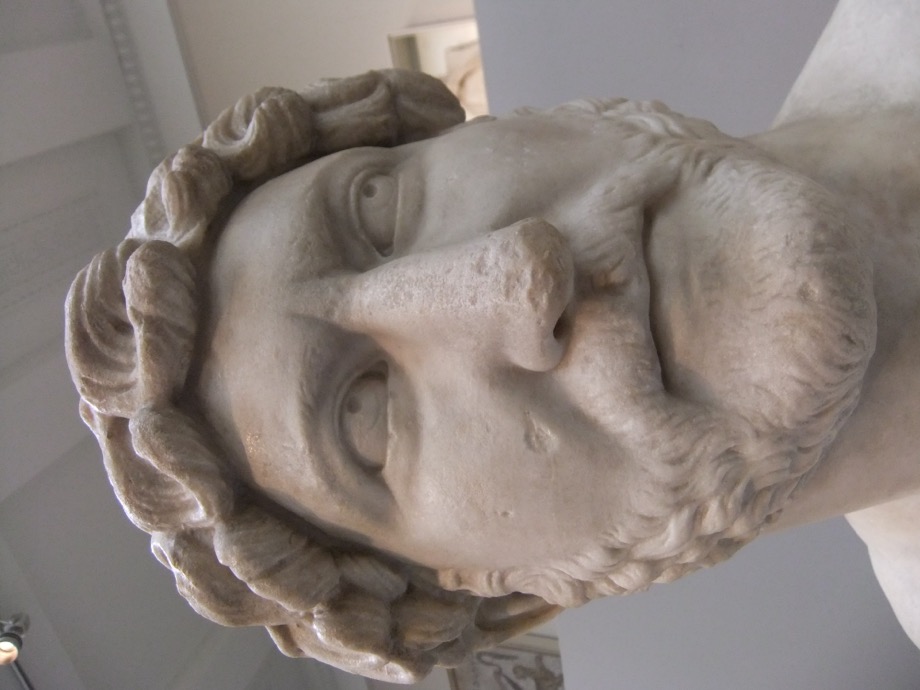
Portrait of Hadrian
The Man Who Drew the Line
In 117 CE, Trajan died in Cilicia on his way home from a war he had not finished. The adoption of a successor was announced at the deathbed by his wife Plotina, with no witness anyone could later cross-examine; Rome has doubted the paperwork ever since. What Rome did not doubt was what the new emperor did next. Before he had even reached the capital, Hadrian gave away the conquest of the age — the freshly won provinces beyond the Euphrates, the gains that had made Trajan a second Alexander in Senate flattery, released, and the frontier pulled back to a line that could actually be held.
By every conventional Roman measure it was a humiliation, and it made him enemies among Trajan’s marshals in his first week. It was also correct. Hadrian had looked at the map the way an engineer looks at a load-bearing wall and concluded that an empire which kept growing would eventually stop being defensible. Everything else in his twenty-one years follows from that act of subtraction: he was not building outward, but building a boundary and perfecting what lay inside it.
He was born in 76 CE — Italica in Hispania by most accounts — a ward and kinsman of Trajan, raised in the household of the man he would eventually contradict: bookish, Greek-obsessed, prickly, disliked by nearly everyone who worked near him. He grew a beard no emperor had worn, made philhellenism state policy, and spent nearly twelve of his twenty-one years outside Italy walking his own frontiers, because a system you have not personally inspected is a system you do not yet know.
Hadrian is the archive’s clearest imperial INTJ: a dominant-Ni architect who saw the finished shape of the empire before anyone else did, and spent two decades forcing the world to match the drawing.
The Closed Shape
Introverted intuition does not brainstorm. It arrives at one image of how a thing must be and refuses every alternative. Abandoning the eastern conquests was the first public demonstration: Hadrian was not weighing options before the Senate, he was reporting a conclusion reached alone. The empire, in his head, had an outline, and Mesopotamia lay outside it.
From 122 CE that outline began to be built in stone. Hadrian’s Wall runs some eighty Roman miles across northern Britain with milecastles, turrets, forts, a ditch: not a defensive line in any tactical sense — a determined enemy could go over it — but a declaration. This is where Rome ends. It is the most literal artifact dominant Ni has ever left behind, an idea about limits converted into masonry.
The same instinct rebuilt the Pantheon. Hadrian imposed his own design for the dome and oculus over the objections of Apollodorus of Damascus, Trajan’s master engineer, who had years earlier mocked the young Hadrian’s sketches — a slight the sources say he settled with an execution. The building is the argument: a perfect sphere implied inside a cylinder, a diagram of the cosmos with a hole cut in the top to let the sky in. And at Tivoli he built the Villa, reproducing in miniature the places that had marked him — the Canopus of Egypt, the Lyceum of Athens. Not a palace: a memory palace, the empire compressed and enclosed so one man could walk through his own understanding of the world.
Inspection as Government
A vision that stays a vision is a hobby. Hadrian’s Te made his drawings real, and it took the form of relentless verification. Other emperors governed by report; Hadrian went and looked. Gaul, Germania, Britain, Spain, Africa, Greece, Syria, Egypt — he walked garrison lines, watched drills, condemned slack officers, approved aqueducts. His address to the troops at Lambaesis survives on stone: a technical review of maneuvers, praising what worked and naming what did not.
The same function reorganized the state’s paperwork. He professionalized the imperial administration, staffing its bureaus with salaried equestrians on career tracks rather than freedmen serving at a whim, and had the jurist Salvius Julianus fix the praetor’s edict into a permanent text, ending the annual improvisation of Roman civil procedure. An institution that would run whether or not a genius was watching it.
Te at full extension is also cold. When Judea revolted under Simon bar Kokhba in 132, the answer was not negotiation but four years of methodical, depopulating suppression — a province processed as an engineering fault. The Wall and the Villa came out of the same faculty that ordered that campaign, and nothing in the stack softens it.
A God Made Out of Grief
His marriage to Vibia Sabina, arranged by Trajan’s women, was cold and childless; both parties seem to have regarded it as a contract rather than a life. He had no wide emotional surface. Tertiary Fi rarely does: it does not distribute warmth, it concentrates it, and what it concentrates on becomes non-negotiable.
In 130 CE, during the imperial progress up the Nile, the Bithynian youth Antinous — his companion of some years — drowned. Accident, suicide, sacrifice, murder: the ancient writers could not agree. What is documented is the reaction. The man who had coolly liquidated two provinces to tidy a frontier wept openly, and then did what no emperor had done for a private person. He declared Antinous a god.
Not a gesture — an infrastructure of mourning. A city, Antinoöpolis, founded on the bank where the boy died. A cult with priests, festivals, games. Temples across the east and near a hundred surviving statues, a face reproduced until it became one of the recognizable images of antiquity. It is the tell of the type: a private feeling no one else was permitted to evaluate, executed at imperial scale, because the only way this mind knows how to honor something is to build it into the system.
The Body on the Frontier
For an emperor who lived so completely in his own head, Hadrian was remarkably physical. He marched bareheaded through German snow and Egyptian heat, covered twenty miles a day on foot in armor, ate and slept with the legions — the soldier-emperor who would not be carried. Inferior Se does not go unused in a life like this; it gets recruited, hard, into service of the vision.
Hunting he loved beyond anything else: a lion killed in Libya and commemorated in verse and relief, a favorite horse buried under an inscribed tomb in Gaul. There is a Hadrian visible only on horseback — not designing anything, simply chasing something across open ground.
Inferior functions take their revenge. The end was ugly — years of illness at Baiae, an emperor begging attendants to kill him and being refused, executing relatives he suspected of waiting him out. The mind that had spent twenty-one years mastering the physical world could not master a failing body, and the last poem attributed to him — a wondering address to his own soul, animula vagula blandula, about to go somewhere pale and unfurnished — is the one surviving moment where the design admits it does not know what comes next.
Why INTJ Over ENTP
Why not ENTP?
The case is real: the compulsive movement, the range across poetry, architecture, law and philosophy, the philhellenism that rewrote Rome’s relationship to Greece, the nerve to overrule the empire’s senior architect on his own subject. That reads as exploratory Ne. But an ENTP opens loops, and Hadrian closed every one he touched. The Wall closes a frontier. The Pantheon redesign closes an architectural argument by executing the man still running it. The Villa closes the empire into a private, ordered replica. The succession plan closes two generations in advance. Ne proliferates possibilities and leaves them standing; Ni converges them into one structure and pours concrete over it.
The travel makes the point most cleanly. An ENTP would have wandered because the next province might hold something unexpected; Hadrian toured to audit — to compare what he found against a specification he was already carrying, and correct the difference. Curiosity that terminates in a standard is not exploration; it is quality control. Nor did his breadth behave like breadth: Greek learning became state architecture at the Olympieion, private grief became a city with a priesthood, an argument about domes became a building that has not fallen down in nineteen centuries.
Connected Figures
Further Reading
- Hadrian: The Restless Emperor — Anthony BirleyThe standard scholarly life, reconstructed itinerary by itinerary from inscriptions — the best account of what the travelling actually consisted of.
- Hadrian and the Triumph of Rome — Anthony EverittA readable narrative biography, strongest on the contested succession of 117 and Plotina's role in it.
- Hadrian and the Cities of the Roman Empire — Mary T. BoatwrightStudies the building programs city by city; the clearest evidence for how systematically he reshaped the provinces.
- Life of Hadrian (Historia Augusta) — trans. David MagieThe principal ancient life — gossipy, unreliable in places, and still the source for the Apollodorus quarrel and the deathbed poem.
- Roman History, Book 69 — Cassius Dio, trans. Earnest CaryThe other ancient narrative, hostile to Hadrian and useful precisely for preserving the senatorial grievance against him.
- Memoirs of Hadrian — Marguerite YourcenarA historical novel, not a source — but the finest imaginative reconstruction of this particular mind ever written.
